Monthly Archives: May 2010

Sunday in the Park with Emma

Most Sundays we all play around the house until noon and then Ariane will do something with Nic while I take Emma on an outing, usually to the “big park” – Central Park. Emma knows what she likes and likes her routines, so most of the time our forays are predictable, except when I try to mix things up deliberately just so she doesn’t get too OCD about it. In the Spring, Fall and Winter months, the routine begins with a visit to the “big carousel” followed by the zoo, the children’s zoo, FAO Schwartz and the Apple store. Sometimes we start with a trip to the Natural History museum and then do one or two items on the other itinerary.

In late Spring, Emma will begin talking about how “the ice skating’s all gone…ice skating over”, in a very sad voice with a very concerned frown. In truth, she’s much more excited than sad, because she can’t wait for Memorial Weekend when an amusement park opens up where the ice skating rink used to be. It’s called Victorian Gardens and Emma has been talking about it and going over to the rink to see if it’s open every weekend for the last month.

Hooray! It opened this weekend and she went on Saturday with Lee and Sunday with me. We spent a few hours there and then we changed into her bathing suit and went to one of the playgrounds inside the park that has a nice sprinkler and a series of little pools she can sit in. We spent a couple more hours there, Emma playing in the water and in the sand and climbing and sliding.

When it was time to go home, Emma did a really good job of rinsing the sand off as soon as I asked her to – something that used to be incredibly difficult to get her to do without a complete tantrum. On the way to the train we stopped for a snack and sat on a park bench. While she was sitting there, happily munching away on her Pirate Booty, she pointed to a butterfly and said, “butterfly.” She pointed again when a woman walked by pushing a carriage and said, “baby asleep in the stroller.”

This is the second weekend in a row that she has pointed repeatedly at different things and labeled her sightings. I’m sure this won’t seem very significant to most people, but it was her lack of pointing and labeling that finally ‘clinched’ her diagnosis with ASD and cut through our last shred of denial. To see her pointing at things while looking at me for my reaction fills me with great joy – and hope.

Years ago we started a diary book that we called Emma’s Hope Book, where we listed every little advancement she made as a way to focus on the positive aspects of her recovery and to bolster our spirits as we repeatedly slid into despair at just how slow her progress has been compared to normal children her age. “Compare and despair” is a recipe for hopelessness and so we still cling to every new achievement as a victory flag placed on top of a mountain.

Emma’s Hope Book is alive and well here (and now open to the public) and more than ever does it serve it’s intended purpose for us – to cut through the other side of our denial — our denial of her gradual but indisputable progress. She is getting better, slowly but surely, more slowly than we would want of course, but moving forward one day at a time. We have hope – and the evidence documented on these pages – that she is getting better a little bit at a time, day after day.

Pretty

Emma loves to wear “party dresses”.  A party dress can be any dress if it’s fancy enough, but the kind she seems to like best are the fairy princess variety you find in toy stores or costume shops -–frilly, bright, colorful, shiny, sequined. When she gets one for a present her typical reaction is to squeal with glee, “OH! It’s so PRETTY!”

Every dinner party we have is an occasion for her to dress up in one of her favorite dresses that she will pick out herself without any suggestions from us. When guests arrive she will prance and skip and whirl around, making sure everyone notices her glamorous attire. If she doesn’t get the “oohs and awws” she’s looking for, she isn’t above fishing for compliments, walking right up to the insufficiently impressed person and shouting, “PRETTY DRESS!” while displaying her ball gown to its best advantage.  All the preening will usually be accompanied by an impromptu concert performance, with Emma belting out a medley of her favorite Sesame Street songs.

Emma definitely has her tomboy side, but she is very much a girly girl too. When I see how happy and excited she gets dressing up and admiring herself in the mirror, I always think of Maria in West Side Story, singing “I feel pretty!” And she is, of course — a chip off Ariane’s block.

Ariane has often talked about the sadness she has felt in not having had the kind of mom/daughter relationship she had dreamed about with Emma – going shopping together or having a manicure side by side. But that is starting to change a little bit at a time. Emma loves it when Ariane paints her toenails now. Next thing you know – Canyon Ranch.

This Morning’s “Conversation”

(Showing Emma this photograph)

Emma splashing

A:  Hey Emma!  What do you see?

Em:  He putting on the sprinkler.

A:  Who’s “he”?

Em:  He putting on his feet in the sprinkler.

A:  Who is that?

Em:  Emma.  Emma putting he feet in the sprinkler.

A:  Her.  Her feet in the sprinkler.

Em:  Her.

A:  You’re putting your feet in the sprinkler.

Em:  Yeah.

A:  Was that fun?

Em:  Yeah.

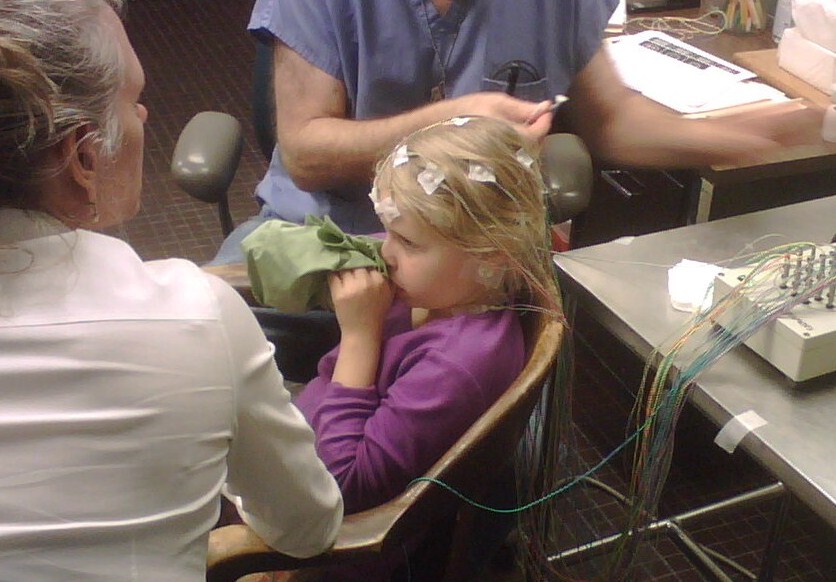
(I show her this photograph)

Me:  What about this?  What’s going on in this photograph?

Em:  Dr. Halper.

Me:  What’s he doing?

Em:  Just Toni Karlsrud.

Me:  Is that Dr. Karlsrud?

Em:  Nooooo!  (Laughing) Dr. Halper.

A:  What’s happenig to you?

Em:  (Touching photograph.)  Goes beep, beep, beep, beep.

A:  You’re having a QEEG done.  It measures your brain waves.

(Emma gets up and walks away.)

A:  Emmy!  Come back!

Em:  Where are you going?

A:  Emmy!  Come back!

(I follow her into the other room where Richard is.)

A:  Hey Em, do you know why you’re having a QEEG done?

Em:  Now goes beep, beep, beep…  (while she says this she is touching various points on her head where the electrodes are placed.)  beep, beep, beep, beep… (she touches her arm) beep.

A:  They don’t put one on your arm!

Em:  (Laughs) Beep!

A:  Do you know why this is being done to you?

Em:  Beep, beep, beep, beep.

A:  It’s looking at your brain.  It measures your brain waves.

Em:  Beep, beep.

A:  Do you like going to see Dr. Halper and having a QEEG?

Em:  Yeah!

A:  Should we go pick out what you’re going to wear today?

Em:  Yeah, sit for one more minute.

A:  Okay.

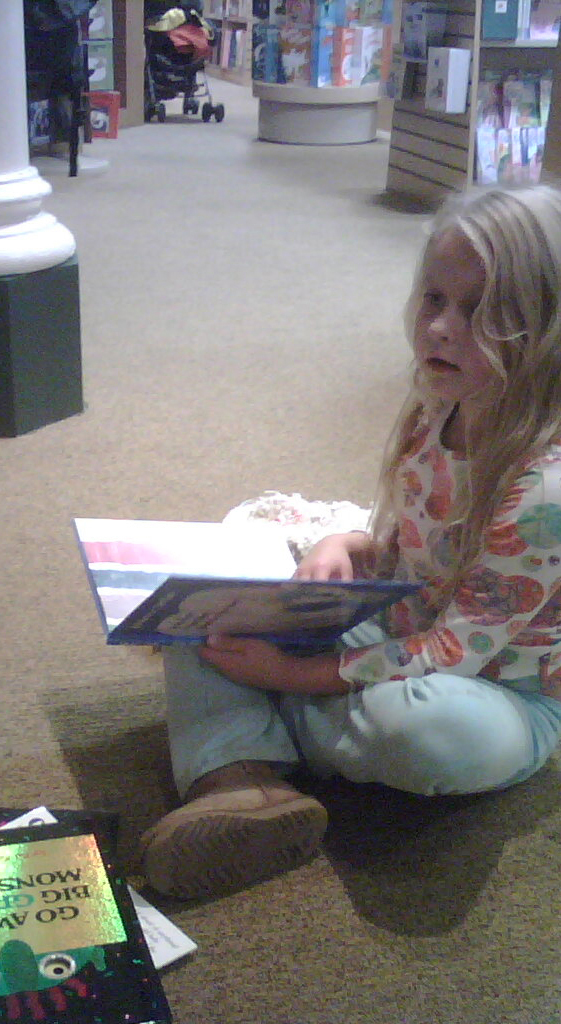
Go Away, Big Green Monster!

This photo was taken a few years ago at the local bookstore near where we live.   Emma has never shown much interest in books.  When she was a baby she would squirm and wimper when I tried to read to her.  As she grew older, she allowed me to read to her as long as she was able to hold the book and turn the pages.  Often she didn’t wait for me to finish reading before turning the page.  Much the way she flips through photographs, so quickly it’s hard to believe she is really able to see what and who are in the photo, she does the same with books.  I often wonder if Emma sees in patterns.  In other words, her brain picks up the entire scene and creates an instant pattern, allowing her to “see” the image instantly, any variation is immediately recognized.  I don’t know that she sees in this way, but I wonder.

Years before this photo was taken, I took Emma to the bookstore.  She couldn’t have been older than three.  She wriggled out of the stroller and ran to the back of the store.  We hadn’t been inside this particular bookstore for at least six months.  I followed Emma, calling out to her, “Emmy, where are you going?”  As was typical, she ignored me and kept running.  To her left was a floor to ceiling bookcase, filled with large picture books.  Emma attempted to scale the bookcase.

“No! No!  Emma!”  I cried.  “You can’t climb that.  What do you want?”

Emma jumped up and down, making noises.

“Is there a book you want to see?” I asked, looking at the shelves for a familiar book, which she might like.  Emma doesn’t like new books.  Whenever we are in a bookstore and I offer a new book, one that she hasn’t seen before, she shakes her head no.  Then goes over to a book she knows and pulls it from the shelf and hands it to me.  A few of her favorites:  “Chicka, Chicka Boom Boom”,  “Gossie”, “Gossie and Gertie”, “Brown Bear, Brown Bear” etc.  On this particular day she wasn’t interested in any of those books.  She was determined to climb the book shelf.  I picked her up, bringing her close to the books so they were in her reach.  “Do you want any of these?”  I asked.  Emma reached above my head, so I lifted her higher.

On the second to highest shelf, at about seven feet tall, Emma pulled a single book by it’s spine down from the shelf.  “Is that what you wanted?” I asked.  I set Emma down on the floor with her new book.  The book was “Go Away, Big Green Monster!”  I had never seen the book before.  As I stood watching Emma flip through the pages, reciting each and every word, I felt a chill.  It was eerie.  Where had she seen this book?  Who had read it to her?  She knew every word of that book by heart and spent the next hour “reading” it over and over again.

When we returned home (with the book) I related to Richard what had happened.  “It was bizarre, ” I said.  “I mean have you ever seen this book?”

“No, really weird,” he said.  “Maybe one of her therapists has it.”

“But she never lets them read to her.  And how did she know where it was in the bookstore?  She ran straight to it.  The therapists don’t take her outside.”

“I don’t know.  It’s really strange,” Richard said, looking at me.

“It was the only copy, Richard.  She knew it from it’s spine.  It wasn’t like it was out on display.  And I haven’t taken her to that bookstore in months.  She immediately knew where to find it.”

During the following weeks I asked everyone who came in contact with Emma, but no one had read her or lent her the book.

After a few months I stopped trying to figure it out.  To this day, I have no idea how she found that book, or even knew of it’s existence.  It remains one of the many unsolved mysteries of Emma’s mind.

The Search

One of the things I realized early on in my search to help our daughter was, there are a number of people who believe they know what causes autism and many more who believe they can cure it.  There is also a tremendous amount of money to be made from desperate parents, like myself.   I cannot tell you how often I took Emma to an alternative “healer” who claimed, if I just kept going and paying them their enormous fee, Emma would be cured.  I do not believe these people meant to deceive, I think they really have convinced themselves their method will cure a child and if it does not, it is because we didn’t give it enough time.

In many ways Bruno Bettelheim’s refrigerator mom is alive and well even if it has taken on a new twist in today’s world.  While no one came right out and said – You are to blame for her autism (and to blame if whatever method they were pushing didn’t cure her) – it was inferred by the questions they asked.  What follows is a sampling of a few of the questions I have been asked over the years.

Did you drink caffeine during your pregnancy?

No.

Did you or do you drink alcohol?

No.

Did you take any sort of medication during your pregnancy or labor?

No.

None?

No.

What about aspirin?

No.

Did you sun bathe?

No.

Did you have an epidural during labor?

No.  No drugs, natural childbirth.

How long did you breast feed?

9 months.

Just nine months?

Yes.  Emma didn’t want to breast feed, she weaned herself.  I wasn’t going to force her to breast feed when it clearly distressed her.

Ahhh…  Did you eat fish?

A couple of times.

What kind?

Grilled swordfish.  I didn’t know about the mercury levels in fish when I was pregnant with Emma.  It was only a few times when we were in Cape Cod.

Uh-huh…

There it was, finally, the answer they were waiting for.  Depending on the practitioner, the questions changed and as a result, my answers, but there always came a point when I gave the “wrong” answer. It always ended the same way with the same look – eyes downcast, a slight sad shake of the head.  I came away from these ‘interviews’ feeling angry, but I also wondered if there was any truth to it.   Maybe the two times I ate grilled swordfish while we were in Cape Cod, really was enough to cause her autism…  I think as a mother, it is second nature to wonder if something one did during pregnancy horribly effected the baby.  To this day I feel tremendous guilt for having unwittingly eaten swordfish during my pregnancy with Emma.  I honestly did not know how toxic our oceans had become.

I have become particularly wary of those who are adamant autism is caused by any one thing.  My guess is, it’s multi-causal, but who knows?  I am also wary of those who speak with absolute assurance they know how to “cure” autism with diets, behavioral therapies and alternative remedies.  Autism is a neurological disorder and while all of these things may play prominent roles in children getting better, I have yet to meet a child who has been cured, in fact, I have yet to meet anyone who has met a child who has been cured.

Mother’s Day

Every year when Mother’s Day rolls around I think about buying a trophy for Ariane. But if you’ve ever seen the kind of “World’s Best Mom” statuettes they sell in gift shops, you’ll understand how easy it becomes to resist that impulse. To do full justice in honoring her ceaseless sacrifices, her boundless commitment, and her indomitable courage in the face of repeated heartbreak, I’d have to commission a giant gold statue of her in full Viking Goddess mode, hair blowing in the wind, fist outstretched in an upward and onward call to arms as she stands atop a mountain of diapers, empty vanilla milk cartons and pancake batter, Emma perched on her shoulder with her thumb in her mouth, her other hand clutching her blanket Cokie as it flutters behind them like a triumphant flag.

Maybe next year. God knows she deserves it.

It’s hard being a mom. It’s hard being a mom for a normally developing child. Harder still raising two normally developing children, which is what we both thought we were doing in Emma’s first year of life. She logged in countless hours in countless playgrounds, bookstores, zoos and museums – with more than a gazillion trips to the Museum of Natural History alone — which Emma still calls the Snakebite Museum because she obsessively goes up to the third floor on each visit to see the diorama of a boy laying on the ground that’s been bitten by a snake.

And it’s hard…really, really hard…to be the mom of an autistic child. It’s hard being the dad of an autistic child too, but not as hard as it is for Ariane. For one thing, Emma can only bond physically with one person in the world, and that’s mommy. She might sit next to me, or lay in bed next to me, but we can’t cuddle. She likes to stroke my arm and she really likes to slap it. But I cannot hug her for more than a few seconds, I cannot hold her in my arms, I cannot sit with her in my lap in the rocking chair, not for long anyway.

She is not daddy’s little girl. She is mommy’s little girl. And along with the joys of that affection comes a world of responsibilities that are extremely difficult to bear when they rest on one person’s shoulders. Only mommy can comfort Emma when she stubs her toe, or gets a cut. Only mommy can hold her and say, “It’s okay.” I cannot count how many times I’ve run to Emma’s assistance when I’ve heard her screaming, only to have her run right past me and into mommy’s arms. And when Ariane is out of the house and she injures herself, there isn’t much I can do but try and calm her while I get a bandaid.

This next part is difficult to talk about, but I think it needs to be said in order to fully appreciate what this has been like for Ariane. Emma has only been able to poop in the toilet by herself for the last year. She has had chronic constipation we have tried everything to relieve for as long as I can remember. Ariane, being the only one who could really hold her, had to hold her on the potty while Emma screamed in agony, trying to relieve herself. This could go on for more than an hour. Every day. For years. Think about it. Now add to this the fact that Emma screams louder than a jet plane on takeoff. Nuff said.

Mothers of autistic children have to cope with another burden that never seems to fully go away, not that I’ve seen anyway. Guilt. Ariane is not alone in this respect, every mother of an autistic child that I’ve ever spoken to about this has said pretty much the same things: “I shouldn’t have eaten so much fish when I was pregnant. Or exercised. Or done those leg lifts the midwife told me to do because they said she was breached – and she wasn’t. I shouldn’t have gone down to the World Trade Center after they blew it up and all that smoke was in the air. I was too old to have another child. That’s what did it. That’s what made her this way.”

I’ve never heard the father of an autistic child wring his hands over his role in ‘causing’ their child’s autism, even though some studies have said that one possible factor in the disease is the age of the father, not the mother. But the mother bears the child and that seems to lead to countless recriminations and self-blame that doesn’t even end after the child is born. “I shouldn’t have given her that MMR vaccine. I shouldn’t have given her any vaccines.” And so on.

I once said to Ariane, “If you were talking to another mom with an autistic child, would you blame her? Would you tell her it was all her fault?”

Of course not. But I wonder how much these thoughts have faded even after all this time.

As soon as we got the diagnosis, Ariane must have read every book on the subject. While I consider myself to be a pretty good dad, equally concerned and committed to healing our daughter, I have still never read a single book on the topic, not cover to cover. Maybe I’m just being a guy, but my initial response was to Google everything I could discover about possible causes and treatments in the most concise descriptions possible. I couldn’t take the pain of all those details, of all those suffering voices. “Bottom line it for me.”

Ariane tried every possible treatment she had heard about on the internet – from other mothers, of course. She has documented many of these efforts on these pages. For example, she mentioned here that she once baked a casein-free/gluten-free cake for Emma’s birthday that took her hours and hours to make. No flour, no yeast, no dairy, no sugar. I couldn’t believe how good it tasted. “What’s in here, fairy dust?” I asked, reaching for a second slice.

Emma never took a single bite of it. That trophy I was talking about should have been awarded for this feat alone. I might have to commission one after all.

Happy Mother’s Day Ariane. I love you. Nic loves you. Emma loves you.

You are amazing.

Tests

We took Emma and Nic to a center specializing in hearing tests.  The tests for Emma came back negative for hearing loss, though the center did recommend hearing therapy for Nic.  Nic was sensitive to loud high pitched noises, like the fire truck’s sirens from the fire house across the street from where we lived.   He would run away from the sound covering his ears and crying.  Emma didn’t seem bothered by noise, in fact, Emma seemed to enjoy noisy situations, loved parties, the more, the merrier, it seemed.  Up until we received the results from the hearing tests I convinced myself this was the crux of the problem.  I remember telling my mother about a book I’d read regarding hearing loss and how it can lead to a variety of behavioral problems.  Surely this was what ailed Emma.

When the hearing tests came back negative, I had to modify my thinking.  Okay so her hearing was fine, this was good news, right?    It didn’t feel like good news.

We set up an evaluation through Visiting Nurse Service of New York.  VSNY is a not-for-profit organization providing health care in New York City.   There were pages of paperwork to be filled out prior to the evaluation.

Some of the questions were:

Does your child look at or turn to sounds?

YES!

Does your child respond to favorite people, making happy sounds or smiling?

YES!  She’s very happy with a jubilant, infectious laugh.

Does your child imitate you when playing a game, such as peek-a-boo?

YES! Another bull’s eye.  Maybe things were going to be fine after all.

Does your child engage in “make-believe”, such as playing with a doll or truck or playing house?

Okay, no, but she’s not interested in dolls, she’s more of a tom-boy.  She likes to run around and be outside.

Does your child indicate when she wants something?

Well no, but Emma never seems to want anything – so it’s not applicable – right?

Does your child interact with peers?

No.

Does your child use one or more words to ask for what he/she wants?

She did… sometimes, okay, not often.  She said “chase me” when she was about 16 months old, but as her language regressed, “chase me” went the way of all the other phrases – into the great abyss.

Does your child look up when you call to him/her?

Well, no.

And so it went.  Each question – like a nail being pounded into a plank – shutting out the possibility she was going through some sort of freakish delay which would right itself if left alone and not questioned.

For more information on Visiting Nurse Service go to:  www.vnsny.org

For more information on Emma’s evaluation see earlier posts:  The Beginning  and Hug Witness.

Emma At Ten Months Old

I sat in the pediatrician’s office with Emma squirming on my lap.  “She’s not really talking.  I mean she says words grouped together, but not single words.”

“Like what?” the pediatrician asked.

“Ba-bye, Da-da, Ah-done… things like that.”

“Smart kid,” the pediatrician said, checking Emma’s reflexes.

“So there’s nothing to worry about?” I asked.

“She looks great,” the pediatrician laughed, as Emma scooted across the room one leg jutted out in a crab-like crawl.

Thirteen Months

“So I shouldn’t worry, right?” I asked the young master’s degree student, studying speech therapy, who was Nic’s ‘teacher’ at his pre-school.

She nodded, “Some kids, especially the ones who are more athletic often have delayed speech.”  She looked at me with a smile.  “And her brother is pretty precocious, sometimes their younger siblings are slow to speak.  I’m sure it’ll come in time.”

I was turning into one of those neurotic New York moms.  It was classic.  I needed to stop worrying, Emma was fine, I told myself as Nic and I walked home from his pre-school.

Twenty-two Months

“Do you think she might have a hearing problem?” I asked my girl friend.

“But she looked up when that siren went by,” she reasoned.

“Yeah, I know,” I said, watching Emma push an empty swing.  “Watch this.  Hey Emma!” I called out.

No response.

Louder, “Hey Emma!”

Nothing.

Now shouting, “Emma!  Emma!  Look at Mommy!”

But Emma continued to play with the empty swing.

“Okay, but half the time my kids don’t look at me when I call them either.  Kids do that,” my friend said.  “Don’t they?”  She looked at me with half a smile.   “Anyway who wouldn’t be mesmerized by that swing?” she added, putting her arm around me and giving me a squeeze.

Thrity-One Months

“When was the last time you heard Emma say, Chase me?” Richard asked.

I thought for a few seconds.  “When was the last time you heard Emma say anything?” I asked in answer.

This was the conversation that poked the final hole in my bubble of denial.   It was August and we had rented a house in Cape Cod.   I remember standing in the living room, looking outside, watching the children.  Nic and Emma were on the porch in their ‘swimming pool’ a make-shift plastic tub we’d filled with water.

The mask I had so meticulously constructed for myself and my family fell away revealing something I couldn’t identify and could not understand.  I remember telling myself to breathe through the rising panic that threatened to consume me.   And then I remember feeling the feeling that I would feel many times in the ensuing years.  Failure.  Something was terribly wrong with my child and I had failed to see it, failed to do something about it.

As often happens when I feel overwhelmed, I began to make a mental list of actions I would take the instant we returned to New York.    The first two items on my list were:  get a hearing test done and get an evaluation.

Mommy & Me Class

One of my girlfriend’s and I decided to enroll our daughters in a Mommy & Me class at the Children’s museum.  Emma was walking, so it must have been when she was about eighteen months old or so.  Our daughters were born four weeks apart and it was a way for us to see each other in a city where one routinely must make appointments months ahead to see even close friends.

During the first class Emma became fixated with the guitar, which the young woman who was leading the class played periodically through out the hour and fifteen minutes.  When Emma wasn’t trying to grab the guitar out of her hands, she was dashing up the wooden ladder, crawling through a series of tunnels and sliding down the inflated slide, over and over and over again.  Meanwhile my friend’s daughter was listening to the stories, happily creating all sorts of “art”, interacting with the other children and seemed content to go along with what was being offered.  I laughed it off at the time, but I remember on the subway ride home feeling ashamed and lonely.  They weren’t feelings I could logically explain.  I mentioned to Richard when he returned home from work in the  evening that Emma didn’t seem to like the mommy and me classes.  Beyond that I was unable to put the feelings into words.  I just felt an inexplicable heaviness.

As was typical, I persevered, hoping she would grow out of it, whatever “it” was and kept showing up for the weekly classes that spanned three months.  While other children seemed to develop relationships with one another, albeit rudimentary ones, Emma continued to show no interest in any of the children or adults, for that matter.  I remember clinging to the idea that she was independent.  Looking back to that time, even now, is painful.  I realize we were in limbo, a sort of odd “in between” place which I was unable to recognize, much less express.