Tag Archives: parenting an autistic child

Christmas

Here’s the thing about Christmas with Emma – she has never shown any interest in it.  The whole Santa thing never held any appeal.  Fantasy is typically a difficult concept for autistic children to grasp.  Add to that her disinterest in most toys or anything which could be wrapped in paper with a bow and you have a huge part of what most children feel excitement for lost on Emma.  Since she loves to ski, we plan to spend tomorrow skiing with her.  We have a number of Christmas presents wrapped and under the tree, a Christmas stocking jammed with little gifts she may well reject or if she continues as she has in the past, will never even open.

Two Christmases ago we joked, after all her presents remained under the tree unwrapped, we would just save them and put them back under the tree the following year.  Our son, Nic, was justifiably horrified by both our jokes and the fact she couldn’t have cared less.

“Can I have them?” he asked.

“Nic, I guarantee you will not want the presents we’ve chosen for her,” we said.

“Well can I just open them at least,” Nic replied, unconvinced.

The following year we unpacked our suitcases and stored them in a little room upstairs where the children have stuffed animals and books.  There, in a pile, were Emma’s unopened gifts.  I felt sad, seeing them there, not because I want my children to be attached to things, but because it represents a lack of neuro-typical development.

Just as we always have a place setting at the dinner table for Emma, despite the fact she has not and will not, eat anything we prepare, unless it’s cupcakes or pudding for the past five years, we continue to have some presents for her under the tree every Christmas, just in case one day, one year, she decides it’s worth her time to see what’s under the wrapping paper.

Christmas is obviously representative of much more than giving and receiving gifts.  For Emma we must find other ways to express our love and appreciation, ways she can understand and recognize.   Perhaps the best way, is to do the things she loves with her – skiing, silly games, singing nonsense songs and just being with her.  Sometimes it takes a little girl with no interest in material possessions to remind us of what Christmas is really about.


The Washing Machine

“Should we put Emma in the washing machine?!” Emma asked, while pointing to the washing machine filled with clothing.  Then before I could answer, she shouted gleefully, “NO!!   We cannot put Emma in the washing machine!”  At which point Emma began to laugh hysterically.  “Should we put Mommy in the washing machine?” Emma asked, still laughing and pointing at me.

“Good idea, Em.  But will I fit?” I asked.

“NO!”  Emma shrieked with laughter.  “You cannot fit in the washing machine.  Mommy’s too big!”

“But maybe I could squeeze inside if I scrunched down into a teeny little ball,” I said, sucking my cheeks in and curling my arms up next to my sides.

“NO!”  Emma shouted.  “You cannot fit inside the washing machine.  Emma’s too big!”

“Emma’s too big?  Or Mommy’s too big?”  I asked, laughing along with her.

“Emma AND Mommy too big!  We cannot put Emma in the washing machine,” Emma said.

This went on for quite some time, with me asking if we should put a whole variety of people in the washing machine:  Daddy, Nic, Granma, Uncle Andy, Uncle Victor, Aunt Toni, Uncle Chris…  the list went on.

Each time Emma would answer, “NO!  We cannot put  Nic in the washing machine. Nic is too big!” or “NO!  We cannot put Daddy in the washing machine.  Daddy’s too big!”

“What about Merlin?  Should we put Merlin in the washing machine?” I asked, expecting the same answer from her.

But Emma surprised me by saying, “Yes.”

Taken aback I didn’t say anything for a second.  Then I repeated, “We should put Merlin in the washing machine?”

“Yes!”  Emma said.

“Are you sure?” I asked buying for time and trying to figure out how to save poor Merlin from such a murky fate.

“YES!”  Emma shouted.  “We can put Merlin in the washing machine!”

“Nooooooo!  We cannot put Merlin in the washing machine,” I said.

Emma threw her head back and laughed and laughed.  I don’t know that I have seen her derive so much joy from anything in days.

Poor Merlin.

Theories

Autism is nothing without theories.  Specialists, doctors, scientists, geneticists, parents, everyone has a theory when it comes to autism.

Richard claims I have more theories regarding autism than the most versed specialist.  And he’s right, I do.  The only difference is, I freely admit 95% of them turn out to be wrong and the remaining 5% have no validity because while they may prove right for Emma on any given day, they do not hold up long term or within the larger autism population.

Richard and I have a running joke about my desire, my need for theories.  When we are confronted with any new behavior from Emma, Richard will look at me and say, ”And your theory is?”

The beauty of having theories is, autism remains an enormous question mark and so the most impractical of theories hold weight if for no other reason than because they are difficult to prove wrong.  There is so much more we do not know than we do.  The other thing about theories is they give us  (me anyway) hope.  Hope that we’re moving forward.  Hope that maybe this line of thinking is going in the right direction.  Hope that the theory will lead to another theory, which in turn will prove to be true, leading us to a cure, a cause, something, anything…  No matter how crazy, the theory stands until proven otherwise and with autism that may be for a long time.  It’s something, anything, to go on amidst the great expanse of unknown.

Richard usually leaves the theorizing to me, so I was surprised when he said to me last night, “I have a theory.’

“Really?” I said looking at him to be sure he wasn’t making fun of me.

“Yes,” he said.

“Great!  Tell me more.” I said.

“Emma is doing great. “

“And your theory is?” I prodded.

“That is my theory.  She’s doing great.  The other day she and I were walking down the street.  I passed her and stepped off the curb to hail a taxi, but she didn’t see me.  She looked around, her eyes got really big and then she said something, I can’t remember what.  But she was scared and didn’t know where I was.  I called out to her – Emma!  I’m right here!  When she saw me, she cried out – There’s Daddy!  There’s Daddy!  I found you!  That’s never happened before,” Richard paused.  “She was really frightened when she thought I wasn’t there,” he said.

Suddenly I remembered when Emma was three and we went to New Paltz for the weekend.  We stayed at a huge rambling hotel right out of The Shining.  Richard and I in one room, the children with Joe in an adjoining room.  At around 2:00AM I heard a door slam, thinking nothing of it I started to go back to sleep.  Five minutes later our door opened and Joe said, “Is Emma with you guys?”  In a panic all of us threw on clothes and began searching the labryinthian hallways calling for Emma.  We split up hoping we might cover more ground that way, I ran to the front desk and reported her missing to the hotel staff.  It was the dead of winter, snow drifts piled up around the hotel, I was terrified Emma might open one of the self locking doors to the outside and not be able to get back in.  She was bare foot with just her nightgown on.  After about 20 minutes when panic had turned to ice – when your body no longer feels it is your own – one of us found her.  It was either Joe or Richard, I can no longer remember, but I know I began to cry in relief.  She was holding hands with some man who worked for the hotel.  He was quietly talking to her – at that time she had almost no language – and leading her back to the front desk.   I was in tears, thinking of all the horrible things that might have happened to her.  But Emma acted as though nothing unusual had occurred.

Richard continued, “Her sentences are becoming more complex, she’s become much more engaged, she talks all the time now and it’s not just because she wants something.  She’s talking to connect with us.  She wants to connect with us.  And except for the other night, she hasn’t wet the bed in almost a month now.”  He looked at me and then added, “She’s doing great.”

I remember when Emma turned four we had a big birthday party for her, hired a musician to come and play the guitar and sing kid friendly songs.  Emma was dressed up in one of her “party” dresses with a tiara on.  She spent most of the party trying to lie down inside of the musician’s guitar case, ignoring all the other children and the music.  I remember plastering on a smile for our guests, at one point I excused myself and wept in the back, giving myself two minutes to cry before returning to the party and pretending everything was fine.  I didn’t fully understand her sensory issues; I hadn’t developed any theories at that point.  I was still in the process of reading everyone else’s theories regarding autism.

“It’s a good theory,” I said to Richard.

“Yup.  I like it,” he said.

Pancakes

Emma loves pancakes.  Until recently she was a purist, adamant that the pancakes not contain any other items.  Ours were not the pecan-raisin pancakes or the macadamia-banana pancakes, just pancakes, plain, drenched in pure maple syrup.  One weekend in a moment of elated inspiration I dumped a container of blueberries into the batter only to watch Emma’s face crumple into sobbing tears of despair by my act of betrayal.  I tried, on a few more occasions, to add something to the batter, hoping to expand her limited repertoire of foods.  Each time Emma refused to touch the pancakes and I learned my lesson.  Don’t mess with Emma’s pancakes.

And then we had my cousin and her two girls over for a slumber party one weekend.  We had discussed the “weekend pancakes in the morning routine” prior to their arrival.  When Liesl and Lily arrived they produced a plastic bag filled with chocolate chips.

“We brought chocolate chips for our pancakes,” Lily solemnly informed me.

“Great!” I said.  I looked over at Emma.  “Look Em, Liesl and Lily brought chocolate chips for our pancakes tomorrow morning!”

Emma peered suspiciously at the bag.

“We can make some with chocolate chips and some plain,” I said cheerfully.

Emma said nothing, but there was no mistaking the look of despair on her face.

The next morning we heated up the griddle and the girls and I got out the pancake mix, milk, a whisk, bowl and the chocolate chips.  The girls crowded around, taking turns pouring the milk into the pancake batter and stirring everything together.  I poured some of the batter onto the grill, making sure Emma would have two pancakes before Liesl and Lily dumped most of the contents of the baggie into the remaining batter.  Emma watched in resigned silence.

“It’s okay Em.  I’ve made you some without the chocolate chips,” I said.  “Look, they’re right here.”  I prodded the plain pancakes with the spatula.

When the pancakes were all cooked I said, “Hey Em, how about trying just one pancake with chocolate chips?”

“No!” Emma said loudly in her sing songy voice, edged with panic.

“Okay.  How about one bite?” I offered her the corner of one pancake sullied with a chocolate chip.

“One bite, Emma?”  Emma said, looking as though I’d just offered her someone’s intestine.

“Yes.  Just one bite,” I said.

Emma reached out and took the offered piece, very reluctantly she smelled it, then placed a tiny piece in her mouth.

“Is it good?  Do you like it?”

“Yeah!”  Emma said.  “Okay, okay, one more bite?”  She looked at me expectantly.

“Okay.  Sure,” I said offering her another piece.

Again she ate it.

“Hey Em, how about you take the rest of this pancake and eat it with the Liesl and Lily?”  I said, going over to the dining room table and placing her plate down next to her two cousins.

Emma then proceeded to eat the entire pancake along with the other two plain pancakes.

The next weekend Emma said, “Pancakes with Mommy?”

Yes!  Come on.  Let’s make pancakes,” I said.

“Pancakes with chips?” Emma asked, rooting around the cupboard for a bag of chocolate chips.

“Let’s see if we have any,” I said.  “Otherwise we will go to the store and buy some.”

“Have to get some chocolate chips,” Emma muttered, still searching.  “Here they are!” She exclaimed holding up a bag.

Emma looks forward to Saturday and Sunday mornings with unadulterated excitement and anticipates our pancake mornings by saying on a Wednesday morning, “Sleep wake up, sleep wake up, sleep wake up, pancakes with Mommy!”

“Yes!  We will have pancakes Saturday morning,” I answered.

“Sleep wake up, pancakes with Mommy!” Emma said the other day, hoping to trick me into making pancakes with her on a non-weekend morning.

I was tired and not paying attention,  “That’s right,” I said.

Emma jumped up and down.  “Pancakes!”

Then the realization I’d made a terrible blunder hit me.  I explained why we couldn’t make pancakes; it was a school day, we wouldn’t have time, the bus was coming, etc.

Now it is a given the pancakes we make will include chocolate chips.  Last Saturday morning I asked, “Hey Em!  What about adding sliced bananas with the chocolate chips?”

“No bananas,” Emma said.

On another Saturday I asked, “Should we add some blueberries?”

“No blueberries,” Emma said.  Then offering an alternative she added, “Do you want pancakes with chocolate chips?”

“Sure, Em,” I said.

“Yes, pancakes with chocolate chips!” Emma said.

M

I took Emma whitewater rafting today, while Ariane attended a seminar. Emma asked me to go rafting a few days ago, so I booked it for today and we slathered on the sunscreen. We went rafting last summer, all four of us, with Nic and Emma riding in the front of the raft, getting soaked and laughing like crazy. Nic was attending day camp today, so he didn’t join us. Just me and Em.

I assumed that Emma would want to ride in the front again and asked the guide to accommodate us (and perhaps prevent a meltdown if she was denied her preferred seat selection). The guide said sure, but when we climbed in the raft Emma wanted to ride in the middle instead. I was surprised and a little disheartened to be honest, thinking she had lost her gung-ho enthusiasm.

It was a gorgeous, crystal clear, blue-sky day. The river was running fast with lots of great rapids. Emma sat in the middle of the seat in the middle row. I was behind her to the left, the guide in the stern to her right. In the formerly coveted front row was a mother and father and their daughter Sydney, who looked about three years younger than Emma, but who of course, was talking like she was three years older. They were all laughing and screaming and squealing as they got soaked to the bone in the 40˚ mountain-fed water — acting pretty much like Emma and Nic and Ariane and I did when we rode together last summer.

Emma sat silently for most of the hour long ride, looking around, or maybe not looking around at all. Maybe just staring off in space. It’s hard to tell. I tried to get her more engaged and excited by alerting her to upcoming waves and waterfalls, whooping it up. She seemed to get slightly more jazzed, but not enough to laugh or scream like she would on a carnival ride, or like she did in our last raft ride. I got a little bummed but then I thought about how much Nic’s and Ariane’s company means to her — how much she laughs when we all play together.

“She misses Nic,” I thought. “Misses mommy too.”

It made enough sense that I stopped worrying about her autistic detachment and just enjoyed the ride, which was about as perfect as a raft ride could be. When we hit a calmer stretch, Emma started singing and grabbed the strap they gave her to hold, leaning way back until her head was resting on the seat next to me, whereupon I tickled her chin and elicited those squeals I wanted to hear. This was repeated many more times between the rapids.

I asked, “Are you having a good time Em?”

She replied, “Yeah,” with a smile as convincing as the eager tone of her voice.

“Me too Em,” I said, smiling back at her.

I noticed how much I’d been calling her ‘Em’ lately, instead of Emma. For some reason, the thought popped into my head that Em should be her stage name when she becomes a huge rock star a few miles further downstream. Then I thought ‘M’ would be even better, out-abbreviating Madonna and Cher and other one-named divas — assuring her charismatic status with a single letter. I pictured what the T-shirt ‘M’ logo would look like – maybe a graceful art nouveau scroll – then I got concerned that Bette Midler, ‘The Divine Miss M’ might claim trademark infringement.

SPLASH! My daydreaming came to an abrupt end as I got soaked head-to-toe by a big wave that blasted over the side. Emma sat upright, placid and unconcerned in her self-selected (and very dry) seat in the middle of the boat. “Em, you’re not even wet!” I laughed and the guide laughed too.

“Yeah, looks like she picked the right seat after all,” he added.

Mmm hmm. I guess she did.

Zurcher’s Folly

Yesterday I asked Emma, “Do you want to go to the indoor pool?”

To my surprise she answered, “No.”

“Do you want to go for a walk?” I asked.

She said nothing, which could mean she wanted to or it also might mean she didn’t.  It could go either way.

I needed to be more specific.  “Do you want to go to the cabin?”

“Yes!” She replied.  She ran into the mudroom and grabbed a leash, which she attached to my shorts.  There is a history (as there is with almost everything she does) to the leash.  When she was a toddler, she became absolutely terrified of dogs, all dogs.  We would explain to her that the dogs wouldn’t hurt her and anyway they would be on a leash.  The only way she could be convinced to go on a hike was if she could hold the leash.  Over time that led to putting me on a leash and now it is a given that the dogs run freely, but I am on a leash that Emma holds and occasionally tugs on if I am not going quickly enough or conversely, am going too quickly to force me to slow down.  In any event, it works.

Off to the cabin we went, the dogs racing around fighting over various sticks they found along the way and Emma and I leashed together.

The cabin, one room, no hot water, no electricity, a wood burning stove and fireplace, was nick named “Zurcher’s Folly”.  My immediate family built it log by log and at the time, my father, in particular wondered if it would sit unused.   In the 1970’s the ranch had no houses on it, just fields, shrub, irrigation ditches some beaver dams, herds of elk roamed through each winter, bears and coyote took over in the summer.   The only structures were a barn and the ranch house at the edge of the property where a revolving door of people lived in return for taking care of the irrigation ditches, sometimes boarding horses on the land.

Since the cabin was built various family members have slept in it.  During a brief break between colleges I even lived in it for four months, packing my food and water in, sitting out on the deck looking out onto the Rockies and contemplated life.  The cabin has always held a special place in my heart, a place my family built with their own hands and hard work, a place of solitude, removed from everything else.  Unless an airplane flew overhead one would not know what year it was.  We go out to the cabin at least once every time we come to Aspen.  A pilgrimage of sorts, it is a reminder of what is important in life and what we all love about being in this part of the world.

My two children have been going out to the cabin ever since they were born.  So it was with a certain degree of excitement that Emma and I made our way through the grass and fallen trees before rounding the bend and caught our first glimpse of the cabin’s roof.

Emma immediately began to run.  After I’d unlocked the door, she dropped the leash and fell onto a mouse dung covered platform, which serves as one of two beds.  We stayed there for a few hours, me rereading the journal we keep where everyone who has visited the cabin over the past thirty plus years is encouraged to make an entry, and Emma singing and dancing.

On the way home Emma grabbed the leash once again and tugged on it.

“What?” I asked.

“Go to the indoor pool,” Emma said.

“But it’s too late now, Emma.  We have to go home and get dressed for the picnic we’re going to,” I said.

Emma pretended to cry with an exaggerated facial expression.  Sometimes this leads to Emma actually crying, what begins as a kind of joke can soon turn into the real thing.

I began to sing, “We can’t go to the indoor pool.  We’re going to a picnic.”

Emma picked up where I left off, “I want to go to the indoor pool,” she sang, then looked at me.

“We can’t, we can’t, we can’t,” I sang back.

Then Emma sang, “Tomorrow, tomorrow, tomorrow.”

We went on like this making up verses and melodies, sometimes overlapping each other, sometimes stopping mid “verse” until the other picked it up.

“I could hear you two singing all the way up the trail,” Richard said when we eventually returned to the house.

“Wasn’t that great?” I asked.

“She’s doing great, Ariane,” Richard replied.

And he’s right.

She is.

Cutie

Ariane and Emma were just dancing in the bedroom, no music, just a lot of finger-snapping and hip shaking. She was so cute, laughing like crazy the whole time, rocking back and forth, proud of her new-found finger-snapping ability, looking at Ariane and me with her million megawatt smile. Ariane tried to get her to do ‘the bump’ which made her laugh even more, though she didn’t quite get the hang of it…yet.

I’m sure she’ll be bumping all over the place in a few days.

Emma has been singing all the time lately. I take her for rides around the ranch every morning and late afternoon on a small four-wheel all terrain vehicle. She sings the whole time. She likes it when we drive out into an open meadow behind the barn. I like it too because a family of coyotes lives there. They romp around, looking for mice to chomp on, or sit in the field catching some rays. They are pretty fearless so we can drive right up to them until we’re about twenty feet away. They just lay there blinking, mostly ignoring us.

Unfortunately, Emma mostly ignores them too. I’ll shout out over and over, “Hey Emma, look at the coyotes!” but she barely gives them a glance, preferring to keep warbling while I point and shout. This morning, we went into the field and I saw the coyotes up ahead, so I drove toward them. As I got closer, I saw these little brown fluff balls bouncing up and down, their heads barely visible above the tall grass.

“Look! Marmots!” I shouted, pointing ahead, trying to get Emma to watch as they bounded along the tire tracks I’d made the previous day. Then I realized they weren’t marmots at all, they were coyote cubs, three of them, about a foot long from nose to tail. They were so cute I could barely stand it, hollering at Emma, “Look! Look at the puppies Emma! Look at the coyote pups!”

She looked at them without any reaction, still singing away as they ran up to Ma and Pa coyote. They circled around them, then headed over to a nearby irrigation ditch to lay low while we putt-putted past them. “Emma look! Look at the little puppies! They’re so cute!”

Still no reaction, except for a polite glance in their direction, probably just to appease me or get me to stop yelling so she could sing without any more interference. It bummed me out she didn’t care about the cute little pups. I was so excited I couldn’t wait to get home and tell everyone, but she couldn’t care less. I thought about her autism, how hard it was for her to engage with living beings or her surroundings, and I could feel a little air hiss out of the tire of my joyfulness, my hopes deflating because she’s been doing so well and has been so engaged lately, with Ariane and Nic and me and Paula and even her other young cousins who came over for a super-soaker gunfight the other night.

When I got back and told Paula, moping a little because of Emma’s lack of interest and excitement, she said, “Well you know how Emma is afraid of dogs…maybe she didn’t like seeing them or they scared her.”

“Yeah, that’s it,” I thought, looking at the glass half-full. She was nervous, she doesn’t like dogs. Maybe that’s why she didn’t care.

Or maybe she was thinking, “Puppies, schmuppies, they might be cute…but they got nothing on me.”

Dedication to a Rock Star

Ariane arrived in Aspen Saturday with Nic and Emma. I’ve been here for a week already, attending the Literary Festival. Ariane’s mom Paula Zurcher (who I adore!) lives here and we come out about four times a year because we love to see her but also to some extent, because travel anywhere else is too difficult. Emma only eats about nine different food items and she only likes to do physically oriented pleasure activities like swimming and skiing. While I think it’s pretty safe to say that Nic wouldn’t hold up too well on a four hour tour of the Louvre, he would at least enjoy other sightseeing activities and have the thrill of visiting faraway places he’s read about or heard about.

No sightseeing for Emma. Unless the sight is a roller coaster or a water slide, which we fortunately have close by in Glenwood Springs, where Nic and Emma went yesterday. Ariane arrived here in time for the reopening of the newly renovated Paepke Auditorium, named after Ariane’s grandfather Walter Paepke, who founded the Aspen Institute,  Aspen Music Festival and Aspen Design Conference, which is now known as the AIGA – the professional association for design. He was a true visionary, a man who accrued his wealth making cardboard boxes, yet had the audacity to run ads for his company that featured art by Herbert Bayer and sayings by Lao-Tzu  — not one word about boxes.

The auditorium opening was amazing, particulary due to the hugely talented Anna Deveare-Smith who performed a reprise of her impression of Paula and her sister Toni DuBrul having lunch with her, which is profound and poignant and one of the funniest things I’ve ever seen.  She ends her brilliant performance with a story told to her by the Paepcke daughters.  Elizabeth Paepcke, their mother, planted a young sapling in her backyard.  Afterward she said, “It will be beautiful in 50 years.”  At the time she was in her 70’s and when it was pointed out that she would not be around to witness that she replied, “I know.  But others will.”

Paula and Ariane would never mention any of this family history stuff on this blog, but there is a legacy to be celebrated that is inspirational and it impacts Emma as much, if not more, as any of us.  After all Emma is the great grand-daughter of those two powerhouses.

Claudia Cunningham is a dear friend of ours who has been incredibly supportive to all of us – the children adore her and when she stays with us in New York, it’s pajama party time. She and I always talk about our firm, no intractable belief that Emma is going to be a huge rock star (and maybe already is). We don’t say this in a half-kidding tone. We mean it. Emma is a natural born performer. She loves an audience, she has an incredible pitch-perfect voice, a set of pipes that can blow the doors off a taxi cab, a gift for the grand gesture and the big finish. And she is staggeringly beautiful.

Why not? Why shouldn’t she be a rock star? She was raised on Gwen Stefani. She loves singing and performing more than anything – even a carousel ride or an all day trip to the water park, and that’s saying something. Should we not dream big dreams for her? Are we over-reaching, not being practical, have our heads in the clouds, our feet off the ground? Are we kidding ourselves? Are we in denial?

Hey, if a business man from Chicago can turn his father’s lumber company into The Container Corporation of America and then go on to create the Aspen Institute, why can’t a beautiful, talented eight year old autistic girl grow up to be a rock star?  She certainly has a head start by having the ambition and vision in her genes.

Here’s to you Emma! You are awesome. And when you read this ten years from now in the back of your limo heading to a sold out show at Madison Square Garden you will always know we believed in you – and never settled for anything less than encouraging your dreams and fueling your heart’s desire every step of the way.

Rock on!

Emma’s Language

Emma’s language continues to fascinate.  What follows are a number of examples demonstrating Emma’s creative use of the English language.

This morning she said tearfully, “ Rope?”

I now know she was asking me to help her find Merlin’s cat toy, which Emma has become particularly fond of.  It resembles a fishing rod, only it’s plastic and at the end of a thinner plastic “line” is a cat’s version of a fishing fly.  The “fly” has feathers in royal blue and black though ours, or I should say, Emma’s no longer has any feathers.  Just a few defeated bristles are all that remain.  I tried to get Emma to call the toy “Merlin’s cat catcher”.  Emma repeated the words and then said, “rope,” in a matter-of-fact tone.  Fair enough, saying rope is certainly easier than the tongue twister I was suggesting.  Emma’s interest in Merlin’s toy is not to engage Merlin in any sort of play.  She likes to hold it and chew on the thinner plastic line.  Merlin, under the misguided impression it is still his toy, leaps at the bristled end and tries to grab it in his mouth.  Emma ignores him unless prompted by one of us to use it to play with him.  At which point she will whip the thing around her head so violently Merlin runs away.  Mission accomplished.  No one can accuse Emma of not being able to creatively problem solve.

“Leash?” Emma said the other day.  “Leash” is short hand for any number of things:  tape measure, jump rope, belt or dog’s leash.  It began out in Colorado where she loves to hold the leash attached to one of my mothers’ two German Shepherds.  She is actually terrified of most dogs, including my mother’s.  Giving her the leash to hold is one way to calm her when we are taking the dogs for a walk.  But since we do not own a dog in New York City I know when she asks, she is looking for my tape measure or less frequently her jump rope.

This morning Emma sat on the floor and looked at some work sheets that had been sent home in her backpack.  There were a series of numbers referring to corresponding red dots.  Emma looked at the number and said, “What’s that letter?”  She then counted the red dots, ” One, two, THREE!”

“What’s that number, Emma?”  I said.  “It’s a number.”

Dutifully Emma repeated, “What’s that number?  One, two, three, four.  FOUR!” She looked up at me and smiled.  “What’s that letter?”  She said pointing to the number 6 on the next work sheet.

“It’s a number, Em.  Look these are numbers and this,” I drew the letter A, “is a letter.  Can you see the difference?”

Emma nodded her head.  “A”, she said.

It was not clear she understood the difference.

As I watched her counting and naming the numbers I thought about how it must all seem so arbitrary to her.  A number, a letter, a rope, a leash, a toy…  All things we learn to identify at a very young age and never think about again.  But for Emma this is not the case.  Why would the symbol for a quantity – say the number 3 – be any different than the letter G if one does not understand quantity?  If one continues along this line of thinking all the names we apply to letters in the alphabet must seem incomprehensible.  Why is the letter H called “Aich”?  It’s phonetic sound doesn’t offer any clues either as it’s the sound one makes when hit in the solar plexis or something resembling a whispered “huh”.   As anyone knows who has attempted to learn the English language, for every rule there is an exception, making it an exceedingly difficult language to learn.

The other night Emma was recounting our trip to Costa Rica, something she often does.  She tapped her stomach and said, “Now go bang-bang!”  Which means she was remembering how her stomach hurt.  “Now see thunder.” She added.  Meaning she remembered her headache.  “Make you cry.”  She said and proceeded to pretend cry while looking at her reflection in the mirror.

We have an African Senufo Bird in our loft which is a primitive statue carved from wood.  It stands about five and half feet tall and Emma refers to it as – “giraffe”.  I have corrected her on numerous occasions, but she remains unconvinced.

Yesterday, seated next to Emma while she ate her breakfast, she looked at my upper arm and said,  “Ahhhh… you bit.”  She made a sad face while pointing to three scars on my arm, which I received when I broke my shoulder about 14 years ago.  The doctors inserted three metal rods into my arm to facilitate the mending of the broken bones.  Emma has never mentioned the scars, so it was interesting that she took notice and then showed genuine compassion for what she imagined must have happened – that I bit myself.  Something Emma does to herself when her frustration becomes unbearable.  That Emma was relating the scars on my arm to an action she often takes and was identifying with it was remarkable and very hopeful.

I have come to appreciate Emma’s use of language.   I would like to become fluent in it.

Emma’s Language

I am lying in bed reading.

Emma comes running in looking for me.  She stops when she sees me.  Huge smile.  In her hand she has two pieces of what are left of her blanket she calls“cokie”.   She drapes the smaller piece on my arm and says, “That one Binky, mine!  Ohhhhh!” She runs to the other side of the room.

“Emma!” I say in an animated voice.  “Are you letting me have your cokie?!”

“Wait a second.  That one cokie,” she says holding the larger piece of her old blanket in her hand.  She jumps up and down.

“Is this piece mine?” I ask.

“That one Binky.  Awww…” She says in her sing-songy voice.

“I have Binky and you have Cokie?” I ask.

Emma twirls around holding her blanket.  “What’s boy?”

I put my ipad away and sit up.  “What is boy, Emma?”

Emma seems to not hear me.  “What’s ee- day? Boy gone.  Yes!” She says while continuing to twirl in place.  “Booooooy..” She says the word as though it were several syllables.  Her voice rising in the middle of the “o” sound and coming down at the end, stretching it out, playing with the sounds.  She pauses and stops twirling.  “Ee-day is gone.” She begins to twirl again.

“Who’s ee-day? “ I ask.

“Ee-day move away.  Ee-day is gone.”

“Emma, do I know ee-day?

“Ee-day move away.”  She begins to jump up and down.  “That’s right.  Boooooy, ee-day gone.  Ee-day is gone.  Ee-day is gone.”  Emma stands still and continues twirling a piece of her hair around her finger.  “What’s watch your finger?  What’s boys?  What’s watch your?  What’s watch, wash your finger?”

“Are you saying watch or wash, Emma?”

“Booooy – wash your finger’s gone,” Emma sings the words.

“Emma, is it wash – like washing soap or watch, like you watch Elmo?”

Emma says nothing.  She stands still with her head cocked to one side and twirls the lock of hair. Twirl, twirl, twirl.   She stares at the piece of hair as she twists it around.

“Or are you saying watch out!” I ask.

Emma looks at me, “WATCH OUT!  WATCH YOUR FINGER!  BE CAREFUL!!”  She shouts while jumping up and down.  Then she begins to laugh.

“Did someone at school tell you to watch your finger because it might get caught in something?” I ask.

“You have to be careful.  Watch your finger!” Emma says.  She runs over to me and yanks away the piece of her blanket still draped on my arm.  She runs away and then comes back and gently places the scrap on my head.  “Ahh, it’s your Binky.”

Earlier that day Emma was taking a shower.  “Emma make sure you use the soap,” I tell her.

She dutifully washes her body with soap.

“Now make sure you rinse your body off.”

Emma stands just to the side of the spray, soap covering her.

“Wash the soap, Emma,” I say.

Emma holds the bar of soap under the water.

Okay, that makes sense, my mistake, I think.  “No not the bar of soap, the soap on your body,” I explain.

Emma moves under the spray and proceeds to wash the soap off of her body.

I don’t know what Emma hears or what goes on for her when she is being spoken to.  I do know she takes things literally, as when I told her to wash the soap, meaning wash the soap off her body.  Often, as in the first conversation, Emma seems to be working through something, though it’s not clear to me what.  Either that or she likes the sounds and is playing with the sounds of the words and their various meanings.  My guess is there is much more going on than I am able to figure out.  I am almost always perplexed by Emma’s language.  It is foreign to me and while I am learning to speak a little of it, I have a long, long way to go.

Soma Mukhopadhyay’s Workshop

A number of people contacted me regarding the documentary – A Mother’s Courage – the documentary about an Icelandic woman’s search to help her autistic son.  The documentary tracks the journey of a mother who interviews many and eventually goes to Austin, Texas where Soma Mukhopadhyay has created the Halo Clinic.  Soma is the mother of a non-verbal autistic child, Tito.  (Tito is no longer a child.) Soma developed a program, Rapid Prompting Method, to teach her son to read and write.  Tito has gone on to write several books, despite being non-verbal.

Joe, Emma’s therapist and I drove out to the Bronx this past Saturday where Soma was leading a workshop.  Soma described RPM as a method to “empower the student and express himself.”  Soma’s method takes a non-judgmental view of self-stimulatory behaviors.  She believes they are clues that can help us interact and teach the autistic child.  Soma never once implied nor does her website that her method is a “cure” for autism.   RPM is a means by which autistics can learn to communicate.

For those of us who parent an autistic child, that is an amazing and wonderfully hopeful prospect.  There is not a day that passes when I do not have the thought – I wish I knew what Emma was thinking.  I wish I had a window into her world.  The idea that Emma might one day be able to read and write is something I have hardly dared to wish for.

Toward the end of the workshop, Soma’s son Tito wrote on the large pad of paper Soma had propped up on an easel:  “I think you are talking too loud.”  Soma had been speaking into a microphone.  She held the microphone to his mouth so he could hear how he sounded as he made a noise into it.   It was a light hearted moment, a moment of a teenager commenting on his mother.

Tito writes in his book – The Mind Tree:  “One day I dream that we can grow in a matured society where nobody would be ‘normal or abnormal’ but just human beings, accepting any other human being – ready to grow together.”

I have ordered Soma’s book describing in detail her Rapid Prompting Method.  I am guardedly optimistic.

For more information on Soma and her work with her son Tito, go to:  www.halo-soma.org

Rules

Emma can be very strict.  She is a stickler for rules.  Merlin (see yesterday’s post) is not supposed to jump up onto the counters or dining room table.  If he does, Emma shouts, “Merlin!  Get down!”  Even if he hasn’t jumped up on the counter (yet) Emma will remind him, “Merlin!  You may not get up on the table.”

If we have a vase of flowers on the dining room table Emma will repeatedly warn Merlin (whether it applies or not) “Merlin, kitty, you cannot eat the flowers!”  Then she’ll laugh.

These are all things she has heard us say at some point and Emma is a terrific mimic.  She will not only repeat the things she hears us say, but she will mimic the tone.  There’s a word for what she does.  It is – echolalia – common among autistic children.  Echolalia is the parroting or echoing of sentences and phrases heard.   Emma does not make the sorts of linguistic mistakes commonly heard in young children.  She does not say things like – I bringed it to her – something often heard from young neuro-typical children as they try their best to navigate the English language.  On the other hand Emma will say – Bye Emma! When saying good-bye to someone, whose name is definitely not Emma.  It is what she hears them say to her when they or she is leaving.  Why would she say anything else!?  To Emma “Bye Emma” means a parting of ways.  Or, as in the case of a dinner party we had a few months ago, Emma felt it was time for everyone to leave, she announced – “Dinner is all done!  Bye Emma!”  When our guests, understandably confused, said, “Oh!  Are you going now?” but did not themselves show any sign of leaving, Emma began bringing them their coats, saying, “Bye! Bye Emma!”  while vigorously waving her hand good-bye.  Needless to say she cleared the place out within minutes, despite our reassurances that it was not time to go yet and wouldn’t they like to stay and have some coffee or tea.

For Emma, however, we had eaten, she had patiently waited while this occurred.  She knew there would be dessert after which she would be allowed to blow out the candles on the dinner table while singing “Happy Birthday” (Any party is a birthday party and remarkably some guest almost always is about to have or has just had a birthday – so it confirms Emma’s ‘party = birthday party’ theory.)  Once Emma has sung Happy Birthday, usually several times and with all of us joining in for the third or fourth “last time” rendition – it is time to go to bed.  Emma has a difficult time understanding that we may not be ready for bed.  We may want to move into the living room to talk, have some tea or coffee and enjoy each other’s company.  This, for Emma, is not how it should be, it is her bedtime now and so it should be everyone elses too.  This sort of flexibility does not fit into her “rules”.  The guests should leave and if they do not, then Emma must remind them.

When Emma was beginning to talk she did not say single words, but whole sentences.  See previous post – “Emma at Ten Months Old”.  As Emma grew older, she would repeat things she heard others say.  But the things she latched on to were things said with a great deal of emotion, or, as Stanley Greenspan used to say, “high affect”.  Sometimes these comments were in context, but other times they were arbitrary.  A dear friend of mine who has two children just a bit younger than mine admonished her son in the playground one day while we were there.

“Rogan NO!”  She shouted, as her son dashed toward the gate leading out onto 10th Avenue.  Emma, for the next four years mimicked her in all sorts of situations.  Often it was when she wanted to go somewhere, but knew she shouldn’t, but just as often it was arbitrary.  Emma would shout, “Rogan NO!”   Sometimes she would add  “You have to come back!”  And sometimes she would just use the short hand version  “NO!”  But we knew from the way she said it, the tone she used who she was mimicking.  She had captured the voice perfectly.  A few years ago we ran into my friend with her children in the park and Emma upon seeing her, immediately said, “Rogan, NO!”  Fortunately my friend has a good sense of humor and didn’t take offense.

Emma does the same thing with another friend of ours.

“Jack!” Emma will shout in a stern voice.  Then “Jack!  Jack!  Jack!”  Said in rapid succession.  She captures the child’s name and the anxiety ridden pitch perfectly.  At Nic’s birthday party a few years back, Emma, upon seeing Jack’s father, started shouting – Jack!  Jack! Jack!

“I guess that’s how I sound, huh?” The father said, looking slightly embarrassed.

How to explain?

For Emma, rules help her cope in a world run riot.  Rules provide sameness and from that, Emma derives comfort.  Though Emma has been known to question some of the rules she does not like.  “We cannot make pancakes,” Emma will say, knowing it is a school day.  She hopes maybe we will make pancakes anyway and this is as close to a question as we often get.  But once confirmed, “No we cannot make pancakes this morning.  It’s Wednesday,” one of us will say, Emma will begrudgingly accept this.  It is our rule after all.

“Sleep, wake up, sleep wake up, sleep wake up, pancakes!” Emma will respond.

“Yes.  That’s right.  Pancakes on Saturday and Sunday.”

“Make pancakes with Mommy?”  Emma will say with a sly grin, trying one last time to see if this ‘rule’ can be suspended if for only one day.

“Pancakes with Mommy on Saturday.  Today is Wednesday.”

“Okay,” Emma will say.

Entering Emma’s World

Early on I knew if I wanted to have a relationship with Emma I needed to enter her world as much as possible.  I tend to project – feelings, thoughts, abstract concepts – none of which are helpful.  Emma’s world does not include the kinds of “feelings” I tend to apply.

For example, upon much urging from Emma, we adopted a cat last November.  Emma rarely expresses a desire for things and so when she began asking to go to various animal shelters and saying, “Now take kitty home,” we felt we needed to oblige.  We went to a rescue shelter together and after about three hours left with Merlin, a black male, just under a year old.  I know Emma enjoys Merlin and is glad we brought him home.  She stopped asking to go to animal shelters or the pet store.  So whatever it was she wanted from having a cat of her own, Merlin has accomplished.  Yet it remains a mystery to the rest of us as to why she was so insistent on having a cat.  Particularly as now that we have one, she seems content that he has been brought into the fold, but by no means appears enamored by him as the rest of us have become.

If Merlin is sleeping in his favorite spot – the rocking chair – the single most coveted piece of furniture in our home, Emma will simply tip the chair over until he falls out.  Nic is horrified by her matter of fact actions and always cries out – “Poor Merlin!  She’s doing it again, Mom.”

Having removed Merlin, Emma then plops down into the rocking chair and proceeds to happily suck her thumb.  We attribute all sorts of “feelings” to her actions.  She doesn’t care about Merlin.  She doesn’t love him as we do.  And in Nic’s case – he feels she is “mean” to Merlin.  But to Emma, Merlin is occupying the place she wants to be and so he must be removed.  It’s pretty simple.  I don’t think she is thinking of Merlin’s feelings.  My guess is she cannot understand why the rest of us react the way we do.  “Poor Merlin!” we say and now she laughs and tips the chair at an even more precarious angle.

When Emma “plays” with Merlin she will whip his toy around her head, rather than try to engage him in play.  His toy is interesting to her, but the idea that it is his toy and one to be used to play with him is something Emma doesn’t seem to understand.  If one considers that “playing” for Emma is an abstract concept, one she does not come to easily then all of this starts to make more sense.  And yet, Emma continues to surprise us.  There are times when Emma clearly is playing with Merlin and enjoying it.  She will grab one of his “mice” which is attached to a string and run through the house, the mouse rocketing along behind her with Merlin hot on her heels.  She squeals with laughter as do I while watching her.  Emma is taking pleasure in something she loves to do – running – but is also taking pleasure in Merlin running too.  It suggests an awareness of “other” which denotes tremendous progress.

Friendships with her peers are not easy for Emma.  They are something she needs help with.    I believe she desires the interactions, but people are unpredictable, particularly young children.  Her head teacher recently sent home this photo of Emma holding hands, (unprompted by any adult) with her classmates while out on an outing.  It is wonderful to see.  (In this photo Emma is wearing a weighted dress, which her school encourages her to wear, as it calms her.)

Emma has a number of “friends” now, much to our pleasure and dismay.  But Emma does not play with her friends as a neuro-typical 8-year-old girl would.  There are no whispered “secrets” or friendship bracelets being exchanged.  She clearly cares deeply for a number of friends, but when they are thrown together she isn’t always sure what to do with them.  Her “best” friend is an adorable little boy named Ben and they often sit together during lunch, sometimes even hold hands.  I cannot begin to express the joy it gives me to know that Emma has a special friend, one whom she looks forward to seeing and wants to sit next to.  How she feels, what she thinks, I cannot begin to know.  What does “friend” mean to her?  I do not know.

In order to know Emma, one must try to toss aside any preconceptions about intent or feelings.  In fact, I have learned over the years, I must put aside all of what I think I “know” about human behavior and enter a state of “what is”.  “What is” =  my description of Emma’s mind.  There is no “good” or “bad” – it simply is.  If  one has ever attempted meditation one will know how difficult it is for most of us to enter a state of non-judgement.  A state of just being present.  People spend thousands of dollars and years of their life attempting to gain mastery over this “practice”.  Emma comes to it naturally.

Sunday in the Park with Emma

Most Sundays we all play around the house until noon and then Ariane will do something with Nic while I take Emma on an outing, usually to the “big park” – Central Park. Emma knows what she likes and likes her routines, so most of the time our forays are predictable, except when I try to mix things up deliberately just so she doesn’t get too OCD about it. In the Spring, Fall and Winter months, the routine begins with a visit to the “big carousel” followed by the zoo, the children’s zoo, FAO Schwartz and the Apple store. Sometimes we start with a trip to the Natural History museum and then do one or two items on the other itinerary.

In late Spring, Emma will begin talking about how “the ice skating’s all gone…ice skating over”, in a very sad voice with a very concerned frown. In truth, she’s much more excited than sad, because she can’t wait for Memorial Weekend when an amusement park opens up where the ice skating rink used to be. It’s called Victorian Gardens and Emma has been talking about it and going over to the rink to see if it’s open every weekend for the last month.

Hooray! It opened this weekend and she went on Saturday with Lee and Sunday with me. We spent a few hours there and then we changed into her bathing suit and went to one of the playgrounds inside the park that has a nice sprinkler and a series of little pools she can sit in. We spent a couple more hours there, Emma playing in the water and in the sand and climbing and sliding.

When it was time to go home, Emma did a really good job of rinsing the sand off as soon as I asked her to – something that used to be incredibly difficult to get her to do without a complete tantrum. On the way to the train we stopped for a snack and sat on a park bench. While she was sitting there, happily munching away on her Pirate Booty, she pointed to a butterfly and said, “butterfly.” She pointed again when a woman walked by pushing a carriage and said, “baby asleep in the stroller.”

This is the second weekend in a row that she has pointed repeatedly at different things and labeled her sightings. I’m sure this won’t seem very significant to most people, but it was her lack of pointing and labeling that finally ‘clinched’ her diagnosis with ASD and cut through our last shred of denial. To see her pointing at things while looking at me for my reaction fills me with great joy – and hope.

Years ago we started a diary book that we called Emma’s Hope Book, where we listed every little advancement she made as a way to focus on the positive aspects of her recovery and to bolster our spirits as we repeatedly slid into despair at just how slow her progress has been compared to normal children her age. “Compare and despair” is a recipe for hopelessness and so we still cling to every new achievement as a victory flag placed on top of a mountain.

Emma’s Hope Book is alive and well here (and now open to the public) and more than ever does it serve it’s intended purpose for us – to cut through the other side of our denial — our denial of her gradual but indisputable progress. She is getting better, slowly but surely, more slowly than we would want of course, but moving forward one day at a time. We have hope – and the evidence documented on these pages – that she is getting better a little bit at a time, day after day.

This Morning’s “Conversation”

(Showing Emma this photograph)

Emma splashing

A:  Hey Emma!  What do you see?

Em:  He putting on the sprinkler.

A:  Who’s “he”?

Em:  He putting on his feet in the sprinkler.

A:  Who is that?

Em:  Emma.  Emma putting he feet in the sprinkler.

A:  Her.  Her feet in the sprinkler.

Em:  Her.

A:  You’re putting your feet in the sprinkler.

Em:  Yeah.

A:  Was that fun?

Em:  Yeah.

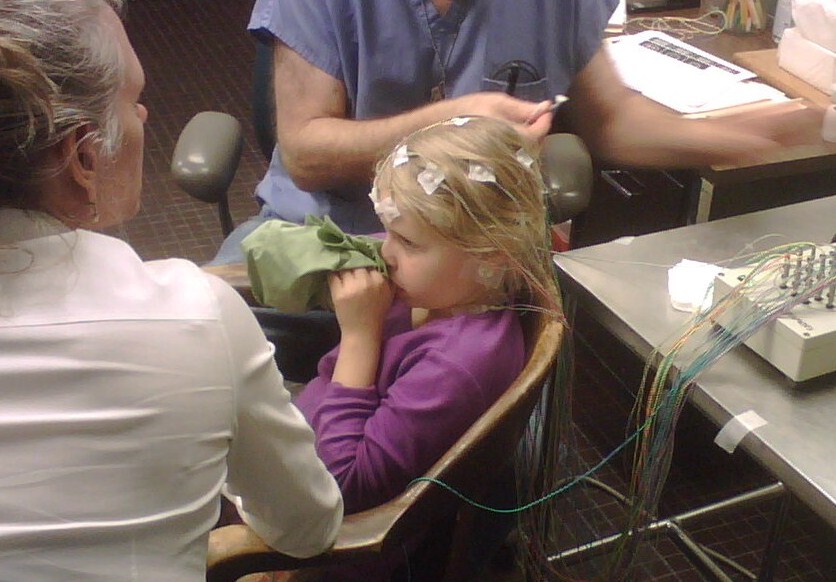
(I show her this photograph)

Me:  What about this?  What’s going on in this photograph?

Em:  Dr. Halper.

Me:  What’s he doing?

Em:  Just Toni Karlsrud.

Me:  Is that Dr. Karlsrud?

Em:  Nooooo!  (Laughing) Dr. Halper.

A:  What’s happenig to you?

Em:  (Touching photograph.)  Goes beep, beep, beep, beep.

A:  You’re having a QEEG done.  It measures your brain waves.

(Emma gets up and walks away.)

A:  Emmy!  Come back!

Em:  Where are you going?

A:  Emmy!  Come back!

(I follow her into the other room where Richard is.)

A:  Hey Em, do you know why you’re having a QEEG done?

Em:  Now goes beep, beep, beep…  (while she says this she is touching various points on her head where the electrodes are placed.)  beep, beep, beep, beep… (she touches her arm) beep.

A:  They don’t put one on your arm!

Em:  (Laughs) Beep!

A:  Do you know why this is being done to you?

Em:  Beep, beep, beep, beep.

A:  It’s looking at your brain.  It measures your brain waves.

Em:  Beep, beep.

A:  Do you like going to see Dr. Halper and having a QEEG?

Em:  Yeah!

A:  Should we go pick out what you’re going to wear today?

Em:  Yeah, sit for one more minute.

A:  Okay.