Tag Archives: living with autism

Emma’s Party

Last night we had some guests over for dinner.  Emma, upon hearing guests were arriving, announced, “It’s a party!” before dashing off to her bedroom to don the appropriate attire.  When she returned, wearing a dress my mother wore to dancing school in the ’30’s, we all oohed and aahed.

“Emma!  What a pretty dress you picked out.”

“Look!  It’s so beautiful!” She said bouncing up and down and twirling around.

My mother told us it was a Hungarian dress that had a velvet vest and a faux fur hat, which evidently Emma had chosen to forego.

Emma seated at the dinner table wearing her party dress

Emma loves a party.  She always has.  She has no inhibitions, loves nothing more than to sing and dance in front of a crowd – the more the merrier.   Her love of parties is something I am always surprised by, as both Richard and I were so very shy at her age.  It’s one of those things, like her talent for holding a tune that we joke about.  “She must get that from you,” I tell my husband.

“Not me.  Don’t know where that came from,” Richard will respond.

And if my mother’s in the room, she’ll usually get the credit.  “Must be Mom,” I’ll say, looking over at her as Nic rolls his eyes.

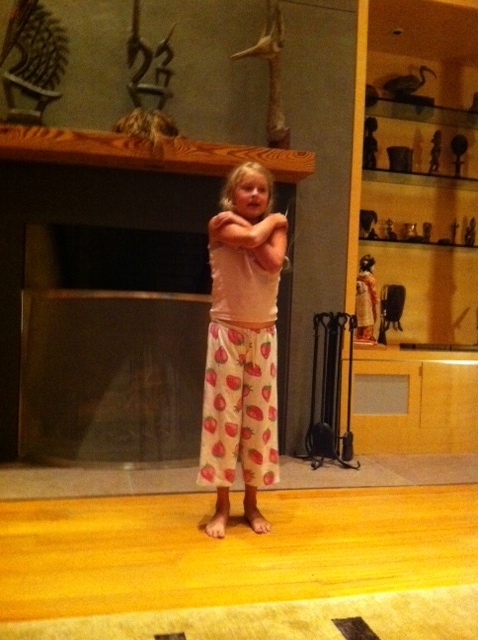
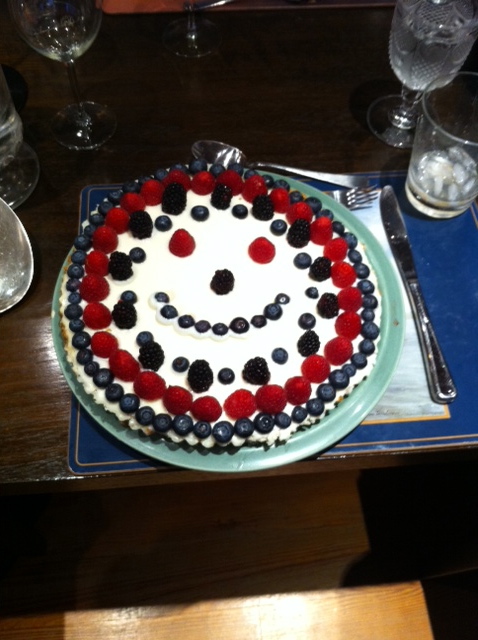
So after dessert (Nic and his Granma made a fabulous cheesecake, which Nic decorated) and the plates had been cleared, Emma ran downstairs in her pajamas and said, “Ready for performance!”  She gestured with her hands for us to gather in the living room and take a seat.  She waited until everyone had sat down before launching into a song, neither Richard nor I had ever heard.  The song whose lyrics at one point are – “I am the thunder, you are the lightening” was sung in a loud voice while she did a little dance.

Emma singing and dancing

When she’d finished she said, “Sing it again?”

“A different song, Em.  You can sing one more song, but it has to be different.”

So she chose an old stand-by, Gwen Stefani’s “It’s my life”.

For more on Emma’s journey through a childhood of autism, go to:  www.EmmasHopeBook.com

Nic’s cheesecake

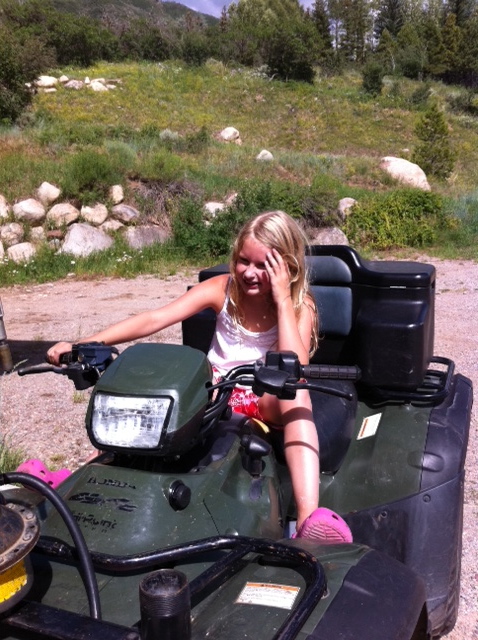
Em & The 4-Wheeler

Emma on the 4-wheeler

Perhaps more exciting than even the ARC (Aspen Recreational Center) is the 4-wheeler kept up on the ranch.  For those who are not familiar with this piece of machinery, it is a cross between a kind of Hummer version of a motorcycle and an open air golf cart.  My two nephews, Colter and Bridger, are cringing at this crude and citified description of mine, because it is actually an essential piece of powerful ranch equipment used to change sprinkler heads, and to haul a variety of other things.  Things I do not pretend to know about.  To me, it is the vehicle we use to go looking for coyote, fox and other wild life up on the ranch.  Last summer we found a den of coyote pups, so cute(!) whose mom lay basking on a nearby rock, unruffled by our intrusion, she didn’t move a muscle as we rode by within ten feet of her pups.  (I know Colter and Bridger – you guys might want to just shut your computer down at this point – it’s got to be painful to read this description.)

Now that I have thoroughly humiliated my fabulous nephews with my utter ignorance in all things to do with ranching, I will attempt to move on.  When Emma arrived in Aspen the night before last, one of the first things out of her mouth was – “Go on the 4-wheeler?”  Followed by, “Go to DuBrul’s (my cousins’s) house?”

When we told her she couldn’t do either of those things, she then went for her back up list.  “Go see motorcycle bubbles?”  (This requires interpretation as this is what Emma calls the 4th of July fireworks, which we missed this year as we were in New York.

“No not going to see motorcycle bubbles.  Go swimming in indoor pool.  Yeah, go to the ARC.”

When we informed her that as it was almost 9:00PM, this wouldn’t be possible, but promised to take her the following day, she said, “Go to outdoor pool?”  (Meaning the Snowmass rec center’s outdoor saline water pool)

Finally tired of our feeble excuses about the late hour and how everything was closed, she conceded sadly, “Time for bed.”

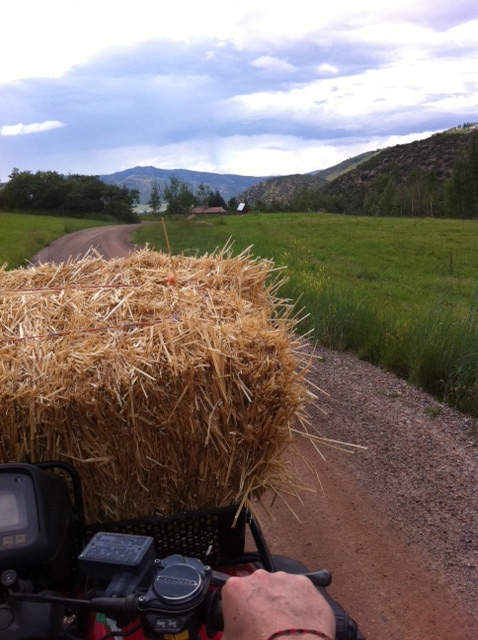
But the following morning the list was proffered up and there wasn’t much we could say as our excuses of it’s too late, no longer held any weight and she knew it.  So off to the ARC Emma went and then a trip to the grocery store where she was able to procure her favorite chocolate milk from Horizon, before getting the 4-wheeler from the barn.  We were also able to load a bale of hay into the front to carry back to the house to set up with a bull’s eye so that Nic can practice his archery skills.

Bringing hay back to the house for Nic

It’s good to be home with the family!

For more on our escapades and Emma’s journey through a childhood of autism, go to:  www.EmmasHopeBook.com

These Last Few Days

Every day for the past month, Emma has gone on the bus to summer camp with her brother, Nic and her therapist Joe, shadowing her.  Joe tells me this year has been terrific.  Emma has tried new things, been engaged and interacted with the other children more than the year before.  Today is their last day before coming out to join me in Aspen.  Because it’s their last day, Nic told me, they can do whatever they like.  Nic said he was probably going to play soccer, practice his archery, swim “a bunch of times” in the the lake and do gymnastics.

I am interested to hear what Emma will do.  When I called last night, she was with Joe in her “study room” so I couldn’t speak to her to ask.  Not that I would have gotten a clear answer.  The future and past are difficult concepts for Emma to express.  I never know when I speak with her if she’s referring to something she wants to do, did do, will do in the future or wished she could have done in the past. Despite my confusion in regards to what time frame is being referenced, Emma is usually without complaint.

Emma at camp – 2011

Every afternoon upon returning from camp, Joe and Emma go into her “study room” where she works on her literacy program.  I haven’t worked with her for the last ten days, so I am eager to see how she is coming along.  Emma’s literacy program, perhaps more than anything else, has caused a significant shift, in Emma, but also in me.  The progress she’s made since this January when she was just learning to form her letters, to now, where she is writing one and two sentences, is tremendous to see.  But I also feel she is gaining a certain degree of self confidence.  Working with her has been incredible as I know how hard it is for her, but she continues to do the work anyway.

Sleep, wake up, sleep, wake up, go on the airplane and see Mommy!

For more on Emma’s journey through a childhood of autism, go to:  www.EmmasHopeBook.com

A Phone Conversation With Emma

Speaking on the phone with Emma has always been challenging.  She tends to forget that there is a person on the other end and often walks away, leaving the phone dangling there before someone either abruptly hangs the phone up, not realizing I’m still there or answers it in a harried sounding voice.  Sadly, since I’ve been out here in Aspen working, both my children and husband remain in New York City, so the only communication I have with any of them is by phone.  This morning I called before the children left for camp – which meant calling them at 5:45AM Rocky Mountain time.  The following was my conversation with Emma.

A rustling sound followed by, “Hi Joe!”

“No, Emmy.  It’s me, Mommy.”

“Oh!  Hi Mommy!”

“How are you Emma?”

“I’m fine.  Have so much fun at camp.  Last day.  Last day summer camp.”

“Two more days, Em.  You have two more days and then it’s Saturday and then you and Daddy and Nicky and Jackie fly out to Aspen!”

“No more summer camp.  Fly to Granma’s house!”

“That’s right Em.  I can’t wait to see you.  I miss you so much.”

Silence.

“I’ll be at the airport, Em, waiting for you guys.  I am so excited to see you.”

Silence.

“Emmy, have you enjoyed camp?  What are you doing there today?  Anything exciting?”

Silence.  Then humming.

“Emmy?”

More humming of a carousel song – whose name I cannot remember.

“Hey Em?”

More humming and the sound of her moving away from the phone until the humming was from far away.

“Em?”

“Oh hi honey.  She took off.  Nic wants to talk with you though.   He was going to call you this morning,”  Richard said.

I then spoke with Nic who informed me that he missed me and Emma did too.  He now knows how to blow bubbles from a single piece of gum, a proud accomplishment and something he had become convinced he would never be able to do.  He’s practicing his Alto Sax and loves it, is playing the piano and is working on a blues composition for it, while learning the guitar, so he is not as good at it, but is still enjoying it.  The sax he is shipping out to Aspen so he can practice while out here and his skateboard he intends to leave in New York.  He explained to me that he plans to buy another one for Aspen so he’ll have one here as well as in New York.  He requested that I find him a bail of hay so he can set up a bulls eye to practice his archery, which I’ve promised to look into.  As he told me all of this I could hear Emma in the background, talking, singing and laughing.  I could hear that Joe had arrived.  As I spoke to Nic, mining him for more information there was silence.

“Hey Nicky!”

Silence.

“Nic!”

Silence.

“Nic!  NIC!”

“Oh yeah, Mom?”

“Nicky, I was talking to you.”

Sorry.  Joe’s here, playing with Emma.  I got kind of distracted.”

Shrieks of laughter were then heard along with running and more laughing.  Talk about feeling out of the loop!  But also relieved everyone is having a good time and I will get to see them in another four days.  Just four more days…

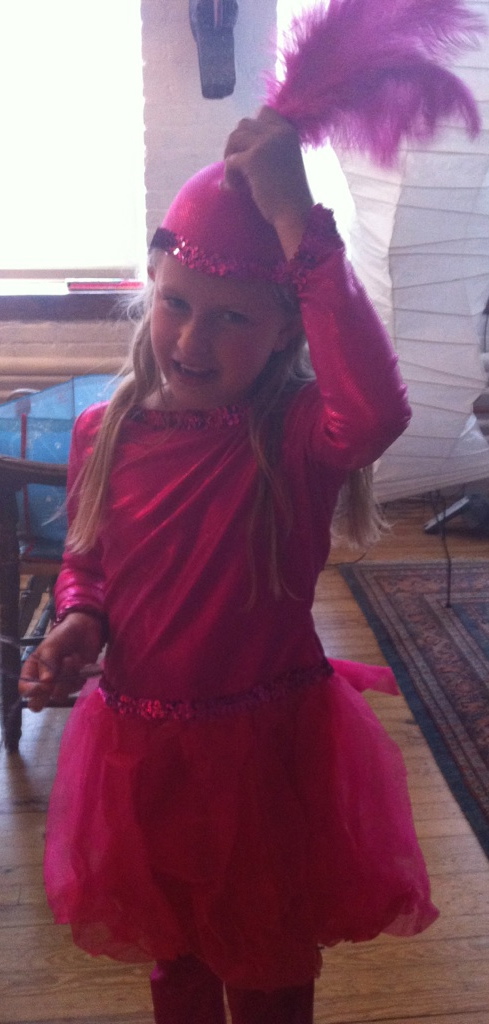
Emma in her Pink Flamingo costume

For more on Emma’s journey through a childhood of autism, go to:  www.EmmasHopeBook.com

Labels – Autism

Labels are easy, they’re shorthand for what we want to communicate and yet they often obscure what is really being said.  (These are the things I think about when I’m away from my family for an extended period of time, as I have been, since coming out to Aspen because of work. All of this reflection will end in another four days, because the children and Richard will be joining me out here this Sunday – Hurray!)

We say things like – “oh he’s schizophrenic,” “she’s bi-polar,” “she’s anorexic,” “he’s an alcoholic” and the meaning gets conveyed and yet, is it?  After all that’s not ALL the person is.  It’s something they have been diagnosed with, perhaps are struggling with,  it’s a medical term, but it does not encompass who and what that person is in their entirety.  When I hear someone describe another person as “autistic” I understand that person has been given a diagnosis of autism, but I don’t presume to know much more about that person.  For example, I won’t know if this particular person diagnosed with autism can speak, read or write, they may have other issues, physical issues, other diagnoses added on to further illuminate, but the labels begin to overwhelm the actual person.  I can’t know from the various labels whether the person has a sense of humor, if they have terrific eye contact or no eye contact, whether they cringe at physical contact or whether they seek it.  The word “autistic” does not give me any clues as to whether the person is gregarious or shy, enjoys reading about painting or knows everything there is to know about quantum physics.  The label does not tell me about the person’s passions, dreams, desires or talents.  If I knew nothing about autism, having someone described to me as such might cause me to presume a great many things.  Things I would be completely wrong in assuming.

In my daughter, Emma’s case, the labels are almost always unhelpful.  I use them, it is shorthand after all, but they reduce her to something that doesn’t help people know her or understand her.  For example, Emma has a terrific sense of humor, she loves playing jokes, being silly, making faces, repeating things in a way that will guarantee a laugh.  When I use the word autism, or say to someone – she has autism – it’s the best I can do in a short period of time.  It’s a little like when we say to one another – “How are you today?”  The answer we all know to give is:  “I’m fine, how are you.”  Even if we aren’t fine.  Can you imagine if you asked that seemingly innocuous question and the response was:  “You better take a seat, this may take some time.”

I avoid using the word “autistic” because it implies more to me, than saying “she has autism.”   It’s a subtle distinction, but to me, anyway, it’s there.  Emma is so much more than a diagnosis.  She is pure Emma. And Emma is complex, just like the rest of us.  She is funny, a talented singer with a beautiful voice, she has a personality and temperament that are unique to her.  She loves to run and swim and swing her arms and zip around on her scooter.  She enjoys being read to, sung to, and any game that involves running.  I dislike that her diagnosis takes up so much room in people’s minds.  I do not like that when people hear she’s “autistic” they make assumptions about her, almost always incorrect.

Can you imagine what the world would be like, if all of us took all these labels, our shorthand for communicating and tossed them out the window?  We would live in a world, which would make prejudice and judgements much more difficult to come by.  We would have to live in the discomfort of not knowing.  But what a great way to live!

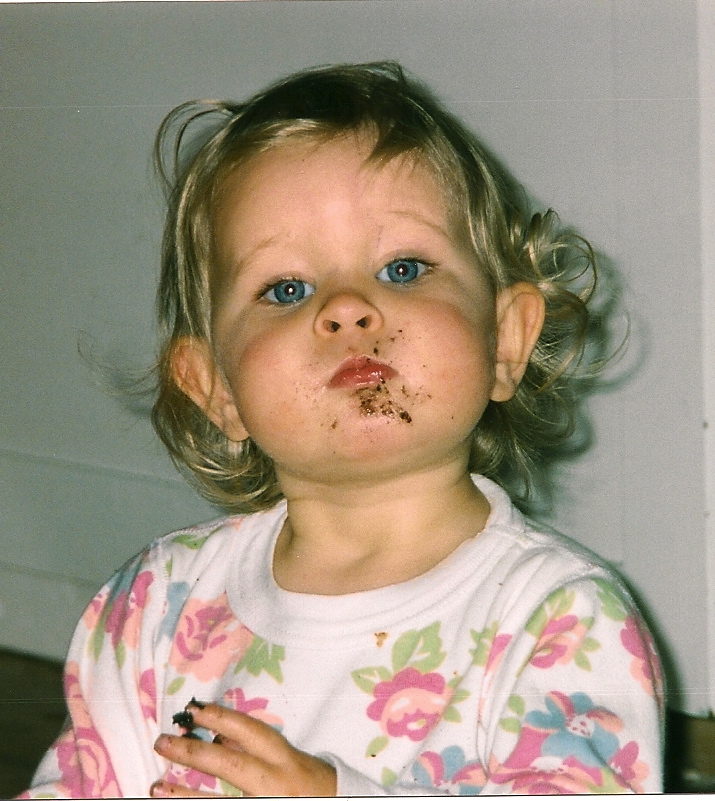
Emma – 13 months – eating a brownie.

For more on Emma’s journey through a childhood of autism, go to:  www.EmmasHopeBook.com

What is Normal – Continued

A few weeks ago while at the swimming pool with Emma, a woman asked me where she should take her two grandchildren, who were going to be staying with her.  After inquiring what the age of her grandchildren were – just a bit younger than Nic and Emma –  I began with a list of parks, (all with water features) moved on to museums, then zoos, botanical gardens etc.

At one point she pointed to Emma, who was standing near me twirling her hair around her index finger, and said, “What are her favorite things to do?”

I waited to see if Emma would respond, when she did not, I said, “Emma likes any park with water and the Central Park carousel,” I said.  As I was speaking Emma was twirling her hair and opening all the lockers in the dressing room.  Trying to engage her I said, “Hey Em.  What do you like to do on the weekends?”

Emma turned to me and said, “You have to ask Mommy.  Mommy can I go home now?”

The woman looked kindly at Emma, then with a certain amount of confusion said, “Oh!”

“Emma has autism,” I said.  “Pronouns have always been tough.”

“I would never have guessed that looking at her,” the woman said.

I put my arm around Emma and said, “It was nice speaking with you, have a lovely time with your grandchildren.”

As we left I thought about what the woman said.

Autism is often invisible.  With many children they have no discernible signs of physical issues, they look healthy, they seem “normal”.  Unless one tried to engage Emma in conversation, one would never know there was anything amiss.  Even then, I’m surprised by how often people still don’t know.  We have such a wide range of what we deem “normal” in human behavior.  I think people assume they are speaking to a neuro-typical child and so it can take awhile before they discern that they are not.  In Emma’s case she also can appear shy or perhaps people assume she’s one of those children who hasn’t been taught to be “polite” and answer when spoken to.   Many of us find it confusing to see someone who “looks normal”, only to find there are deeper neurological issues lurking.  Most people think, when first meeting Emma that she’s aloof or bored.  Sadly, many people assume she hasn’t been brought up properly and so they become rude or scolding, speak to her harshly, before I can intervene.

So what exactly is normal?

I don’t know.   But I’m not convinced it’s anything I aspire to.

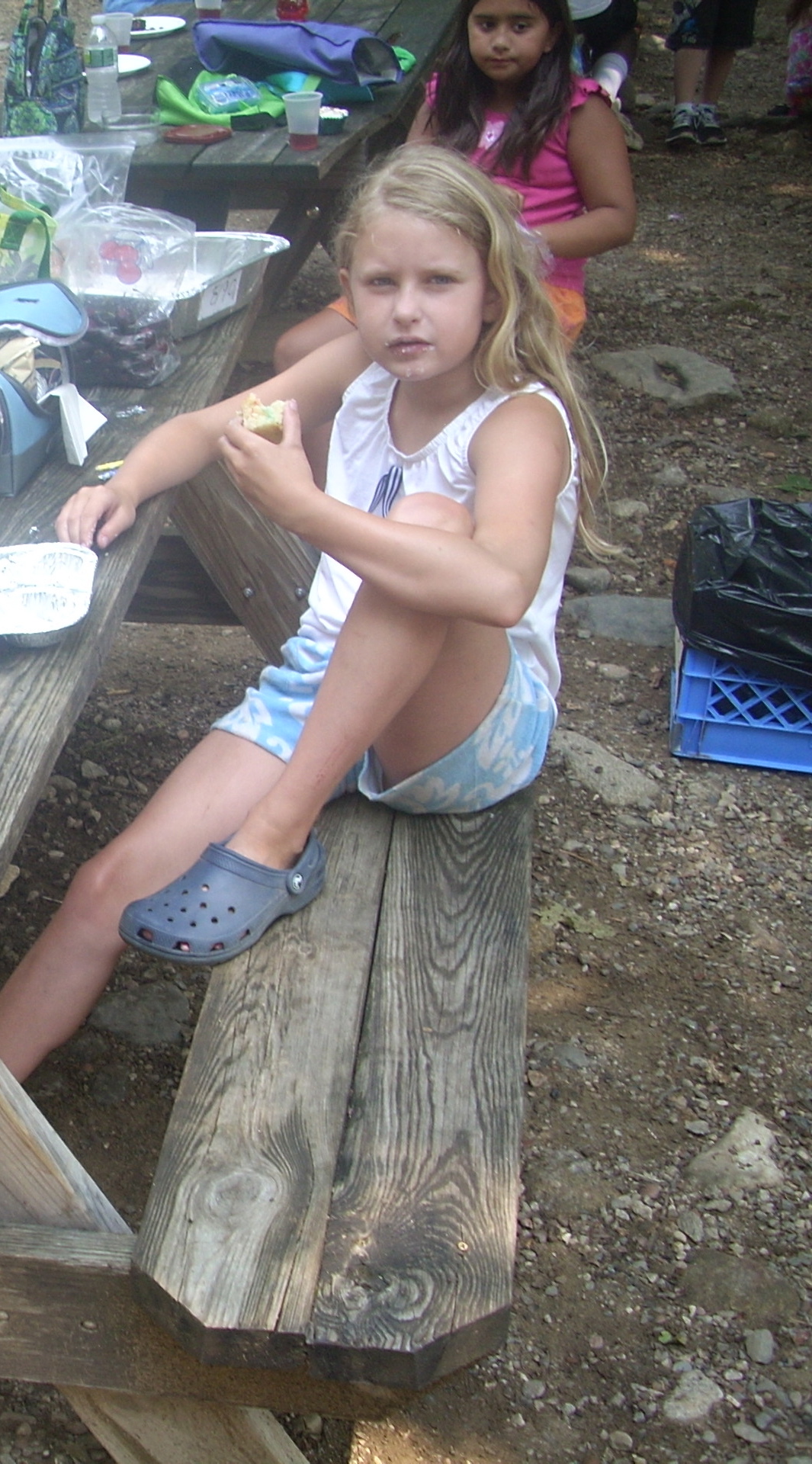
Emma eating lunch at camp

For more on Emma’s journey through a childhood of autism, go to:  www.EmmasHopeBook.com

What is Normal?

Having a child diagnosed with autism, one inevitably comes up against this question – What exactly is normal?

According to Dictionary.com – “Normal:  1. conforming to the standard or the common type; usual; not abnormal; regular; natural.  2. serving to establish a standard.  Psychology – a. approximately average in any psychological trait, as intelligence, personality, or emotional adjustment.  b. free from any mental disorder; sane.”

Autism is a neurological disorder, yet interestingly, if one goes to dictionary.com and looks up autism, the word “neurological” never shows up in it’s definition.  In fact, it is defined as:  1. Psychiatry – a pervasive developmental disorder of children, characterized by impaired communication, excessive rigidity, and emotional detachment.  2.  a tendency to view life in terms of one’s own needs and desires.”

Okay  – so the definition certainly suggests something outside of “normal”, though “a tendency to view life in terms of one’s own needs and desires” certainly describes a great many people I’ve come in contact with over the course of my life.  In fact, couldn’t one even say that this is one of the great flaws of being human?  We all tend to view our lives as our own private universe, and though we have grown to understand we are not the center of it, a great many still wish we were.

Have you ever engaged in a conversation with another person only to begin lamenting the problems of the world, our government, other governments only to conclude that if everyone just listened to us, the world would be a better place?  How many times in a relationship have you thought, if only the other person would listen to me, do as I wish, everything between us would be so much easier?

It all comes down to the degree.  I didn’t bother to look up narcissism, but I’m pretty sure people who have that tendency would fall under the second definition of autism – though the resemblance stops there.

When I think about my daughter, Emma, she is the antithesis of narcissism.  Emma is without ego.  She is also without malice.  It would never occur to Emma to tease or set out to hurt another person’s feelings.  These are not things she is cognitively capable of.  I remember the first time she told a lie, I was ecstatic.

“Did you hear her?” I asked my husband, Richard.  ”I asked her if she’d brushed her teeth and she told me she had, but when I went into the bathroom, her toothbrush hadn’t been used!”

“Things are all falling into place,” Richard said with a grin.

The idea that Emma understood that if she told me what she knew I wanted to hear, even though it wasn’t true, it might allow her to get away with not doing something she didn’t want to do, was a huge step toward “normalcy”.

I have grown to dislike these definitions and labels.  I find them utterly unhelpful.  Perhaps in the beginning when I knew nothing about PDD-NOS – the diagnosis first given to Emma when she was two – I had no idea what people in the field were talking about, and so it was imperative that I learn what these labels meant.  But now, some seven years later, those same labels do little to help us help our daughter.

For more on Emma’s journey through a childhood of autism, go to:  www.EmmasHopeBook.com

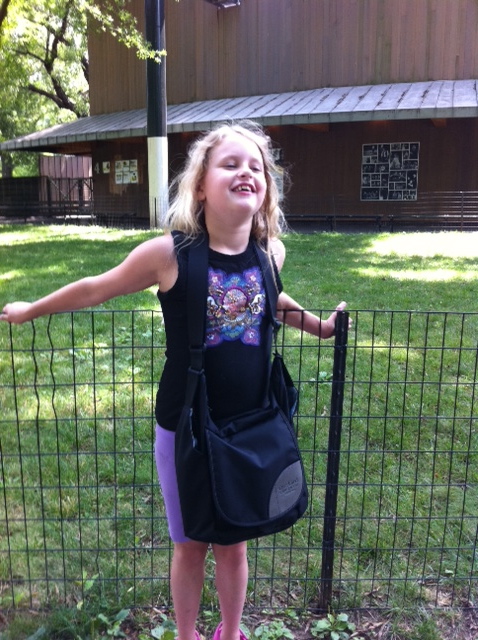
Emma in Central Park carrying her dad’s “man bag.”

Sunday with Emma

Yesterday Richard and I took the children to the park, where Emma played in the sprinklers, while Nic sat with us in the shade and talked.

Emma in Union Square Park

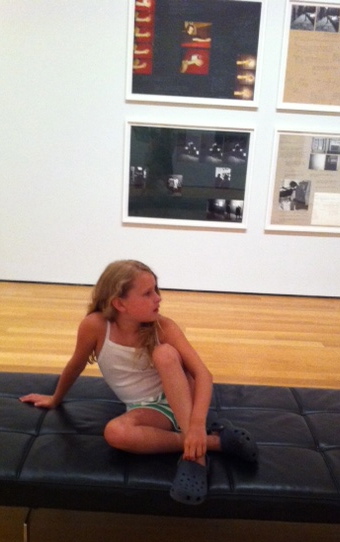
Then off to Toys R Us to return a Nerf gun that was faulty, then to MOMA (Museum Of Modern Art) where we watched several video installations by the Belgian artist – Francis Alӱs.  Emma wasn’t interested in the video of him pushing a huge block of melting ice through the streets until it disappears, but she was fascinated with the video of him chasing tornadoes, particularly when he entered the tornado.  Another video she liked was one in which he is driving a VW Bug up a very steep dirt road, but never makes it to the top, instead rolls backwards, before attempting to climb the hill over and over again.  Talk about the trials of Sisyphus…

When we went to a lower floor Emma pointed to a giant collapsed fan and said, “Telephone.”

“Look Em.  It’s a huge fan!”

“Fan,” Emma said, before going to the next sculpture with wheels, “Bicycle,” she said.  Then she turned and pointed to an enormous sculpture of a man holding a steering wheel.  “Bus driver!” she said, jumping up and down.  And on it went.  When she didn’t know what something was or if it didn’t look like any recognizable object she would point out it’s color.  “Red!” She said.  Or, “Green!”

“Hey Em.  Look.”   I pointed to two sculptures that resembled melting metal.

“Blobs,” she said nodding her head before running over to a sculpture of a vaguely female form.  “Mommy,” she said, pointing and smiling at me.

Emma at MOMA

After the museum we made our way to the swimming pool at the Vanderbilt YMCA, where we went swimming.

Prior to our leaving the house that morning, I’d made a list of all the things we planned to do and went over it with Emma.  “Okay so first we’re going to go to Union Square, then the museum, then the pool and then Toys R Us.”  I pointed to each item on the list as she repeated all our activities.  Except when we got to Union Square and saw how hot it already was and how heavy Nic’s Nerf gun was we amended out list.

“I think we better unload this thing,” Richard said gesturing toward Nic who was barely able to lift the bag carrying his broken toy far enough off the ground so that he could carry it.

Once we got to Toys R Us and Nic found a newer, bigger, better and even heavier Nerf gun, Richard turned to me and said, “I guess we’re going to have to take this thing home before we go to the museum.”

Meanwhile the list I’d painstakingly made and gone over with Emma was no longer relevant.  I worried with each change that a meltdown was imminent.  But the meltdown never came.  In fact Emma was great, took each change in stride, repeating the change of plans to me, before cheerfully going along with the next activity.

“Well that was a great day!” Richard said as we headed home.

Everyone agreed.

For more on Emma’s journey through a childhood of autism, go to:  www.EmmasHopeBook.com

Empathy and Autism

My thinking on this topic has changed since I last posted about Emma and Empathy over a year ago.  I am not convinced that Emma “has a terrible time figuring out what another person is thinking or feeling.”  Today that is not something I would say.  I often wonder if Emma feels things in the extreme rather than not at all.  I have read a great many articles written by people on the spectrum who describe their feelings and responses to other people’s emotions as being too much for them.

One young woman, Dora, says:  “I often feel things too deeply or have too much empathy and have to run away, not because I am callous, but because I feel so strongly it causes my brain to shut down or freak out.”    Her statement is similar to another woman with autism, who’s amazing mother, Clara Claiborne Park wrote two books about her daughter, Jessy.  She describes how Jessy would cover her ears and could not tolerate certain words because they were “too good”.

When one of us is upset and Emma appears to completely disregard our emotional state, whether by ignoring it or making sympathetic comments, which to our ears strikes us as insincere, I have to question whether our interpretation is accurate.  How can we know what she is really experiencing?  We cannot.    I choose to believe Emma is deeply sensitive to her  own and our emotions, but just as she has trouble expressing herself verbally, she may express her feelings differently as well.

Dora goes on to point out:  “The notion that we don’t have feelings frees up people to commit atrocities against us without accountability.”

When I hear neuro-typical people discussing autism I am often surprised by the conclusions they come to.  How differently might we treat someone if we believed them to be fundamentally unintelligent?  How would we speak to them?  What things would we say because we believed they have a low IQ, lack empathy, could not understand us?  How would we treat them as a direct result of our assumptions?   If we decide a child’s behavior is a form of manipulation or because the child is “spoiled” or because they “think they can get away with it”, do we not treat them differently?  Isn’t it true we can behave in some pretty horrific ways when we make assumptions about other’s actions?  Isn’t it easy to rationalize our behavior when we’ve decided a person or child is “dumb”, “less than”, “inferior”, cognitively unaware”?  And what if all those assumptions we’ve so quickly and easily come to are completely wrong?  How does our response stand up under further scrutiny?  Have we not behaved with callous disregard?  Have we not completely “disregarded” their “feelings”?

For more on Emma’s journey through a childhood of autism and her relationship with her brother, Nic go to: www.EmmasHopeBook.com

Emma in Union Square Park – Summer, 2011

A Brilliant Mind

I have maintained in previous posts, that I continue to believe in my daughter’s brilliance.  Current IQ tests do not account for children who are non-verbal or with limited or impaired speech.  I have no way of knowing what Emma’s IQ is, but I can tell you there are things Emma does, on a daily basis, indicating her mind is capable of some pretty astonishing leaps.  What follows are a number of examples.

Our refrigerator light is out.  The first thing I did was replace the bulb, only to find that wasn’t the problem.  A little later Emma opened the refrigerator door and pressed a switch on the ceiling of the refrigerator and immediately all the lights came back on.

“Wow Em!  How did you know to do that?” I asked incredulous.

“Lights broken,” Emma said, nodding her head up and down as she removed her caramel yogurt from the frig.

“Yeah, but how did you get them back on?” I went over to her and watched as she reopened the door and pressed on the little white button that activates the lights when the door is opened, something I did not realize until Emma showed me.  The lights flickered for a second and then went out.  Emma reached up and matter-of-factly jiggled the switch and the lights came back on.

“There,” she said, with a certain degree of satisfaction.

After a few days of all of us wiggling the switch, the lights flickered on and off feebly one last time before remaining permanently off and I had to call the company to get the light switch replaced.  Now to many of you, this may seem completely commonplace, but I can tell you, I had spent quite a bit of time trying to figure out what was causing the problem.   I should have saved my time and just asked Emma.

Yesterday while Emma and I worked on her literacy program requiring her to choose the word “leg” from several options, she positioned the cursor over the correct button then clicked on the space bar.  Then she looked over at me with a mischievous grin as if to say – did you see that?

Again, hitting the space bar instead of clicking on the mouse or the return key never would have occurred to me.

Another thing I’ve noticed while working with Emma is that she has an amazing ability to see patterns.  So, for example, if I show her a series of “words” but with only parts of the letters showing such as:  _a_s,  r_ _ _, _e_ _, _ _s_ and ask her to find the one that can be “eats” she will find the correct one immediately, less than a second, faster than I am able to.  I am consistently amazed by this.  It is in keeping with her ability to know instantly when a photograph is missing from her pile.

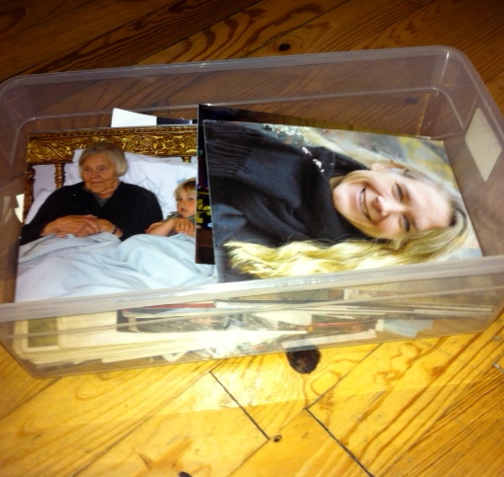
Emma’s box of photographs – over 200

The other day Emma was singing while shooshing around on her scooter.  Richard was reading in the rocking chair, Merlin happily nestled in his lap.  “You know what she’s doing right?” Richard said looking over his reading glasses at me.

“Yeah,” I said without looking up.

“She’s created her own carousel.  Do you hear her?  She’s singing all the songs they play on the carousel.  And watch.  She’s going around and around on her scooter in the same direction as the carousel.”

I stopped reading and watched and listened.  Emma was currently singing “Georgy Girl” one of the many songs they play at the Central Park Carousel.

“I wonder if she’s singing the songs in the correct sequence,” he wondered out loud.  “We’ll have to make a note of that next time we go.”

Emma riding on the Central Park Carousel

These are only a few examples of Emma’s brilliant mind.  There are countless others.

We, as a society have a tendency to view ourselves and others with a critical eye.  We are taught early on to look at our deficits and then do all we can to take corrective measures to make up for those deficits.  I don’t believe this kind of thinking is helpful with children diagnosed with autism.  The deficits pile up unbidden until that’s all we can see.  Our children are routinely viewed as “less than” as we struggle to help them.  I feel strongly a more balanced approach is necessary.  Our children are often brilliant.  If I approach Emma with this in mind, I am able to more fully help her, by focussing on her talents, on the things that are easy for her and using those assets to help her with the things that are more difficult.   In addition I find I can learn a great deal from her.

For more on Emma’s journey through a childhood of autism, go to:  www.EmmasHopeBook.com

“I’m Home” – Autism

When I opened the door to our loft, Emma came tearing up on her scooter shouting, “Mommy’s back!  It’s Mommy!”

As I dropped my bags and opened my arms to greet her, she sped away.  Nic meanwhile rushed up to me and threw his arms around my waist.  “Mommy!” he cried, “It’s so good to have you home.  I missed you so much!”

As I hugged Nic and then Richard, I said to Emma, “Hey.  I want a hug from you too.  Come over here, Em!  Remember?  Put your arms around and …”

“Squeeze!”  she shouted, while complying.  She peered up at me, with an odd expression on her face.  Then she pointed to my face and said, “It’s Mommy.  Mommy came back,” as though she hadn’t been sure I would.

“I’m back Emmy.  It’s so good to be back.”

“Yeah, Mommy came back.  Mommy stayed at Granma’s house.  Mommy had to go away,” she said, nodding her head sympathetically.

“It’s okay, Em.  Now I’m home.  I’m not going anywhere.”

Nic then played five different songs on his new Alto Sax for me, two new songs which he composed for the piano and then plugged his electric guitar into his amp and riffed on several more.  Emma scooted around on her scooter and eventually it was time for everyone to go to bed.

“Mommy come to Emma’s room,” Emma said, taking me by the hand.

“Yes!” I said following her.

“Mommy’s back,” Emma whispered as she snuggled down under her blanket.

“Yes, Em.  I’m home,” I said stroking her cheek.

Later Nic expressed his upset that I was away for almost three weeks.  He was able to tell me that he didn’t like that I was gone for such a long time.  But Emma…  Emma doesn’t have the words to express her upset nor does she have the ability to ask me why I was away.  I can only hope she understands I had to go for work, but I don’t know that she does understand.  When she looked up at me earlier it was with a mixture of shock at seeing me again and happiness.  I don’t know whether I’m reading more into her expression than was actually there, but given that she isn’t able to ask me, who knows what reasons she applied to my absence.

“Go swimming with Mommy,” Emma whispered.

“Yes,” I said.  “We’ll do that tomorrow.”

“No, not going to go back to Aspen,” she said, holding my hand.

“Nope.  Tomorrow we’re going to spend the whole day together.”

We were quiet then.  “Mommy sing?” Emma said after awhile.

“Sure, Em.  Which one – Swing Low, Sweet Chariot or Summertime?”

“Swing Low first, then Summertime,” Emma said.

“I love you Em,” I whispered.

“So much,” Emma finished.

For more on Emma’s journey through a childhood of autism, go to:  www.EmmasHopeBook.com

Searching

In three more days I will be home.  Home with my two children, Nic and Emma, my husband, Richard and our black cat, Merlin.  Everyone but Emma and Merlin understand that I’ve been away for so long because of work.  I guess I should rephrase that – I don’t actually know whether Emma understands I’ve been away because of work.  Perhaps the reason why I’ve been gone so long is meaningless to her, she just knows I’m not there.  But on Friday when she returns home, I will be waiting for her with open arms.  I don’t like being away this long.  I don’t like having so many miles between me and my family.

When I spoke to Emma on Sunday she said, “No, you cannot spit.  If you spit Mommy will leave.”

“Oh Em, you didn’t spit.  I didn’t leave because of anything you did,” I said.

“There is no spitting!”  Emma shouted into the phone.

“Okay Em.  I’m really glad to be speaking with you, tell me about your day.”

“No you cannot spit.  There is no spitting or Mommy leaves.”

“Sweetie, tell me about your day.  What did you do today?”

“No spitting.  Bye Mommy,” she said before casually putting the phone down and walking away.

Sometimes one waits then, hoping the chaos that constitutes our life in New York city isn’t so much that everyone forgets about the phone and the person on the other end.  Sometimes one has no other choice than to eventually hang up.  Once, after hanging up, I tried to call back only to receive a rarely heard busy signal.

But this time after a few moments Richard returned.  “Do you think she thinks I’m gone because I’m angry with her?”  I asked.

“No.  I heard her, I don’t know what that was about,” he tried to reassure me.

Being away is like entering an alternate universe.  It’s familiar, a bit like seeing an old friend from high school.  It’s easy to fall back into a kind of routine, but my children and husband are always there in my head.  I am here to work, so I do.  But I still have time to socialize with friends, Sunday I even took the entire day off and went for a much needed long, long walk with a friend.  I can say yes when someone asks me to have a coffee with them.  My life is completely different here from my life in New York.  In many ways it’s wonderful, calm, relaxing, yet I’ve been weepy ever since I arrived.  Being able to have feelings and have the time to look at them, talk about them, it’s all a luxury really.  One needs the time and space to indulge them.  So I’ve been blogging about some of those things – the existential quest that most of us feel at certain times in our life, the searching.  That too is something that needs time, a certain silence to be able to fully indulge.

I have no answers, I continue to search though.

For more on my family and Emma’s journey through a childhood of autism go to:  www.EmmasHopeBook.com

Dinner With The President – Autism

I received a form letter from Vice President Joe Biden yesterday.  It was one of those mass emails one gets, but rarely reads.  For some reason I glanced at it and read that the president will be having dinner with one person who makes a small donation of five dollars.  Their name will be thrown into a hat and one name will be drawn.

I thought about what I would say to the President were I to have the opportunity to have dinner with him.  And of course I knew what the answer was without hesitation.  I would speak with him about the rising numbers of children diagnosed with autism.  I would direct him to the countless news stories regarding the rampant abuse of those same children and adults living in group homes and institutions.  I would ask him to help set up communities where individuals with autism would have more control over how they lived, allowing them to pursue their interests, encouraging them to follow their dreams.  I would tell him about our trips to Central America with our daughter, Emma for stem cell treatments.  I would encourage him to put more funding into stem cell research, umbilical cord stem cells, using the patients own stem cells, and any other form of stem cells that might prove viable in restoring the lives of hundreds of thousands, even millions.

As I continued to think about all the things I wanted to say and ask for, in the name of autism, I thought of the families like mine who have been affected.  I don’t just mean on an emotional level, but financially as well.  A diagnosis of autism is devastating to any family financially.  We have chosen to pursue a more aggressive route than many can or want, but any family, even those who have not taken their child to foreign countries for stem cell treatments has found the cost of caring for a child with autism staggering.  For those who have little or no resources, who have to rely on social services to help them, who cannot afford to have a caregiver come to their home to give them a break, they live in a world starkly different from those with similar financial constraints who have neuro-typical children.

So Mr. President, on the off chance my name isn’t chosen and I don’t have the opportunity to sit down with you, can you please help galvanize the medical community and make autism a priority in research, can you look at what we’re doing when we cut so much funding from our already overwhelmed schools, can you earmark autism as something we need to find answers to?

To read about the genesis of this blog and Emma’s journey through a childhood of autism, go to:  www.EmmasHopeBook.com
“Go Back” – Autism

Last week Emma began crying and said, “Go back to hotel.”  Richard felt she was missing me, as I had to leave my family to return to Colorado for work when we left California instead of returning with them to New York City.  We also felt she was wishing we could have stayed longer and spent more time with my extended family, all of whom she loves being with.  She had such a wonderful time with so many family present at the Bed & Breakfast in Napa, California where we stayed for my brother’s wedding.

There’s a mistaken thought by many people that because a great number of children and adults with autism cannot express themselves well and often do not show tremendous emotional attachment to those they love, that they do not love.  Some people believe they do not feel the same intensity of emotion that we neuro-typicals do.  I disagree with this thinking.  I believe Emma loves and misses people as much as any neuro-typical child.  I believe she misses them with the same aching as any of us do.  The difference is, Emma doesn’t have the same neuro circuitry or the ability to put into words her feelings.  She lives in a world that must be incredibly confusing so much of the time.

I wonder, when I get on the phone with her, how much does she understand?  Does she understand that I am in Colorado and not in New York with her, Nic and Richard because I have to work?  Because time is a difficult concept for her, does she really understand when I will be returning?  When she wakes up in the morning does she wonder if I might be there only to find I’m not?   Our phone conversations are limited.  When speaking with Nic, I can reassure him that I will be home in another couple of weeks.  We can discuss what he did, he can describe the breakfast he fixed for his dad yesterday for Father’s Day.  We can talk about things.  With Emma, who does not and cannot ask questions, I ask – How are you?  She tells me she’s fine, even if she isn’t, because it’s the conversation we always have on the phone.  She may add some random thing such as – “Seal park, Chelsea piers carousel” and I can deduce that Richard took the children there yesterday.  I always ask her – What did you do today?  To which I can receive an accurate list of what she did, but just as easily I can receive a somewhat confusing version of events that may or may not have taken place.  I then will verify with Richard to get a clearer idea.

Yesterday was Father’s Day and Richard spent it with the children.  There was no sleeping in for Richard as I’m not there to give him a break.  Nic made him a special breakfast and then Richard took the children to various parks.  I know it wasn’t the day Richard would have liked.  I know how hard it is being the sole parent taking care of everything, especially for such an extended period of time.  And particularly tough when it’s a day designated to celebrate fatherhood.  When I spoke to Emma yesterday I said, “Be sure to tell Daddy – Happy Father’s Day and give him a hug, Em.”

“Happy Father’s Day,” Emma said into the phone.  I have no idea where Richard was or if he overheard her.  I can only hope he did.  I know Emma loves her dad.  She isn’t able to express it in the typical ways we are used to, but she does.

For more on Emma’s journey through a childhood of autism, go to:  www.EmmasHopeBook.com
Amusement Parks & Autism – Continued

Emma’s entire system was crashing.

“You have to ask Mommy!  Mommy can I go on the roller coaster with Gaby, please?”   She cried over and over again through screams and tears.

It was heart breaking and anyone with a neuro-typical child would think – oh just let her go on it one more time and then go home.  I even thought this a number of times as I tried to peel her off the pavement where she had fallen in a heap of tears, snot pouring from her nose, her hands made into tight fists while hitting herself in the head, on her chest, legs, arms wherever she could before I, or any of us could stop her.  The biting is horrible because it can break the skin and then there’s blood, and later scabs and enormous angry blue and purple bruises that can last for more than a week, reminding all of us of her agony.  But the hitting – a quick, violent punch to the face is shocking to witness and as a parent, it’s difficult not to feel one has done something horribly, horribly wrong.  How can this sweet, blissful child do this to herself?

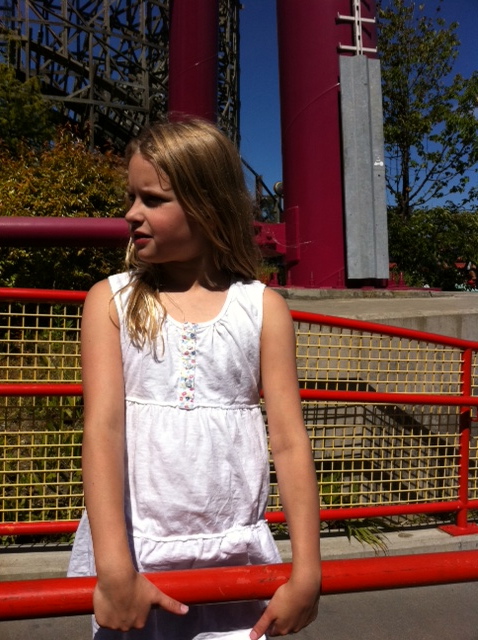
Emma waiting for Joe, Nic and Gaby while they ride on the Corkscrew

Richard and I have always said to the children – hitting is wrong.  We don’t do it, we don’t want them to ever do it to each other and until Emma began hitting herself, it hadn’t occurred to us to add – we don’t hurt ourselves.  We don’t hit others or ourselves.  We say it, but I don’t know that it makes a difference.  When Emma’s brain has become set on something, no amount of calm, reassuring logic seems to help her.  No amount of soothing, we just have to vacate the premises.  It’s our only hope.  Kind of like shutting the whole system down, a kind of reboot.  We have tried the other option, which is to let her go on one more ride or do whatever it is one more time and the misery, the abject misery continues.  Like an addict who has to have that drink or that drug even while bringing them no real solace.  There’s no relief to be had at a certain point.

“Emmy it’s going to be okay.  We’re going to go home now.  We can ride the little roller coaster one more time and you can sit with Gaby and then we have to go home,” we told her.

But Emma’s brain couldn’t take in this information it was already in lock down mode.  I gave her a banana to eat and then everyone, our once cheerful little group, now more weary warriors than a family intent on having a lovely day at an amusement park trooped along.  She was able to sit with Gaby on the little roller coaster for one last ride and then we trudged back to the car while Emma kept looking over her shoulder at the wooden roller coaster named Roar.  As we headed home Emma said, “It’s okay, we’ll come back tomorrow.”

“No Em.  Tomorrow we’re going to traintown where there are different rides and then we’re going to Uncle Andy’s wedding,” we told her.

“Different rides,” Emma repeated, sadly.  “We’ll come back soon,” she said.  There was a wistful tone to her words, and we knew it wasn’t likely that we would ever come back to this part of the world.  But there would be other amusement parks and maybe one day Emma’s massive sensory issues will have abated to such a degree that these kinds of episodes will become rarer.

We can only hope.

For more on Emma’s journey through a childhood of autism go to:  www.EmmasHopeBook.com