Tag Archives: autism & parenting

Emma’s Party

Last night we had some guests over for dinner.  Emma, upon hearing guests were arriving, announced, “It’s a party!” before dashing off to her bedroom to don the appropriate attire.  When she returned, wearing a dress my mother wore to dancing school in the ’30’s, we all oohed and aahed.

“Emma!  What a pretty dress you picked out.”

“Look!  It’s so beautiful!” She said bouncing up and down and twirling around.

My mother told us it was a Hungarian dress that had a velvet vest and a faux fur hat, which evidently Emma had chosen to forego.

Emma seated at the dinner table wearing her party dress

Emma loves a party.  She always has.  She has no inhibitions, loves nothing more than to sing and dance in front of a crowd – the more the merrier.   Her love of parties is something I am always surprised by, as both Richard and I were so very shy at her age.  It’s one of those things, like her talent for holding a tune that we joke about.  “She must get that from you,” I tell my husband.

“Not me.  Don’t know where that came from,” Richard will respond.

And if my mother’s in the room, she’ll usually get the credit.  “Must be Mom,” I’ll say, looking over at her as Nic rolls his eyes.

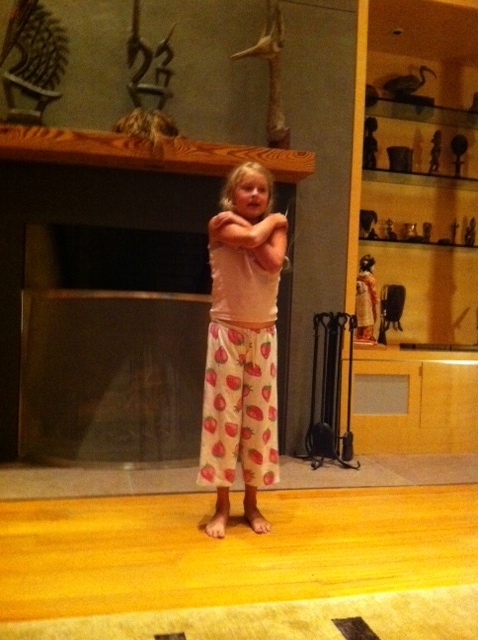
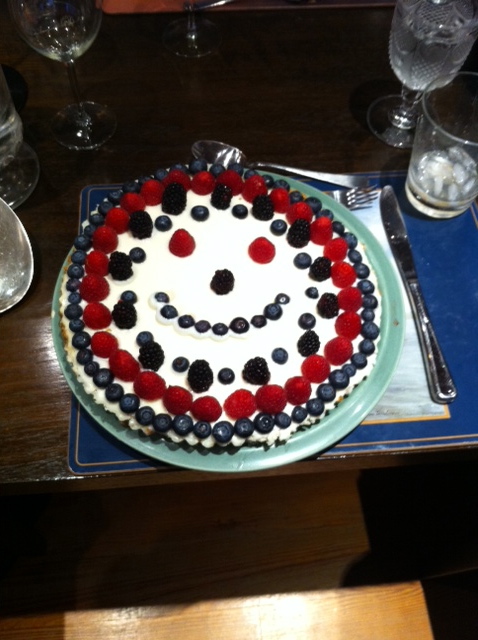
So after dessert (Nic and his Granma made a fabulous cheesecake, which Nic decorated) and the plates had been cleared, Emma ran downstairs in her pajamas and said, “Ready for performance!”  She gestured with her hands for us to gather in the living room and take a seat.  She waited until everyone had sat down before launching into a song, neither Richard nor I had ever heard.  The song whose lyrics at one point are – “I am the thunder, you are the lightening” was sung in a loud voice while she did a little dance.

Emma singing and dancing

When she’d finished she said, “Sing it again?”

“A different song, Em.  You can sing one more song, but it has to be different.”

So she chose an old stand-by, Gwen Stefani’s “It’s my life”.

For more on Emma’s journey through a childhood of autism, go to:  www.EmmasHopeBook.com

Nic’s cheesecake

Emma’s Struggle with Pronouns

I have written about this before – Emma’s continuing struggle with using the correct pronouns.  It is something one sees in children on the spectrum.  Pronoun confusion, lack of pointing at an early age, a lack of engagement or initiating play, these are all warning signs in small children and almost all children diagnosed with autism share at least a couple of these.

Emma uses the word “you” when speaking about herself, but also when speaking about someone else.  It’s a word she uses for anyone, herself included.  As in “You want to go on the 4-wheeler?”  Someone who doesn’t know Emma would assume she’s inviting them to go with her and the response is often an enthusiastic, “Yes, I do want to go on the 4-wheeler!”

Emma, then happily runs outside, turns the engine on and waits for the unsuspecting person to join her.  This scenario actually happened with our cousin Max, whom neither of the kids had ever met until last summer.  But when Emma says things like, “Bye Emma!” to the person she has just been introduced to, things get a bit more confusing.

So last night when Richard and Emma picked me up from my store in town, she said, “No not going to see July fireworks.  They’re too scary.  Mommy has to pick you up.”  Then she paused and said, “No, Mommy has to pick me up!”  We were surprised and pleased.

“That’s right Em!”  And then as an aside to Richard, “Wow!  That was pretty great.  She corrected herself!”

Emma then repeated herself several times, “Fireworks too scary.  Mommy will pick me up.”  She looked from Richard to me proudly.  “Good talking!” she said, before leaping into the car.

During the ride back to the ranch she tried various variations on this theme.  Each time using “me” correctly.

It was a proud moment for all of us.

For more on Emma’s journey through a childhood of autism, go to:  www.EmmasHopeBook.com

Em & The 4-Wheeler

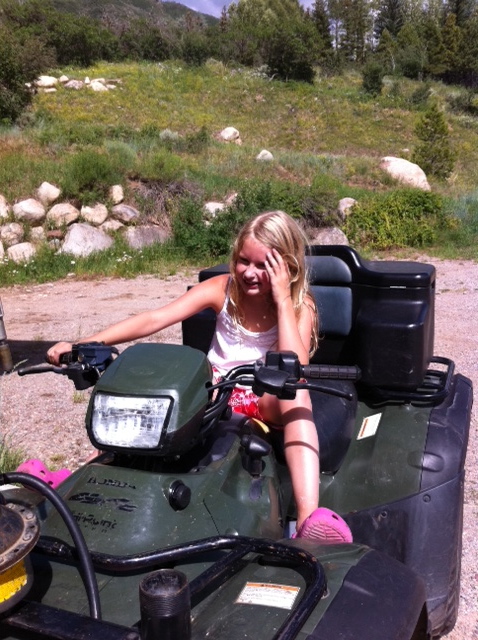
Emma on the 4-wheeler

Perhaps more exciting than even the ARC (Aspen Recreational Center) is the 4-wheeler kept up on the ranch.  For those who are not familiar with this piece of machinery, it is a cross between a kind of Hummer version of a motorcycle and an open air golf cart.  My two nephews, Colter and Bridger, are cringing at this crude and citified description of mine, because it is actually an essential piece of powerful ranch equipment used to change sprinkler heads, and to haul a variety of other things.  Things I do not pretend to know about.  To me, it is the vehicle we use to go looking for coyote, fox and other wild life up on the ranch.  Last summer we found a den of coyote pups, so cute(!) whose mom lay basking on a nearby rock, unruffled by our intrusion, she didn’t move a muscle as we rode by within ten feet of her pups.  (I know Colter and Bridger – you guys might want to just shut your computer down at this point – it’s got to be painful to read this description.)

Now that I have thoroughly humiliated my fabulous nephews with my utter ignorance in all things to do with ranching, I will attempt to move on.  When Emma arrived in Aspen the night before last, one of the first things out of her mouth was – “Go on the 4-wheeler?”  Followed by, “Go to DuBrul’s (my cousins’s) house?”

When we told her she couldn’t do either of those things, she then went for her back up list.  “Go see motorcycle bubbles?”  (This requires interpretation as this is what Emma calls the 4th of July fireworks, which we missed this year as we were in New York.

“No not going to see motorcycle bubbles.  Go swimming in indoor pool.  Yeah, go to the ARC.”

When we informed her that as it was almost 9:00PM, this wouldn’t be possible, but promised to take her the following day, she said, “Go to outdoor pool?”  (Meaning the Snowmass rec center’s outdoor saline water pool)

Finally tired of our feeble excuses about the late hour and how everything was closed, she conceded sadly, “Time for bed.”

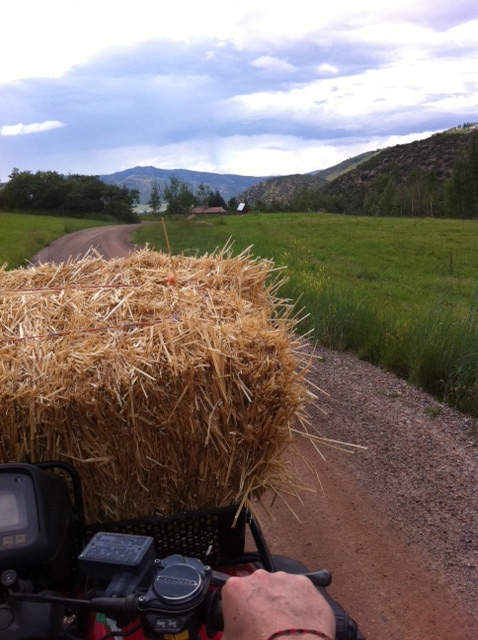
But the following morning the list was proffered up and there wasn’t much we could say as our excuses of it’s too late, no longer held any weight and she knew it.  So off to the ARC Emma went and then a trip to the grocery store where she was able to procure her favorite chocolate milk from Horizon, before getting the 4-wheeler from the barn.  We were also able to load a bale of hay into the front to carry back to the house to set up with a bull’s eye so that Nic can practice his archery skills.

Bringing hay back to the house for Nic

It’s good to be home with the family!

For more on our escapades and Emma’s journey through a childhood of autism, go to:  www.EmmasHopeBook.com

Bliss

I am sitting here writing this, with Emma to my left singing “Three Little Elephants” in Spanish.  Okay, so you might not know that was what she was singing even if you were a native spanish speaking person, but I know the song, because the tune is exact even if her pronunciation is not.  Richard and the children arrived in Aspen last night.  To say that I was pleased to see them, really doesn’t sum up my excitement and happiness.  I am blissfully happy!

Last night Emma was so excited to be here that she didn’t want to go to bed.  As my husband, now to be referred to as the man-of-the-decade (MOD – I tried “century” whose acronym then became MOC and have opted for “decade” simply because of the acronym and not because there’s a time limit on my admiration for him and all he does) was unpacking, I got Em into her nightie and brushed her teeth.  When she finally felt it was time for bed, at around 10:00PM (that’s midnight by New York time) she said, “Time for reading and bed!”

“Are you ready for bed, Em?” I asked.

“Yes.  Mommy come,” she replied.

I am reading a book written by a wonderfully talented friend of ours – Dan Elish – whose book is entitled “The School for the Insanely Gifted” and Emma is enjoying it immensely, as am I.  As I read to her, Emma snuggled up against me, putting her head on my shoulder as I read.  I use to do the exact same thing when my mother used to read to me and it filled me with joy.  When her little body succumbed to sleep I lay with her, not wanting to move, just relishing her head on my shoulder, her body pressed up next to mine.

This morning Nic and Emma woke at the rousing hour of 5:30AM – in part because the dogs began barking at a particularly tenacious coyote who has a habit of coming right up to the house and yelping.  The dogs, in a spectacular display of frenzied aggression twirl around barking and ramming their bodies against the door in an effort to get outside.  My mother’s voice shouting from her bedroom, “be quiet!” does nothing to calm them.  And in fact, may just rile them up further, though I’d never say this to her directly.  The whole thing has a comedic aspect to it – dogs making more noise than one would think possible, coyote howling, children bolt upright in bed, Mom shouting for quiet in a kind of exaggerated stage whisper and Richard covering his ears with a pillow.

Once downstairs Emma and I made chocolate pudding, while Nic proceeded to play his newest composition on the piano.  By the way – Piglet – if you’re reading this – any tips on how to keep the instant pudding from turning into soup after an hour or so in the frig?  I think it has something to do with the altitude, as this doesn’t happen to us in New York.  But I digress…  After making pudding, Nic proceeded to demonstrate his newly acquired skill of blowing bubbles and Emma went upstairs only to return wearing her bathing suit.  “Time to go to the indoor pool!” she cheerfully announced.

Nic proudly blowing a bubble

The aftermath of another bubble

“But Em, it’s not open yet.”

“We have to wait.  Then going to go to the indoor pool, jump off the diving board, go down the slide, go in the carousel.  Go with Mommy?”

“I can go later today or tomorrow Emmy,” I told her.

“Okay,” she said.  “Mommy has to work,” she added in a serious tone.

“How about getting dressed so you’re all ready to go?”

Emma returns wearing her swimsuit and clothing over her suit.


“Playing bells,” Emma explained as she pounded on the keys of the piano.

Everyone is together and I am in bliss.

For more on our crazy family and Emma’s journey through a childhood of autism, go to:  www.EmmasHopeBook.com

These Last Few Days

Every day for the past month, Emma has gone on the bus to summer camp with her brother, Nic and her therapist Joe, shadowing her.  Joe tells me this year has been terrific.  Emma has tried new things, been engaged and interacted with the other children more than the year before.  Today is their last day before coming out to join me in Aspen.  Because it’s their last day, Nic told me, they can do whatever they like.  Nic said he was probably going to play soccer, practice his archery, swim “a bunch of times” in the the lake and do gymnastics.

I am interested to hear what Emma will do.  When I called last night, she was with Joe in her “study room” so I couldn’t speak to her to ask.  Not that I would have gotten a clear answer.  The future and past are difficult concepts for Emma to express.  I never know when I speak with her if she’s referring to something she wants to do, did do, will do in the future or wished she could have done in the past. Despite my confusion in regards to what time frame is being referenced, Emma is usually without complaint.

Emma at camp – 2011

Every afternoon upon returning from camp, Joe and Emma go into her “study room” where she works on her literacy program.  I haven’t worked with her for the last ten days, so I am eager to see how she is coming along.  Emma’s literacy program, perhaps more than anything else, has caused a significant shift, in Emma, but also in me.  The progress she’s made since this January when she was just learning to form her letters, to now, where she is writing one and two sentences, is tremendous to see.  But I also feel she is gaining a certain degree of self confidence.  Working with her has been incredible as I know how hard it is for her, but she continues to do the work anyway.

Sleep, wake up, sleep, wake up, go on the airplane and see Mommy!

For more on Emma’s journey through a childhood of autism, go to:  www.EmmasHopeBook.com

Labels – Autism

Labels are easy, they’re shorthand for what we want to communicate and yet they often obscure what is really being said.  (These are the things I think about when I’m away from my family for an extended period of time, as I have been, since coming out to Aspen because of work. All of this reflection will end in another four days, because the children and Richard will be joining me out here this Sunday – Hurray!)

We say things like – “oh he’s schizophrenic,” “she’s bi-polar,” “she’s anorexic,” “he’s an alcoholic” and the meaning gets conveyed and yet, is it?  After all that’s not ALL the person is.  It’s something they have been diagnosed with, perhaps are struggling with,  it’s a medical term, but it does not encompass who and what that person is in their entirety.  When I hear someone describe another person as “autistic” I understand that person has been given a diagnosis of autism, but I don’t presume to know much more about that person.  For example, I won’t know if this particular person diagnosed with autism can speak, read or write, they may have other issues, physical issues, other diagnoses added on to further illuminate, but the labels begin to overwhelm the actual person.  I can’t know from the various labels whether the person has a sense of humor, if they have terrific eye contact or no eye contact, whether they cringe at physical contact or whether they seek it.  The word “autistic” does not give me any clues as to whether the person is gregarious or shy, enjoys reading about painting or knows everything there is to know about quantum physics.  The label does not tell me about the person’s passions, dreams, desires or talents.  If I knew nothing about autism, having someone described to me as such might cause me to presume a great many things.  Things I would be completely wrong in assuming.

In my daughter, Emma’s case, the labels are almost always unhelpful.  I use them, it is shorthand after all, but they reduce her to something that doesn’t help people know her or understand her.  For example, Emma has a terrific sense of humor, she loves playing jokes, being silly, making faces, repeating things in a way that will guarantee a laugh.  When I use the word autism, or say to someone – she has autism – it’s the best I can do in a short period of time.  It’s a little like when we say to one another – “How are you today?”  The answer we all know to give is:  “I’m fine, how are you.”  Even if we aren’t fine.  Can you imagine if you asked that seemingly innocuous question and the response was:  “You better take a seat, this may take some time.”

I avoid using the word “autistic” because it implies more to me, than saying “she has autism.”   It’s a subtle distinction, but to me, anyway, it’s there.  Emma is so much more than a diagnosis.  She is pure Emma. And Emma is complex, just like the rest of us.  She is funny, a talented singer with a beautiful voice, she has a personality and temperament that are unique to her.  She loves to run and swim and swing her arms and zip around on her scooter.  She enjoys being read to, sung to, and any game that involves running.  I dislike that her diagnosis takes up so much room in people’s minds.  I do not like that when people hear she’s “autistic” they make assumptions about her, almost always incorrect.

Can you imagine what the world would be like, if all of us took all these labels, our shorthand for communicating and tossed them out the window?  We would live in a world, which would make prejudice and judgements much more difficult to come by.  We would have to live in the discomfort of not knowing.  But what a great way to live!

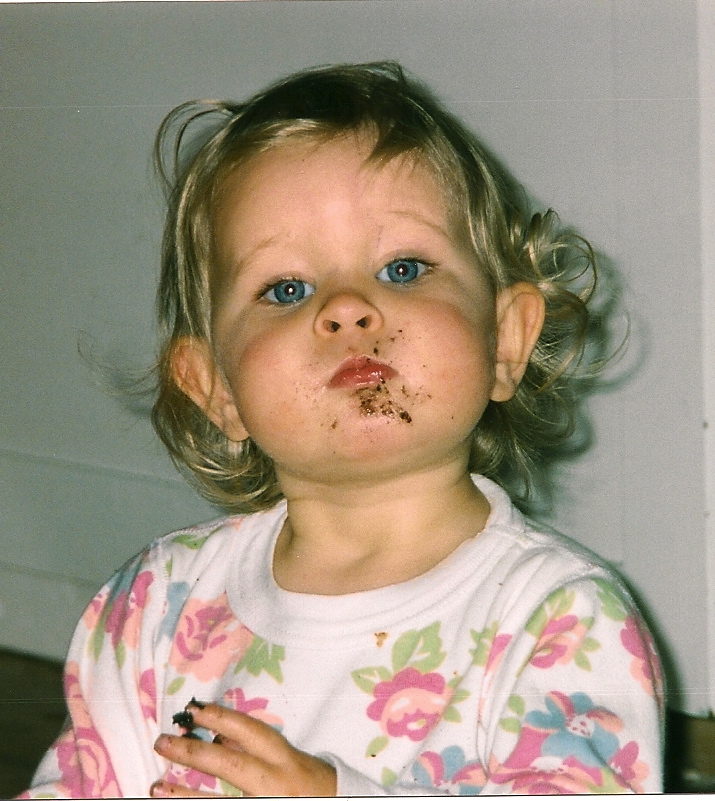
Emma – 13 months – eating a brownie.

For more on Emma’s journey through a childhood of autism, go to:  www.EmmasHopeBook.com

What is Normal – Continued

A few weeks ago while at the swimming pool with Emma, a woman asked me where she should take her two grandchildren, who were going to be staying with her.  After inquiring what the age of her grandchildren were – just a bit younger than Nic and Emma –  I began with a list of parks, (all with water features) moved on to museums, then zoos, botanical gardens etc.

At one point she pointed to Emma, who was standing near me twirling her hair around her index finger, and said, “What are her favorite things to do?”

I waited to see if Emma would respond, when she did not, I said, “Emma likes any park with water and the Central Park carousel,” I said.  As I was speaking Emma was twirling her hair and opening all the lockers in the dressing room.  Trying to engage her I said, “Hey Em.  What do you like to do on the weekends?”

Emma turned to me and said, “You have to ask Mommy.  Mommy can I go home now?”

The woman looked kindly at Emma, then with a certain amount of confusion said, “Oh!”

“Emma has autism,” I said.  “Pronouns have always been tough.”

“I would never have guessed that looking at her,” the woman said.

I put my arm around Emma and said, “It was nice speaking with you, have a lovely time with your grandchildren.”

As we left I thought about what the woman said.

Autism is often invisible.  With many children they have no discernible signs of physical issues, they look healthy, they seem “normal”.  Unless one tried to engage Emma in conversation, one would never know there was anything amiss.  Even then, I’m surprised by how often people still don’t know.  We have such a wide range of what we deem “normal” in human behavior.  I think people assume they are speaking to a neuro-typical child and so it can take awhile before they discern that they are not.  In Emma’s case she also can appear shy or perhaps people assume she’s one of those children who hasn’t been taught to be “polite” and answer when spoken to.   Many of us find it confusing to see someone who “looks normal”, only to find there are deeper neurological issues lurking.  Most people think, when first meeting Emma that she’s aloof or bored.  Sadly, many people assume she hasn’t been brought up properly and so they become rude or scolding, speak to her harshly, before I can intervene.

So what exactly is normal?

I don’t know.   But I’m not convinced it’s anything I aspire to.

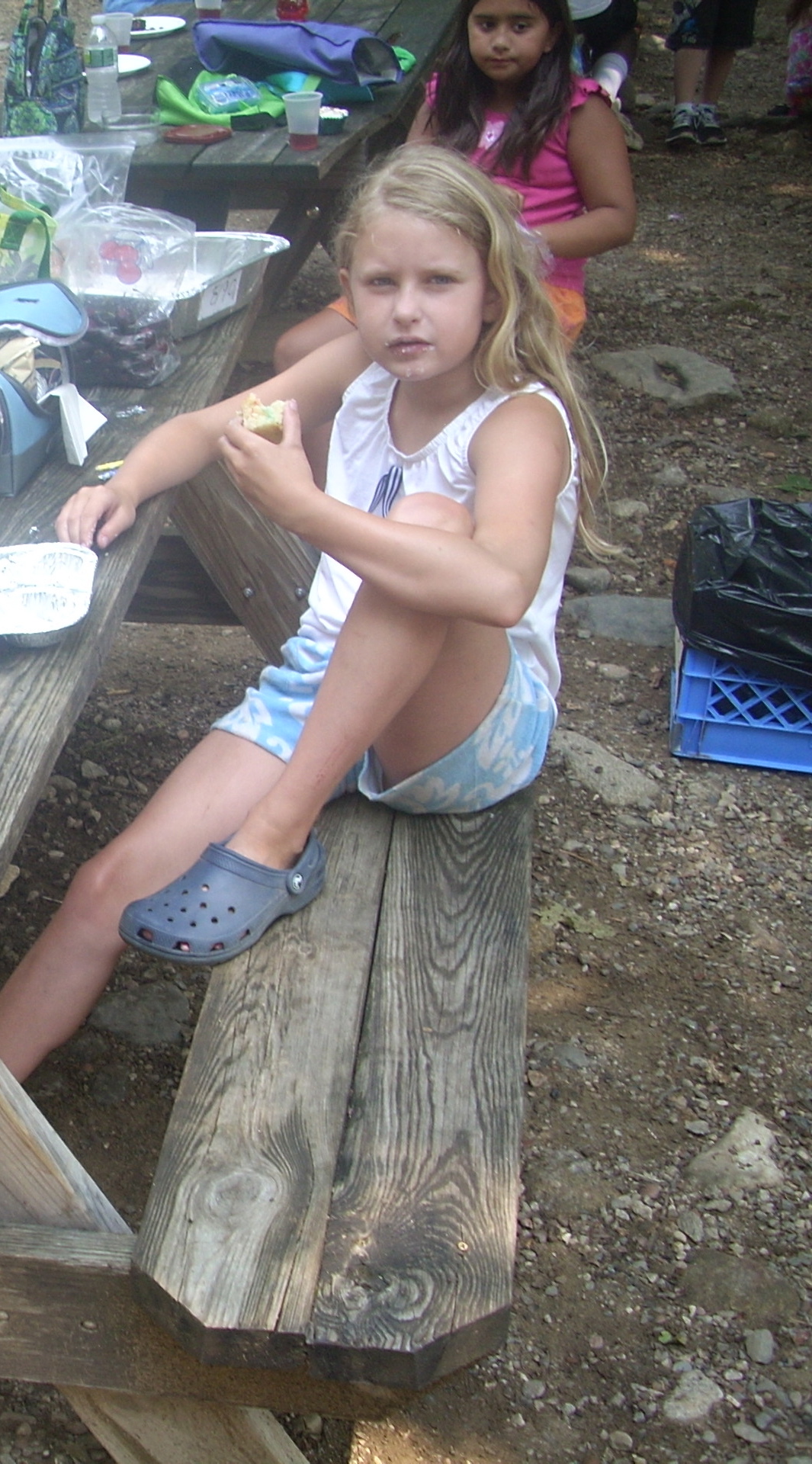
Emma eating lunch at camp

For more on Emma’s journey through a childhood of autism, go to:  www.EmmasHopeBook.com

What is Normal?

Having a child diagnosed with autism, one inevitably comes up against this question – What exactly is normal?

According to Dictionary.com – “Normal:  1. conforming to the standard or the common type; usual; not abnormal; regular; natural.  2. serving to establish a standard.  Psychology – a. approximately average in any psychological trait, as intelligence, personality, or emotional adjustment.  b. free from any mental disorder; sane.”

Autism is a neurological disorder, yet interestingly, if one goes to dictionary.com and looks up autism, the word “neurological” never shows up in it’s definition.  In fact, it is defined as:  1. Psychiatry – a pervasive developmental disorder of children, characterized by impaired communication, excessive rigidity, and emotional detachment.  2.  a tendency to view life in terms of one’s own needs and desires.”

Okay  – so the definition certainly suggests something outside of “normal”, though “a tendency to view life in terms of one’s own needs and desires” certainly describes a great many people I’ve come in contact with over the course of my life.  In fact, couldn’t one even say that this is one of the great flaws of being human?  We all tend to view our lives as our own private universe, and though we have grown to understand we are not the center of it, a great many still wish we were.

Have you ever engaged in a conversation with another person only to begin lamenting the problems of the world, our government, other governments only to conclude that if everyone just listened to us, the world would be a better place?  How many times in a relationship have you thought, if only the other person would listen to me, do as I wish, everything between us would be so much easier?

It all comes down to the degree.  I didn’t bother to look up narcissism, but I’m pretty sure people who have that tendency would fall under the second definition of autism – though the resemblance stops there.

When I think about my daughter, Emma, she is the antithesis of narcissism.  Emma is without ego.  She is also without malice.  It would never occur to Emma to tease or set out to hurt another person’s feelings.  These are not things she is cognitively capable of.  I remember the first time she told a lie, I was ecstatic.

“Did you hear her?” I asked my husband, Richard.  ”I asked her if she’d brushed her teeth and she told me she had, but when I went into the bathroom, her toothbrush hadn’t been used!”

“Things are all falling into place,” Richard said with a grin.

The idea that Emma understood that if she told me what she knew I wanted to hear, even though it wasn’t true, it might allow her to get away with not doing something she didn’t want to do, was a huge step toward “normalcy”.

I have grown to dislike these definitions and labels.  I find them utterly unhelpful.  Perhaps in the beginning when I knew nothing about PDD-NOS – the diagnosis first given to Emma when she was two – I had no idea what people in the field were talking about, and so it was imperative that I learn what these labels meant.  But now, some seven years later, those same labels do little to help us help our daughter.

For more on Emma’s journey through a childhood of autism, go to:  www.EmmasHopeBook.com

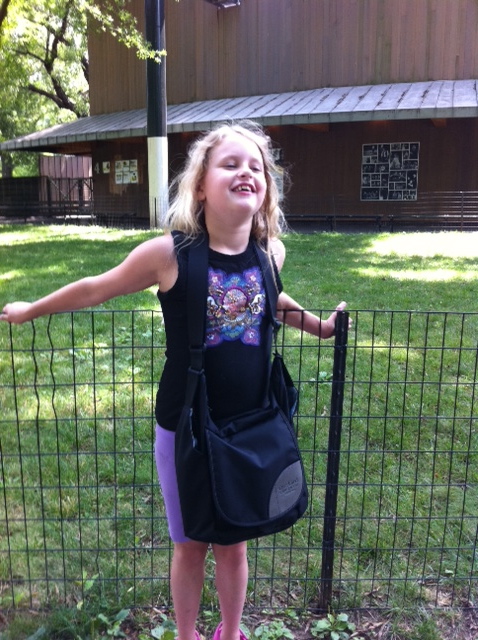
Emma in Central Park carrying her dad’s “man bag.”

Emma’s Ears – Autism

Monday night Emma was up at midnight screaming.  Her ears were bothering her.  This has been an ongoing problem for many months now.  She is highly sensitive to the changing air pressure.  As a result of Emma’s sensitivity, I too have become increasingly aware of it and am surprised that I have lived this long without noticing how often it changes, causing my ears to “pop”, as Emma describes the sensation, too.  Still, just to be safe we have taken her to her pediatrician who assured us her ears were fine and referred us to an ear specialist.  To date Emma has gone to the ear specialist three times.  Her ears are fine, we’ve been repeatedly told.  She’s just extremely sensitive to the air pressure which is constantly fluctuating.

“I need help!”  she screamed.  “Ears popping, have to unpop!  Mommy!  Mommy I need help?”

This can go on – as it did Monday night for hours.  That night she was up until past 4:00AM, I don’t know when she finally fell asleep as I eventually lapsed into a kind of restless state of unconsciousness.  When I woke it was just past 7:00AM and Emma was fast asleep, arms spread out like Christ on the cross, blonde hair fanned out on the pillow beside me.  Richard had long since relinquished his place in our bed and gone to her bed.  Merlin, preferring the rocking chair in the living room, was happily curled up away from all of us when I came into the kitchen to begin preparing the children’s breakfast.

I reminded myself that Emma used to regularly wake up at around 2:00AM only to finally fall back asleep somewhere between 4:00 or 5:00AM.  How we managed to get through those middle of the night awakenings month after month is something I cannot fathom given how exhausted I was yesterday.  The combination of crying in pain and screaming for help, help I am unable to give, is what breaks my heart.  I try to remind myself that being there, just sitting with her, even though I cannot change the air pressure, is a kind of help too.  Still it’s difficult not to feel the rising panic and accompanying helplessness that come with witnessing ones child in such obvious pain.

“Please Mommy.  You have to unplug.  Ears!  Ears!”  she continued to cry while twisting her blanket up and trying to push it down her ear canal.

“Em, try to yawn,” I told her opening my mouth in an exaggerated yawn.

“NOOOOOOOO!”  Emma screamed, pounding the side of her head with her hand.  “Nooooo!  Mommy!  Mommy!  I need help!”

It is during moments like these that I want to scream.  I want to hit the wall with my fist.  I want someone or something to help my daughter.  So I go wake up my blissfully sleeping husband, Richard and get him to help me.

“I got this,” he told me after I woke him, waving me away.  “Go back to sleep.”

Only I couldn’t go back to sleep so I followed him into her bedroom where he had ingeniously pulled out a balloon and told her to blow into it for a few seconds.  He also had the foresight to bring some nasal spray which the ear specialist had given us for her.

And while none of these things were “magical” cures for her popping ears, his calm demeanor helped settle her and me down.

“I’m going to lie down with her, you go back to bed,” I told him.  As he got up to leave, I said, “And thank you.”  To say I feel gratitude that I have a husband who is so completely in the trenches with me, who is more than willing to do his share and often does much more than that, who isn’t afraid to submerge himself in all things that make up our crazy family, would be a vast understatement.

An hour later, Emma, still in pain, but at least not screaming like an air raid siren, whimpered, “Ears still popping.  Go to Mommy’s bed?”

“Okay Em.  Come on.”  I led her through the hallway into our bedroom and climbed into bed with her.

Last night, exhausted and concerned that we might have a repeat episode, I went to sleep early.  Miraculously Emma slept until almost 7:00AM.

For more on Emma’s journey through a childhood of autism, go to:  www.EmmasHopeBook.com

“I’m Home” – Autism

When I opened the door to our loft, Emma came tearing up on her scooter shouting, “Mommy’s back!  It’s Mommy!”

As I dropped my bags and opened my arms to greet her, she sped away.  Nic meanwhile rushed up to me and threw his arms around my waist.  “Mommy!” he cried, “It’s so good to have you home.  I missed you so much!”

As I hugged Nic and then Richard, I said to Emma, “Hey.  I want a hug from you too.  Come over here, Em!  Remember?  Put your arms around and …”

“Squeeze!”  she shouted, while complying.  She peered up at me, with an odd expression on her face.  Then she pointed to my face and said, “It’s Mommy.  Mommy came back,” as though she hadn’t been sure I would.

“I’m back Emmy.  It’s so good to be back.”

“Yeah, Mommy came back.  Mommy stayed at Granma’s house.  Mommy had to go away,” she said, nodding her head sympathetically.

“It’s okay, Em.  Now I’m home.  I’m not going anywhere.”

Nic then played five different songs on his new Alto Sax for me, two new songs which he composed for the piano and then plugged his electric guitar into his amp and riffed on several more.  Emma scooted around on her scooter and eventually it was time for everyone to go to bed.

“Mommy come to Emma’s room,” Emma said, taking me by the hand.

“Yes!” I said following her.

“Mommy’s back,” Emma whispered as she snuggled down under her blanket.

“Yes, Em.  I’m home,” I said stroking her cheek.

Later Nic expressed his upset that I was away for almost three weeks.  He was able to tell me that he didn’t like that I was gone for such a long time.  But Emma…  Emma doesn’t have the words to express her upset nor does she have the ability to ask me why I was away.  I can only hope she understands I had to go for work, but I don’t know that she does understand.  When she looked up at me earlier it was with a mixture of shock at seeing me again and happiness.  I don’t know whether I’m reading more into her expression than was actually there, but given that she isn’t able to ask me, who knows what reasons she applied to my absence.

“Go swimming with Mommy,” Emma whispered.

“Yes,” I said.  “We’ll do that tomorrow.”

“No, not going to go back to Aspen,” she said, holding my hand.

“Nope.  Tomorrow we’re going to spend the whole day together.”

We were quiet then.  “Mommy sing?” Emma said after awhile.

“Sure, Em.  Which one – Swing Low, Sweet Chariot or Summertime?”

“Swing Low first, then Summertime,” Emma said.

“I love you Em,” I whispered.

“So much,” Emma finished.

For more on Emma’s journey through a childhood of autism, go to:  www.EmmasHopeBook.com

“Go Back” – Autism

Last week Emma began crying and said, “Go back to hotel.”  Richard felt she was missing me, as I had to leave my family to return to Colorado for work when we left California instead of returning with them to New York City.  We also felt she was wishing we could have stayed longer and spent more time with my extended family, all of whom she loves being with.  She had such a wonderful time with so many family present at the Bed & Breakfast in Napa, California where we stayed for my brother’s wedding.

There’s a mistaken thought by many people that because a great number of children and adults with autism cannot express themselves well and often do not show tremendous emotional attachment to those they love, that they do not love.  Some people believe they do not feel the same intensity of emotion that we neuro-typicals do.  I disagree with this thinking.  I believe Emma loves and misses people as much as any neuro-typical child.  I believe she misses them with the same aching as any of us do.  The difference is, Emma doesn’t have the same neuro circuitry or the ability to put into words her feelings.  She lives in a world that must be incredibly confusing so much of the time.

I wonder, when I get on the phone with her, how much does she understand?  Does she understand that I am in Colorado and not in New York with her, Nic and Richard because I have to work?  Because time is a difficult concept for her, does she really understand when I will be returning?  When she wakes up in the morning does she wonder if I might be there only to find I’m not?   Our phone conversations are limited.  When speaking with Nic, I can reassure him that I will be home in another couple of weeks.  We can discuss what he did, he can describe the breakfast he fixed for his dad yesterday for Father’s Day.  We can talk about things.  With Emma, who does not and cannot ask questions, I ask – How are you?  She tells me she’s fine, even if she isn’t, because it’s the conversation we always have on the phone.  She may add some random thing such as – “Seal park, Chelsea piers carousel” and I can deduce that Richard took the children there yesterday.  I always ask her – What did you do today?  To which I can receive an accurate list of what she did, but just as easily I can receive a somewhat confusing version of events that may or may not have taken place.  I then will verify with Richard to get a clearer idea.

Yesterday was Father’s Day and Richard spent it with the children.  There was no sleeping in for Richard as I’m not there to give him a break.  Nic made him a special breakfast and then Richard took the children to various parks.  I know it wasn’t the day Richard would have liked.  I know how hard it is being the sole parent taking care of everything, especially for such an extended period of time.  And particularly tough when it’s a day designated to celebrate fatherhood.  When I spoke to Emma yesterday I said, “Be sure to tell Daddy – Happy Father’s Day and give him a hug, Em.”

“Happy Father’s Day,” Emma said into the phone.  I have no idea where Richard was or if he overheard her.  I can only hope he did.  I know Emma loves her dad.  She isn’t able to express it in the typical ways we are used to, but she does.

For more on Emma’s journey through a childhood of autism, go to:  www.EmmasHopeBook.com

Amusement Parks & Autism – Continued

Emma’s entire system was crashing.

“You have to ask Mommy!  Mommy can I go on the roller coaster with Gaby, please?”   She cried over and over again through screams and tears.

It was heart breaking and anyone with a neuro-typical child would think – oh just let her go on it one more time and then go home.  I even thought this a number of times as I tried to peel her off the pavement where she had fallen in a heap of tears, snot pouring from her nose, her hands made into tight fists while hitting herself in the head, on her chest, legs, arms wherever she could before I, or any of us could stop her.  The biting is horrible because it can break the skin and then there’s blood, and later scabs and enormous angry blue and purple bruises that can last for more than a week, reminding all of us of her agony.  But the hitting – a quick, violent punch to the face is shocking to witness and as a parent, it’s difficult not to feel one has done something horribly, horribly wrong.  How can this sweet, blissful child do this to herself?

Emma waiting for Joe, Nic and Gaby while they ride on the Corkscrew

Richard and I have always said to the children – hitting is wrong.  We don’t do it, we don’t want them to ever do it to each other and until Emma began hitting herself, it hadn’t occurred to us to add – we don’t hurt ourselves.  We don’t hit others or ourselves.  We say it, but I don’t know that it makes a difference.  When Emma’s brain has become set on something, no amount of calm, reassuring logic seems to help her.  No amount of soothing, we just have to vacate the premises.  It’s our only hope.  Kind of like shutting the whole system down, a kind of reboot.  We have tried the other option, which is to let her go on one more ride or do whatever it is one more time and the misery, the abject misery continues.  Like an addict who has to have that drink or that drug even while bringing them no real solace.  There’s no relief to be had at a certain point.

“Emmy it’s going to be okay.  We’re going to go home now.  We can ride the little roller coaster one more time and you can sit with Gaby and then we have to go home,” we told her.

But Emma’s brain couldn’t take in this information it was already in lock down mode.  I gave her a banana to eat and then everyone, our once cheerful little group, now more weary warriors than a family intent on having a lovely day at an amusement park trooped along.  She was able to sit with Gaby on the little roller coaster for one last ride and then we trudged back to the car while Emma kept looking over her shoulder at the wooden roller coaster named Roar.  As we headed home Emma said, “It’s okay, we’ll come back tomorrow.”

“No Em.  Tomorrow we’re going to traintown where there are different rides and then we’re going to Uncle Andy’s wedding,” we told her.

“Different rides,” Emma repeated, sadly.  “We’ll come back soon,” she said.  There was a wistful tone to her words, and we knew it wasn’t likely that we would ever come back to this part of the world.  But there would be other amusement parks and maybe one day Emma’s massive sensory issues will have abated to such a degree that these kinds of episodes will become rarer.

We can only hope.

For more on Emma’s journey through a childhood of autism go to:  www.EmmasHopeBook.com

Emma’s older brother, Nic

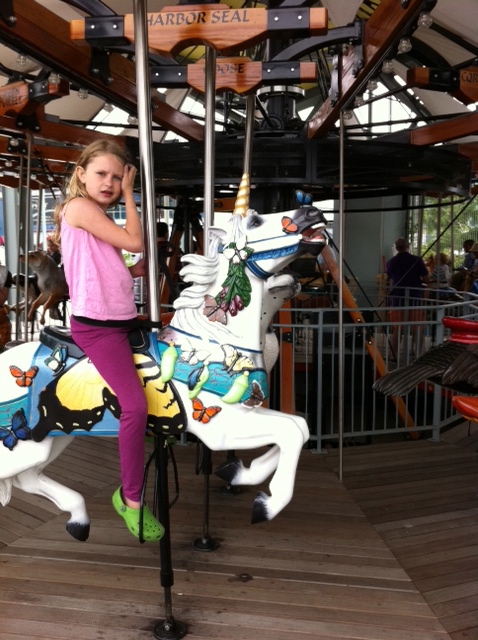
Yesterday I took Nic and Emma to a relatively new carousel on the refurbished park along the Hudson River.  It’s unlike other carousels in that it has a wide variety of animals, fish and insects instead of the traditional horses one usually sees.  Emma likes to ride on the Atlantic Sturgeon, with the Unicorn and Wild Turkey coming in second and third.

Emma riding on the unicorn

I’d ride on the hyena or the coyote,” Nic told me when Emma chose the Atlantic Sturgeon for a second time.  “What would you ride on?”

“I’d have to go with the Harbor Seal,” I answered.

“Yeah, that would be a smooth ride,”  he said.  We watched Emma go around and around.  Every now and again she’d use the waist strap to tap the sturgeon, as though she were urging it on.  “Mom?”

“Yeah Nic?”

“So how do you blow bubbles with your gum anyway?”

“Okay, here I’ll show you,” I said, taking a piece of gum from his remaining pack.

“Emma blows huge bubbles.  I just don’t get it,” he said as I chewed the gum, trying to get it to the right consistency.

“Well she chews a lot of gum…”

Nic interupted me, “Yeah, I know, because of her ears.”

“Exactly, so she’s had a lot of practice.   But here, watch.”  I tried several times to demonstrate how to blow a bubble, which is quite a bit more difficult to explain than one might think.

After several attempts Nic said, “I think it’s a girl thing.”

We watched Emma for awhile on the carousel.

“Hey Mom?”

Yeah, Nic?”

“It’s weird.”

“What is, Nic?”

“I mean Emma’s so good at some things, but so bad at others.  Like she can blow bubbles and taught herself to swing and she’s really good on the scooter, but she still can’t read or write very well.  I think it’s interesting,” he said.

“Well, you’re right Nic.  There are things that are much easier for her and then lots of other things that are really hard.”

“But I don’t get it.”  He looked at me expectantly.

“Yeah.  I know.  It’s difficult to understand.  It’s the wiring in her brain.  It makes a great many things really, really difficult for her.”

Nic kept trying to blow bubbles with his gum.

“Does that make sense?” I asked.

“No,” he said, shaking his head.  “Not really.”

“Yeah, I know.  It’s really hard for us to understand.  There’s so much more we don’t know about autism than there is we do.”

“Mom?”

“Yeah Nic?”

“Do you think I’ll ever be able to blow a bubble?”

“Yes.  You just have to keep practicing.”

“But you don’t let me chew gum that much.”

“Yeah, that makes it harder.”

Nic stared at me with a little half smile on his face.

“Hey, you get to do all kinds of other things that Emma doesn’t get to do, and the only reason we let her chew gum is because of her ears.”

Nic kept grinning at me.

“What?”

“Nothing, Mom.  Nothing.”

For more on Emma’s journey through a childhood of autism and her older brother, Nic’s experiences along the way, go to: www.EmmasHopeBook.com

Que Sera, Sera

I’m the silent partner. On Emma’s Hope Book anyway. It’s been a long time since I posted an entry. Ariane has always been the driving (and writing) force of Emma’s Hope Book, but I’ve been completely MIA lately. I went on interferon/ribovirin treatment two months ago. I knew the side effects were going to be extreme, but it turned out to be much worse than I could have imagined – one of those cases where if the disease doesn’t kill you, the cure will. I was basically an invalid, physically and mentally. I had to quit the treatment just so I could function and it took a month before I felt well again.

Ariane did an amazing job holding down the fort while I was laid up. She does an amazing job all the time. I’m very lucky and very grateful. Frankly, it’s been a rough patch for all of us lately. “We’ll get through this,” Ariane said a few minutes ago, kissing the top of my head as she scurried back and forth, preparing for a jewelry trunk show.

“Yep,” I nodded, “we always do.”

Of course, exactly what “this” means is open to debate. I guess it means “today”, because our lives never seem to get less complicated, difficult or worrisome for any significant length of time. This is true of any family I imagine, but Emma’s autism contributes greatly to our never-ending “whack-a-mole” game.

Her progress with language, reading and writing continues at a steady pace – a daily miracle from my perspective. Yet at the same time, she has had a recurrence of her difficulties with being able to go to the bathroom, which we thought was long behind us. Two steps forward, one step back.

I finished my novel a while ago and it is being shopped around by my agent. Ariane submitted a proposal for a book about Emma and our family. Both of us are stressed, bracing ourselves and hoping for good news. The day before I went on the interferon treatment, a conflict with my business partner developed that seems irresolvable, adding to the career pressure. Obviously, I would prefer to have enough success as a writer to provide well for the family, just as Ariane would like her jewelry business and her own writing efforts to be wildly prosperous. I’m sure they will be. It’s a lot easier for me to have faith in Ariane’s talents and potential for good fortune. I come from Irish stock.

Every night for the last week Emma has gone to bed listening to a CD of lullabies recorded by the talented and lovely Alycea Ench. The first song is “Que Sera, Sera.”

The second is “Somewhere Over the Rainbow.” I sit in bed with Emma and listen to these incredibly poignant melodies and lyrics, so full of hope and unattainable longing. Do they speak to Emma with the same desperate yearning I hear? Does she question whether she will ever have a chance to experience the normal phases of life the rest of us take for granted? Or does she just like listening to the Alycea’s lovely voice as she sings:

Que Sera, Sera

When I was just a little girl

I asked my mother, “What will I be?”

“Will I be pretty? Will I be rich?”

Here’s what she said to me:

Que Sera, Sera

Whatever will be will be

The future’s not ours to see

Que Sera Sera

What will be will be.

When I was young I fell in love

I asked my sweetheart, “What lies ahead?”

“Will we have rainbows day after day?”

Here’s what my sweetheart said:

Que Sera Sera

Whatever will be will be

The future’s not ours to see

Que Sera Sera

What will be will be.

Now I have children of my own

They ask their mother, “What will I be?”

“Will I be handsome? Will I be rich?”

I tell them tenderly:

Que Sera Sera

Whatever will be will be

The future’s not ours to see

Que Sera Sera

What will be will be.

Somewhere over the rainbow

Somewhere over the rainbow

Way up high,

There’s a land that I heard of

Once in a lullaby.

Somewhere over the rainbow

Skies are blue,

And the dreams that you dare to dream

Really do come true.

Someday I’ll wish upon a star

And wake up where the clouds are far

behind me.

Where troubles melt like lemon drops

away above the chimney tops.

That’s where you’ll find me.

Somewhere over the rainbow

Bluebirds fly.

Birds fly over the rainbow.

Why then, oh why can’t I?

If happy little bluebirds fly

Beyond the rainbow

Why, oh why can’t I?

As Ariane said yesterday in her post, unless Emma is stressed out about one of her OCD issues or unable to attain her most basic needs, she is so incredibly happy in the moment. Blissful. So I doubt very much that she questions what the future holds in store for her — any more than she wonders what lies over the rainbow. She is here. Now. It is Ariane and I that so achingly desire for her to feel and experience all the things kids her age normally go through: having friends, playing games, chattering back and forth.  And as she grows older: dating, falling in love, raising her own family.

Just trying to imagine that kind of normal life for Emma and the rest of us is almost impossible for me. As I write this, I cannot clearly picture it. Even as a fantasy, this truly lies over the rainbow. But even if I can’t visualize it, I have never lost hope that it is possible. In fact, I believe with all my heart that it will happen — someday, somehow – and our little bluebird will fly.

In the meantime, we will get through this — today. As for tomorrow? Que, Sera, Sera.

Emma’s State of Bliss

It was this state, this blissfulness in Emma that caused us tremendous existential concern.  When Emma was first diagnosed she was two, just three months shy of her third birthday.  She was an exceedingly happy, though quiet and increasingly isolated child.  If left alone, she was content to putter around, seemingly unaware of dangers, which led her to cross the street without looking, wander into a raging surf at the beach, go off by herself never looking back to see if anyone knew or was following, etc.  When one of us tried to interact with her, she immediately made us aware of her displeasure – we were rejected, pushed away.  Emma was happiest in the company of herself.  It was this state of apparent blissfulness, we realized, we would have to break through in order to have any hope of connecting with our daughter.

Parents often describe their child diagnosed with autism as “slipping away” from them, the bizarre sense that their child “was disappearing” or “fading.”  These are the words we use to describe the inexplicable distance and disconnect we feel from a child who appears not to need nor want anything from us or the world.   These words cannot adequately describe the inexpressible grief, the feelings of impotence that inevitably arise from parenting such a child.  The bizarreness of Emma’s “autism” is beyond description.  Our decision to break into Emma’s state of bliss was not without land mines.  We were aware that the world we wished her to enter (ours) was both a selfish desire on our part, but also selfless, in that if we didn’t, it seemed likely she would only sink deeper into a world of her own making, isolated, alone and silent, making it impossible for her to survive.

I am reminded of the poem by John Donne – “No man is an island entire of itself; every man is a piece of the continent, a part of the main…”  That she was unaware of this, seemingly incapable of grasping what this meant was something we knew we would have to teach her.  It is something we continue to work on.

Emma’s sixth birthday

For more on Emma’s journey through a childhood of autism, go to:  www.EmmasHopeBook.com