Tag Archives: autism children

The Comedian

Emma is a bit of a clown if she’s given any encouragement.
The other night, Emma nodded her head, while pursing her mouth in a kind of lopsided pucker and said, “I know.  You can’t go on the bike carousel.  It’s closed.”  Her tone was one of sorrow, as though she were sympathetic to the situation, but that it was ultimately beyond her control.  “I know,” she repeated.  “You have to wait.  It’s too cold for the bike carousel.”

Forget that I don’t know what “bike carousel” she was referring to.  The only one I know of is in Battery Park and it most certainly was too cold and snowy to go there.

Emma often carries on whole conversations with herself playing the role of child wanting to go somewhere and benevolent authority figure telling her she cannot do whatever it is.  There is a kind of mimicked sadness as she tells herself she cannot do something and even provides herself with perfectly plausible reasons why whatever it is, can’t be done.  It’s what they call in tennis, playing both sides of the net.

“I want to go on the bike carousel!”  Tone high-pitched, demanding, her face animated even lit up with anticipation and then the response, “I know.”  Sadness, apologetic, followed by the reason why this is impossible,  “You cannot go on the bike carousel, it’s too cold outside.”  Then she adds the facial expression with her mouth twisted to the side, puckered lips and the nodding of her head – it’s almost impossible to witness this performance and not see the comedy in it.

The other day we were all in the elevator with Emma when she went through a similar routine,  “I’m sorry,” she said.  “You cannot go on the swings.  That swing is for babies.  You’re too big.”  This last was said with a stern, though sympathetic tone.  “I want to go on the big swing,” this was uttered in a higher pitched voice.  “I know,” she said, nodding her head and giving the look, which made all of us start laughing.

“Emmy, you can’t go on the baby swing!  It’s too cold!” we said.

“I know,” she said sadly, nodding her head again.  It seemed there was a tiny hint of a smile though as she said it.  “You’re too big!”  Then she laughed.

“Em, make that face,” Nic prompted the other night.  He was referring to her puckered lopsided nodding of the head face.  But instead she just looked at him.

“Nicky!” she said sternly.  “Nicky!  Stop talking!”

“Hey Emma, go like this,” I encouraged, mimicking her expression.  When she finally complied she did it and then seeing all of us laughing she joined us and began laughing too.  “I love that expression, Emma.  You’re funny,” I told her.

“It’s funny,” she said.

On another occasion Emma burst into hysterical laughter for reasons none of us could decipher.  “Hey Em.  What’s so funny?” I asked.

“Justice!  Justice slammed the door,” she said before collapsing into peals of laughter.

“Was Justice being funny?” I asked, hoping to get more out of her.

“Yes!” But the moment was over and she wandered off.  Whatever scenario she was remembering, it was one we couldn’t share with her.

A few weeks ago when Richard and I went to her classroom with cupcakes to celebrate her birthday with her classmates we met Justice.  He and Emma sat together during story time.  On occasion one of them would reach over and stroke the others hair.  It was adorable.  Clearly they feel tremendous affection for one another and it was wonderful to see.  Then Justice began singing in a high pitched gravelly voice, making the teacher admonish him for making her ears hurt, as he and Emma laughed and laughed.

“No Braid!”

Combing through the tangled knot that was Emma’s hair this morning, she cried, “I don’t like hurt.  Ouch, use brush.”  She grabbed the brush next to her and began brushing her hair.  Only Emma’s “brushing” her own hair consists of placing the brush arbitrarily on some portion of her head and pulling down, which is fine if her hair isn’t tangled.  If her hair is tangled, as it was this morning, Emma’s attempts to brush it, only serves to make it more so.

“Okay, Em.  I’m sorry, I didn’t mean to hurt you,” I said, plying the brush from her.

“It doesn’t hurt,” Emma responded.  Which meant it did hurt.

“Here, I’ll use the brush, see?” I said, being careful to not pull on her hair.  How about I make a braid today?”

“NO!  No braid.  Ponytail!”  Emma cried grabbing the brush again.

“Okay.  How about I make pigtails?” I asked.

“Yes.  Pigtails!” Emma said.  She made her hand into a fist and put each fist on either side of her head, indicating where she wanted the pigtails.

“Perfect.  I’ll do that,” I promised.  After I put the pink frilly hair ties in place I said, “Let me see!”

Emma turned toward me and tossed her head from side to side making her hair whip around.  With a huge grin, she shouted,  “Pigtails!”

“Oh Emma you look great.  I love those pigtails.”

“You’re so pretty!” Emma said jumping up and down.

“Yes you are.  Now let’s go brush your teeth.”

When we went into the bathroom, Emma looked at her reflection in the mirror.  “Look at you!” she squealed, grinning at herself.  “You’re so cute!”

As we left to catch her school bus, Emma carefully put her hat on over her pigtails, only the pigtails were so high on her head it made her look as though she had little horns.  I smiled at her as we got into the elevator.

Emma jumped up and down and waved her arms while making a kind of whooping noise, something she does when she’s excited.

“Are you happy?” I asked, smiling at her.

“Are you happy?”  Emma repeated.   After a pause, Emma shouted, “YES!”

“Why?”

Answering “why” questions is usually quite difficult if not impossible for many autistic children.  Emma is no exception.  Usually a conversation, which starts with “Why?” ends as abruptly as it began.

“Hey Em, why do you want to do that?”  “Why do you want to go there?”  “Why are you screaming?” “Why are you sad?” “Why are you hitting yourself?” etc.

99.9% of the time when asked “why?” Emma will either – walk away, not answer or will answer by repeating the question.

“Why?” Emma will respond in a high-pitched voice edged with anxiety.  “Why you hitting,” or “Why want to?”

Repeating the question does not produce positive results.  Repeating the question in a louder voice also does not make a difference.  After all there is nothing wrong with Emma’s hearing.  She hears the question she just has a difficult time responding.  So it was noteworthy when Emma responded to a “why” question the other day.

Emma wanted to have a pair of scissors so as to cut the gym mat we had tied around a standing beam for Nic to use when practicing his karate punches and kicks.

“Emma why do you want to take it down?” Richard asked.

“Because I want to jump into the swimming pool,” came Emma’s surprising response.

Now many of you reading this may be confused by her words, but to us, who understood she meant she wanted to turn the multi-colored gym mat on it’s other side, which happens to be all blue, and pretend it’s a swimming pool, we were in shock that she answered a “why” question and answered it so beautifully with a clear, concise, complete sentence.

When Richard told me I couldn’t believe it.  “Really?” I said, barely able to contain my excitement.  “Really?  She said because?”

Richard nodded his head.

“But that’s amazing!”

“Yup,” Richard said.

So Richard cut the mat down, told her to put on her swimsuit and let her “dive” into the “swimming pool”.

Ah life at the Zurcher-Long’s… it just never gets boring around here.

“Caesar Stop the Music!”

These are the words Emma sings, to the Rihanna song, Please Don’t Stop the Music, which despite our corrections, she insists on singing her way.

“Emma!  It’s not Caesar, it’s Please don’t stop the music!”  We have said on more than one occasion.

Often she will correct herself, only to return to – “Caesar stop the music”, and then she’ll laugh and continue the song.   “Caesar stop the music, Caesar stop the music, Caesar stop the music, Caesar stop the music!”

What follows is pretty garbled and since I don’t know the words to the song, impossible for me to decode.  But after the garbled words she will usually hum, keeping the tune intact, before singing, “I wanna take you away, let’s escape…” more garbled words and humming, before launching into the grand finale, “Caesar stop the, Caesar stop the, Caesar stop the, Caesar stop the music!”

This is Emma at her silliest and yet most endearing.  I know she knows the lyrics.  We’ve corrected her dozens of times.  I know she can say the correct words as I’ve heard her on rare occasion say them.  But “Caesar stop the music” is the way she prefers to sing the song.

That Emma “plays” with words – although that may be a gross misreading of what is actually going on – is something I’ve always found fascinating.  As a toddler, she would say things none of us could understand, but over time we were able to decipher.  Often they were nonsense words, which in no way resembled the actual word used for the object she was referring to, such as “Cokie” for blanket.  For months we thought she was asking to eat a cookie.  And then there are the words she uses to describe things, a kind of poetic beauty, as when she called rain, “bubbles”.  There is a literalness to that – if you examine the rain as it falls from the sky it does resemble tiny bubbles and when it falls to the ground it will often form a bubble, but it isn’t something I would ever have come up with.

Emma also uses words, both descriptive as well as strangely similar to the actual words as she does with the stars in the night, “sorry bubbles”, “cheese solos” for cheese doodles.  It’s interesting to note, for a child who is so literal she cannot come up with a name for her baby doll, but instead calls her, “baby” or “doll” or “girl” that Emma creates such unusual words to describe other things.  It is, perhaps, this literal application to things which we take for granted or do not even notice that makes her choice of words so interesting.

As always I am left wishing I could be inside her body and mind for an hour to feel, hear, see and experience the world as she does.

Emma’s Birthday

Emma and Martin Luther King share a birthday.  It remains to be seen if they will share anything else.  Perhaps one day Emma will be a persuasive speaker perhaps she too will express her abhorrence of violence and injustice.  It’s impossible to know, as Emma is autistic.

Yesterday Emma turned nine.  She has a lifetime ahead of her to tell us what she cares about and how she feels about things.

On Sunday we had a party for her and despite my concern that few children were able to make it, it turned out to be lovely and Emma had a blast.  A number of our friends made the effort to come to the gym we rented for an hour and a half and afterward a group of us returned to our place for gumbo and birthday cake.  Emma was ecstatic – not so much with the gumbo, which she didn’t eat, but the gymnastics party, her guests, the birthday cake, complete with candles and song and all the attention.

Later, Emma disappeared into her bedroom.

“Mom!  Mom!  Look!” Nic yelled.

“You have to see this,” Richard said from the doorway into Emma’s bedroom.

There Emma was, sitting up in her bed, wearing a pair of brand new birthday pajamas, her head resting on a new matching pillow and a padded eye cover around her neck.

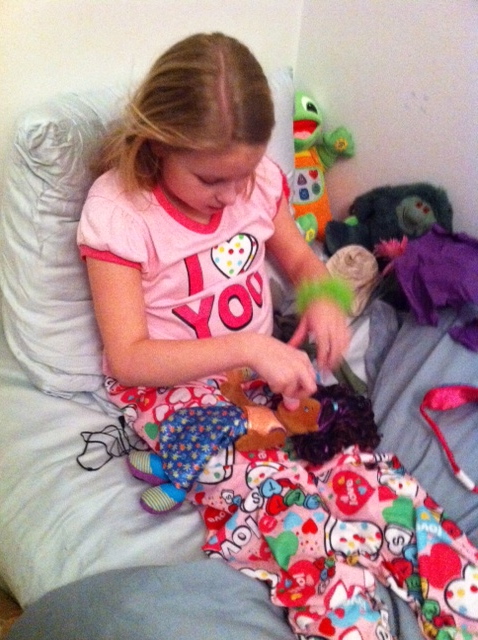
Emma wearing her new PJ’s

Several of us crowded into her room, like subjects attempting to catch the attention of a queen.  We “oohed” and “aahed” as she opened each gift presented to her one by one by her brother, Nic.

Emma feeding her new “Geneva” groovy girl

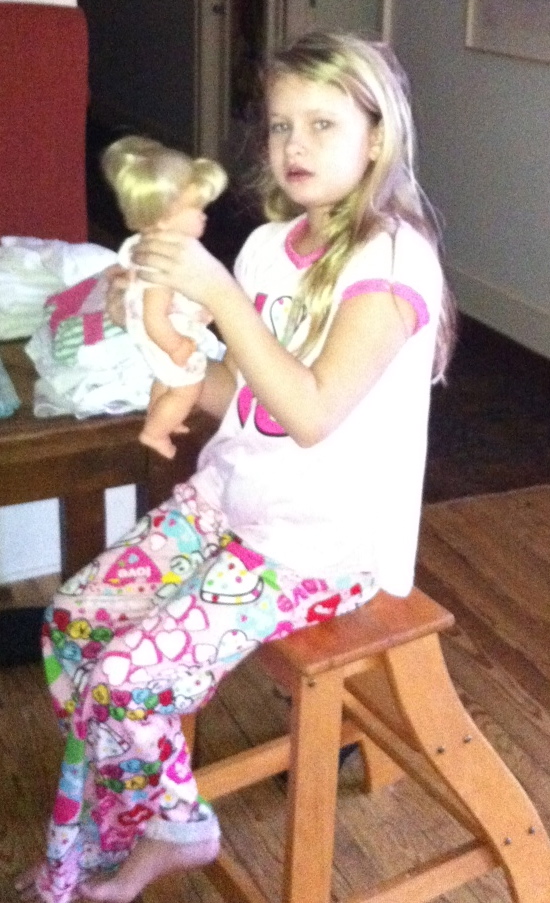
Emma Monday morning with her new baby doll

Now for most parents all of this must seem rather mundane and hardly worth documentation, particularly documenting to the degree we have.  But for Emma, this was a first.  It marked the first birthday she took any genuine delight in opening her gifts and once the gift was opened, took actual pleasure in playing with each present.  Emma sat happily in her bed, her admirers clamored around in adoration, Nic raced back and forth carrying each gift to her as if it were the Holy Grail itself.

And perhaps to Emma, it was.

Wake Up Calls

Last night Emma came into our bedroom every few hours.  The first time was just after midnight, then again at 2:30AM or thereabout, again sometime after 3:00AM and once more, only I was so tired, I can no longer remember what time it was.  The last time she came in, standing beside the bed and looking at me, we told her she had to go back into her room and that we would come get her when it was time to wake up.  When she left, whispering, “Mommy, Mommy come into the other room,” I stayed awake waiting for her return.  Only she didn’t return.  She went back to her room and managed to fall back asleep, something I was unable to do.

So I’m tired.

And when I’m tired things can look a bit bleak.

I know this about myself.

This post is therefore about countering that exhaustion induced bleakness with a more balanced view of Emma and how far she’s come in the last year.

At this time last year, Emma was still wearing a diaper at night.  She was often awake in the middle of the night, unable to go back to sleep without one of us, usually me, lying next to her for the remainder of the night.  Or she would come into our bed, forcing Richard to sleep in her twin bed in her bedroom.  The feeling of utter exhaustion I am currently experiencing was commonplace a year ago.

In addition to the nocturnal awakenings, Emma had a habit of sucking on a strand of her hair, returning home with an encrusted lock, which I had to soak in lukewarm water before brushing out.  Emma was unable to shower by herself, brush her teeth, floss or brush her hair and needed reminders to go to the bathroom. Emma showed no interest in most toys and her language was not as complex as it is now.  Her utterances were in the three to five word category and often were difficult to understand.  Her difficulty distinguishing between pronouns such as “you”, “me”, “I”, “him” and “her” was all too apparent.  More often than not she referred to herself in the third person and often referred to others by calling them – “Emma”.

In the last few months, Emma has become enthralled with one of her baby dolls.  Each night for the past week, she comes home, bathes and washes her baby doll’s hair with shampoo, then wraps her in a towel and puts her to bed.  Her pretend play continues to be somewhat literal, in other words she doesn’t pretend to talk for her doll, she isn’t able to “name” her dolls beyond calling them things like:  doll, girl, baby, etc.  But Emma is showing an increased interest in playing with them, taking on the role of “mother” and spends longer periods doing “motherly” things with them.
This is the first year Emma has shown even a remote interest in Christmas and likewise with her birthday.  She has been talking about her birthday and the party we are giving her for over a month now.  Sadly, few children are able to come to her party, as it falls on a three-day weekend and almost everyone is busy or away.  But despite this, we are making sure she and her birthday are celebrated.

Sometimes it takes exhaustion and numerous wake up calls to remind me of just how far Emma has come.

Returning Home

When I finally returned home – after midnight – I crept into both the children’s rooms and stood at the foot of each of their beds for a moment.  Emma lay sprawled out one leg thrown over her duvet despite the cold, one hand clutched a shred of her blanket.  I watched her for a moment, her blonde hair fanned out on the pillow, her chest rising and falling with each breath.

Richard and the children returned to New York the week before me, though it felt as though I hadn’t seen them for a month.  The next morning Emma appeared in our bedroom at 6:29AM.  “Hi Mommy,” she said pointing at me.  “It’s Mommy!  Mommy’s back!” she cried, before climbing into bed beside me.

“Emmy!”  I answered, hugging her.  “It’s so good to see you!  I’ve missed you.”

“Missed Mommy!” Emma said.  Then she gave me a kiss on my cheek.

The following night I read to Emma before turning out the light and leaving.  Emma began breathing rapidly and making little panting noises, expressing her distress at my leaving her.

“It’s okay, Emma.  I’m not going anywhere.  I’ll be in our bedroom when you wake up tomorrow morning,” I tried reassuring her.

“Mommy!  Mommy stay!”  Emma cried.

“Em, I’m not going anywhere,” I repeated.  I’ll be right here.  It’s okay.”

Unconvinced, Emma pointed at me, “You,” she said, then pointed to herself, “and me, in Emma’s bed.”

“Okay Em.  I’ll stay here for a few more minutes and then I’m going to go into my own room.”

By the time I left her, it seemed she had finally fallen asleep, only fifteen minutes later she appeared in our bedroom.  “Mommy!”  She cried.

“It’s okay Em.  I won’t leave.  I’ll be right here when you wake up.”

“Mommy come.  Mommy come into the other room,” Emma pleaded.

I returned her to her bed and sat with her for close to an hour before telling her I was going to go into our bedroom, that I was going to be there when she woke up, that I wouldn’t leave.  “Okay,” she whispered.

Within five minutes she was back in our bedroom crying for me.  I knew how distressed she was.  I knew she was worried I was going to leave again.  I knew she just needed reassurance and eventually she would understand that I wasn’t going anywhere.  But I was also utterly exhausted and by this time it was after midnight.  I could feel my patience dissipating.  “Emma, you have to go back to your bed.  You have to trust me that I’m not going to leave.  I will be here in the morning.  I have to go to sleep now and so do you,” I said.

When Emma didn’t return to her bed, but instead stood staring at me unconvinced, I got up and said, “Emma!  Go to bed NOW!”

Emma turned away.  “Mommy come!”

I followed her into her room, sat on the edge of her bed and said, “Don’t worry, Emma.  I’ll be in the other room when you wake up.  I promise.”

“Okay,” Emma said, holding my arm tightly.

“It’ll be okay,” I said.

Emma nodded her head, “It’ll be okay,” she repeated, not letting go of my arm.

Emma’s Birthday

This coming Sunday we are giving Emma a birthday party.  In years past this has been a dubious endeavor, often met with initial excitement on Emma’s part, only to end with complete indifference or worse.

When Emma turned four, we hired a musician to come to the house and play kid friendly music before eating pizza and cake.  Emma spent the entire hour and a half trying to lie inside the musician’s guitar case, while Richard and I tried, with little success, to entice her to join the party.  The other children, many of whom were also diagnosed with autism, ran around, danced, sang along with the music or sat watching and listening with their mother or caregiver.  Richard and I took turns excusing ourselves and each went separately into our bathroom where we allowed ourselves a few minutes to cry, before mustering up the strength to return to our guests, doing our best to act as though everything was fine.

It was also the year we had been called into a parent/teacher conference at her special education pre-school only to be told our daughter was a “red flag” and that she had “flat-lined” in her development.  It was a tough year.  A year Richard and I still refer to when we feel doubtful of Emma’s current progress.  That year marked a time of desperation, sadness and a general feeling of impotence on our part.   It seemed whatever therapy we tried, whatever medical interventions we took on, nothing made a difference.

This year, Emma not only told me where she wanted to have her party she also told me which of her friends she wanted to attend her party.  Before she left Aspen (where I am currently snowed in) she listed all the people she wanted to invite.  She was very specific.  When I asked about a couple of children, she said simply, “No.”  It was the same with the place.  She wanted a specific place where she can play and do gymnastics with her friends.  Afterwards we will order pizza, which Emma won’t eat, and cupcakes, which Emma will.  I expect it will be a very different kind of party than five years ago when she turned four.  Emma has come a long way in five years.

Dozer

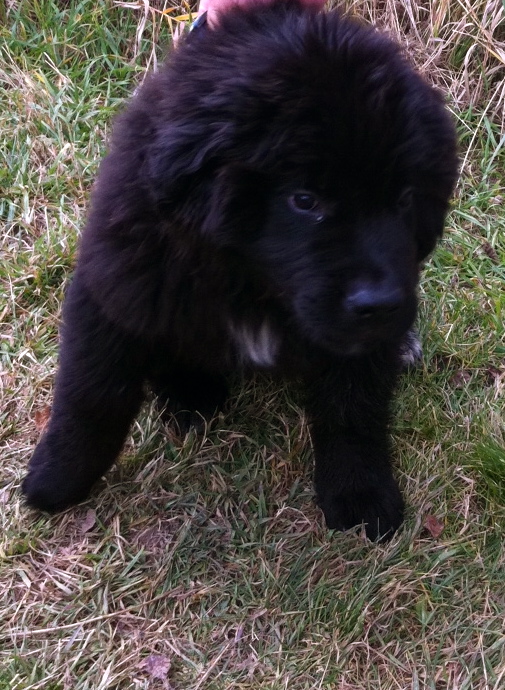
This is my talented nephew, Bridger’s puppy, Dozer.  This photo was taken in October.

The aptly named, Dozer, is now at least four times as big and still growing.  To my son, Nic, he is a welcome addition.  Dozer’s hair is as soft as the finest fur.  He’s full of puppy energy and best of all, loves to be with kids.  Nic is ecstatic and cannot wait to see him again.

For Emma, however, Dozer is a furball nightmare come true.  He’s bouncy and teething so he nips and grabs hold of anything that moves.  His actions are erratic – he seemingly comes out of nowhere and jumps to lick, usually the face.  That he is adorable is completely lost on Emma.  All she sees is black menacing fur in the shape of a not so small bear, rapid movement, wet tongue, drool and sharp teeth.  To say she is terrified of him, would be a vast understatement.

When Emma went up to the barn one day while out in Aspen for the holidays, Dozer came out to play.  Emma was terrified as Dozer bounded toward her at a rapid clip.

“Pick me up!” she screamed.

Emma now weighs over seventy pounds, so picking up a writhing, screaming, terrified body is not an easy task.

“Pick me up!” she screamed again, pulling at my arms.

I tried to shield her with my body, but Dozer was so fast, he was able to bounce around me, giving Emma an enormous, wet “kiss”.  Only to Emma it wasn’t a “kiss”, it was nothing short of an assault.

“Mommy!  PICK ME UP!” Emma shrieked, her fear palpable.

Eventually we managed to get to the barn and locked Dozer out where we could hear him pacing up and down, trying to find an alternate means of entry.  Add a creepy sound track and you have nothing short of a scene from a horror movie.

After twenty minutes or so, we peered out the door to see if an escape was possible.  There Dozer was, lying in front of the only door, his enormous body draped across the exit, making any attempts to leave impossible.

Emma began to fret.

“It’s okay Em.  I’ll pick you up,” I reassured her.

“No Dozer.  Dozer go back to Bridger’s house,” Emma said desperately.

“It’ll be okay, I’ll carry you down the road and Dozer will go home,” I said.

Except when I picked Emma up, she is so tall now, her feet dangled not far from the ground, an easy grab for Dozer, who comes up to my hips.  Emma screamed and tried to “climb” up my body.  The whole thing would have been comical had I not been trying to hold onto her, while pushing Dozer away, somewhat like trying to move a stalled car, as we made our way down the ranch road.  “It’s okay, Em.  He’s not going to hurt you.  He wants to play, that’s all,” I told her.

Any time I saw Dozer’s attention stray, I would take a moment to rest by putting Emma down, where upon she would immediately scream, attracting Dozer’s attention again.  Back he would race to see what he was missing.  It was a laborious process and poor Emma by the end of the trip was repeating over and over again the same ineffective words – “Dozer! NO!  You have to go back to Bridger’s house!  You have to stay inside!”

Only Dozer had no intention of returning to an empty house, he was having far too much fun with this odd child and her fumbling mother.

Later, in the safety of Granma’s house, Emma stared out the window and said, “No you cannot go up to Bridger’s house.  Dozer has to stay inside. It’s okay.  It’s okay.  Dozer has to go home.”

Now Emma is safely back in New York, home to millions of dogs, but very few Newfoundlands, so perhaps she feels safe, finally.

A “Conversation”

“Hi Mommy!”  Emma said this afternoon into the phone.

“Hi Em, how are you?”

This is a standard question which Emma never fails to answer with a cheerful, “I’m fine!”

“Did you have a good day at school?”  I asked, knowing that she did not have a good day.  In fact, Emma’s teacher wrote us an email describing how Emma was unable to focus, wept for a good part of the day, cried for me and zoned out for much of the rest.

“No you cannot go on the baby swing.  It’s too small!”  Emma said in answer to my question.  “You have to wait over here!  You have to go on the big swing.”

I knew what Emma was referring to as she was picking up on a “conversation” we’d begun before she flew back to New York.  I have no idea why the swing in “Seal Park” was occupying her mind, but it evidently was.

“That’s right, Em.  You’re too big for the baby swing!”

“You have to wait.  You have to swing on the other one,” she continued.

“How was school today, Em?” I asked, hoping to bring the conversation back to the present.

“It’s too small for you!”  Emma laughed.  And then she said something else, but she was wandering away from the phone so it was impossible for me to hear what it was.

“Hey,” Richard said into the phone.

“Was she okay when she came home?” I asked.

“She’s been great.  Happy as a clam,” he answered.

Okay then.

“Sorry Bubbles”

Emma calls the stars in the sky – Sorry Bubbles – it has a certain poetic beauty to it.  She used to call fireworks, rain and the noise motorcycles make, “bubbles”.  But “sorry bubbles” remain my favorite.  This New Year’s Eve she referred to the fireworks, which showered Aspen Mountain as “fireworks”.

“Look!  Look at the fireworks!” she cried.  Then she made noises, which sounded a bit like the noise fireworks make.

“Does the noise bother you?” I asked.

“Yes!” she said, covering her ears.

“Does it scare you?” I asked.

“Noooo!” she said, laughing.

“Do you want to go outside with Daddy and watch them?”

“Do you want to stay inside the boy’s house?” she answered.  Which meant she wasn’t asking a question, she was stating a fact.  She wanted to stay in our friend’s house and most definitely did NOT want to go outside in the 10 below zero cold to watch the fireworks with her Dad.  Richard stayed close to the house and occasionally jumped up and down to keep himself warm.

“Dance, Richard!  Do your dance,” Nic’s friend, Eli said, from the warmth of the kitchen.

“Daddy’s jumping!” Emma commented.

“He’s trying to stay warm,” we told her.

“Daddy wants to see the fireworks.  Daddy’s cold,” Emma said.

Later as we made our way back to our house and after the fireworks had ended, Emma looked up at the sky and said, “Sorry bubbles!  Look at sorry bubbles!”

“Is that what you call the stars, Em?” I asked, confirming what I suspected.

“Yeah!”

Going Home

“Wake up, get on airplane, go through tunnel, see Merlin kitty, see Joe!” Emma said upon waking this morning.

“Yes, Em.  That’s right.  You and Daddy and Nicky are going on the airplane this morning,” I answered.

“One, two, three, four, five,” Emma said, pointing at each of us.

“Five of us are going to the airport, but three of you – Daddy, you and Nic are getting on the airplane.  I have to stay here with Granma for a few more days,” I explained.

“One, two, three, four, five to the airport, then you and Mommy and Daddy and Nicky go on the airplane,” Emma said.

“You are Emma.  Just Emma and Nic and Daddy,” I said as she looked at me.

“You,” she said, pointing to me.

“No Em.  I have to stay here and work for a few more days, but I’ll try to come home on Thursday or Friday.”

“Mommy on the airplane,” Emma insisted.

“I’m sorry Emmy, but I’ll be home soon.”

I waited for her to say, “Okay”, but she never did, because it wasn’t okay and I knew it.  Regardless, I have to work for a few more days here, tying up loose ends before I can leave to join my family in New York.  Meanwhile both Nic and Emma have school tomorrow and Richard will be going through the piles of mail, making sure both children get on their school busses on time, picking up groceries, sorting through laundry and all the other things necessary to returning home after being away.

I miss them already.

Making Sense of It All

Yesterday as I was driving the children with all our ski gear to the slopes, Nic said, “Mom, did you get me a new pair of poles?”

“No Nic, I didn’t,” I said.  “What’s wrong with your poles?”

“I can’t use them any more,” he answered.

“Why not?”

“The baskets fell off.”

“What do you mean the baskets fell off?”  I asked with growing irritation.

“I don’t know.  They fell off.  I can’t ski with them.”

I began imagining the long lines at the rental shop at Buttermilk, how we were suppose to meet Emma’s Challenge Aspen ski buddy in less than five minutes and we were just leaving the house.  I said as much to Nic who now sat quietly in the back seat staring out the window.

“Mommy’s so upset,” Emma’s voice could be heard saying, from the backseat.  “Nicky’s so upset.  Mommy’s angry.”

“Oh Em,” I said.  “I shouldn’t have gotten angry just now.  I’m sorry Nic.  Don’t worry, we’ll borrow a pair of poles and get you a new pair this afternoon.  Okay?”

“Okay,” Nic said.

“Hey Em?  Are you excited to go skiing?”  I asked.

“Yeah.  Ski with Mommy and Nicky and Matt!” Emma said.  “Mommy’s upset.  Nicky’s upset.  Nicky wants to jump off the diving board.  I’m sorry, it’s closed.  Nicky’s crying,” Emma continued cheerfully.

This kind of dialogue from Emma is typical, she applies whatever logic she can to a given situation, usually however, it’s incorrect.  She will come up with reasons for someone’s upset with things that have recently upset her.  If Emma doesn’t get to the Aspen Recreation Center by a certain time during the week, the diving board is closed and she cannot jump off it.  As jumping off the diving board is one of her favorite activities, she is upset when she realizes she won’t be able to.  That Nic is now upset, it stands to reason, he must be upset as she is, about the diving board.

“I don’t care about the diving board Emma,” Nic grumbled.  “And I’m not crying,” he added.

“Hey Em.  Nicky’s not upset about the diving board.  Nicky’s upset because I was cross with him about his ski poles,” I explained.

“You got that right,” Nic muttered, giving me a grin.

“Nicky’s upset, Nicky’s angry, Mommy’s so upset, Mommy’s angry, Emma’s upset, Emma wants to jump off the diving board,” Emma said.

It’s a bit like watching an Olympic Sporting Event where the newscaster does an ongoing narration of the events as they develop.  Only Emma is reporting on events with reasoning which has nothing to do with what’s actually going on.

“Mom, make her stop,” Nic said irritably.

I began laughing, “I can’t Nic.  She’s just trying to make sense of it all.”

“But it doesn’t make any sense,” Nic said.

“It does to her,” I answered.

“Whatever,” Nic said.

The Good News And The Bad News

Emma has been spitting on people – that’s the bad news.  A few days ago she spit on people while waiting in line for the chair lift.  This has been an ongoing problem.  One we have tried, with little success to eliminate by – taking away privileges, taking away favorite activities, talking to her – so far, little seems to sink in.  The act is random and seemingly without malice.  It appears she just likes the sensation and doesn’t understand the implications or how disrespectful it is to those who come under her spray.

We are hoping if we continue to diligently keep on her about it, immediately removing her from the situation, not allowing her to do the things she loves when she spits as well as wildly praising her when she does not spit, one day she’ll figure out it’s more fun when she doesn’t do it.   Yesterday there was no spitting, but there never is when we are with her.  She spits when she isn’t with us.  And perhaps that’s what she is telling us – you guys are working too much, spend more time with me.  Or maybe she just likes to spit.  I have no idea.

Yesterday I skied with Nic and Em and I will again today.  I will go into the store later in the afternoon.  To any working parent, who must manage their time – trying to maintain that tricky balance of work with time with ones children, particularly when ones child is acting out – this must sound familiar.  I know it’s certainly not unique.  With an autistic child who doesn’t seem aware of the implications of their actions, it all feels pretty daunting.

The good news is Emma is more often than not sleeping through the night and when she has woken up in the middle of the night, as she did last night, she is returning to her own room and bed without complaint after being told to do so.  Yesterday she picked up one of Nic’s toys, it’s called “Bop It!”  A gift from Joe, Emma’s therapist of almost seven years, it was a huge hit when Nic received it, though Emma has never showed any interest in it.  Yesterday Emma picked it up and started playing it.  You have to do what the voice commands.  “Bop it!” “Twist it!”  “Pull it!” and if one isn’t quick enough it says, “Oh so close!”

Emma was able to follow ten of the commands before losing.  She became distracted by the music and began bopping her head up and down to the beat of the music, forgetting to “pull it!”  When she lost, she laughed and then played again.  At the moment I am clinging to the “good news”, while doing my best to manage my concerns about her random spitting.  We will continue to monitor her behavior and immediately intervene when she spits.

Christmas

Here’s the thing about Christmas with Emma – she has never shown any interest in it.  The whole Santa thing never held any appeal.  Fantasy is typically a difficult concept for autistic children to grasp.  Add to that her disinterest in most toys or anything which could be wrapped in paper with a bow and you have a huge part of what most children feel excitement for lost on Emma.  Since she loves to ski, we plan to spend tomorrow skiing with her.  We have a number of Christmas presents wrapped and under the tree, a Christmas stocking jammed with little gifts she may well reject or if she continues as she has in the past, will never even open.

Two Christmases ago we joked, after all her presents remained under the tree unwrapped, we would just save them and put them back under the tree the following year.  Our son, Nic, was justifiably horrified by both our jokes and the fact she couldn’t have cared less.

“Can I have them?” he asked.

“Nic, I guarantee you will not want the presents we’ve chosen for her,” we said.

“Well can I just open them at least,” Nic replied, unconvinced.

The following year we unpacked our suitcases and stored them in a little room upstairs where the children have stuffed animals and books.  There, in a pile, were Emma’s unopened gifts.  I felt sad, seeing them there, not because I want my children to be attached to things, but because it represents a lack of neuro-typical development.

Just as we always have a place setting at the dinner table for Emma, despite the fact she has not and will not, eat anything we prepare, unless it’s cupcakes or pudding for the past five years, we continue to have some presents for her under the tree every Christmas, just in case one day, one year, she decides it’s worth her time to see what’s under the wrapping paper.

Christmas is obviously representative of much more than giving and receiving gifts.  For Emma we must find other ways to express our love and appreciation, ways she can understand and recognize.   Perhaps the best way, is to do the things she loves with her – skiing, silly games, singing nonsense songs and just being with her.  Sometimes it takes a little girl with no interest in material possessions to remind us of what Christmas is really about.