Monthly Archives: April 2014

How Do We Put A Price on Communication?

As I was downloading a couple of photographs just now, I found the video we took of Ari and Emma’s presentation Wednesday evening.  Intact.  We’ve got it all!!  Woot!  Woot!  But before I put the video on here, I have to get permission from Ari and Emma.  So let me do that and then, if both agree, you should be able to view it next week.  I’m hoping by Monday.

In the meantime, there’s something else I want to talk about.  And that is the experience of hearing your child’s thoughts and opinions, interests, questions, and desires, when you weren’t sure you would ever be able to do so.  Now this is a little loaded because there are some who believe it’s wrong to suggest all Autistic people will be able to express themselves.  Those people believe there are some who cannot and it is creating false hope to suggest otherwise.  There are still others who feel that communication comes in myriad forms and we must stop insisting one way (speech) is the only way. They believe we should honor all methods of communication, whether that’s through words, sounds, body language, or silence and using our other senses.   Those people believe, and I am one of them, that we all have the wish to connect with our fellow humans in some capacity, at least some of the time, and it is incumbent upon all of us to figure out how we can support each other so that all have the opportunity to do so.

When Emma first wrote an unexpected sentence, described in detail ‘here‘ it was the beginning of what would turn out to be nothing short of an odyssey for all of us.  From that moment, on November 25th, 2012, we have experienced what can only be described as a dream-like adventure with Emma leading the way.  The degree to which she was underestimated by almost everyone who met her, including us, is beyond my ability to describe.  I say “almost” because there were a few people who met her who were not fooled.  It is interesting to note that those few were Autistic.  My friend Ibby was the first and we’ve written a little about this in two pieces she and I wrote featured in Parenting Autistic Children With Love and Acceptance’s first addition of their terrific new magazine, which you can read ‘here‘ (It begins with a piece by Ibby on page 17 and then ends with my companion piece beginning on page 21.)  By the way, the entire magazine is filled with wonderful pieces by Beth Ryan, Nick Walker, Cynthia Kim, Amy Sequenzia, Renee Salas, Sharon davenport, Alyssa Hillary, Kimberly F. Steiner, Juniper Russo, Amy Caraballo, Jane Strauss, Kelly Green, Steve Summers, Leslie Rice, Zita Dube-Lockhart, Leah Kelley, Lei Wiley Mydske and others who donated their art work.

When someone sees Emma, who now communicates by pointing to letters on a letter board, (which is different from when she wrote that first sentence a year and a half ago) I sometimes hear the following comments – “I just don’t see how this can translate to a school setting” or “It takes too long” or  “economically it’s not feasible because it requires a one on one ratio that most schools won’t be able to pay for.”  Except here’s the thing…  The way Emma communicates is tailored for an academic setting.  Just as in any classroom, a student is called upon to give an answer or thought, about any given topic, so could Emma be given the opportunity.  All it requires is for the teacher to say, “Emma when you’re ready just signal and you’ll be next.”  The aide can then raise their hand when Emma has finished writing.  This would also deal with the comment that it “takes too long” and I’ll just add that our society’s increasing desire, that everything be reduced to a sound bite, should be tempered, and having someone like Emma in a classroom, would be beneficial to all, by the very fact that we all need to slow the f*ck down.

As far as what this means economically, I argue that there is a great deal of money being spent on a great many things that are NOT working.  Things like trainings for methods that do not produce the type of complex and nuanced language we are seeing.  How do we put a price on communication?  How can anyone suggest that having someone who was thought to be unable, or worse, incapable of expressing their thoughts, not be supported to do so because of the cost associated with it?  How can any of us seriously object?  And yet… people do all the time.  And it catches me by surprise every, single time when they do.

To see your child express their thoughts, as we have had the opportunity to do, is beyond anything I’ve ever experienced.  It has changed everything.  Literally everything.  Some people have said to me, “Oh you’re so patient.”  No.  I’m not.  When Emma is writing something, I am filled with eager anticipation for what she’ll say.  Patience?  No.  Ecstatic is a better way to describe my feelings as I witness the outpouring of her words.

How we engage with our daughter, how we speak to her, what we think and now believe, all of it has dramatically changed as a direct result of her communication.  I haven’t even begun to discuss what this has meant to Emma.  And here’s just one more massive difference between then and now.  Instead of me guessing or making assumptions about what this means to Emma, she can now tell us.

“I want to tell you that I am capable.  Daring massively, eager to prove my intelligence, I will work tirelessly so that Autistic children younger than me won’t be doubted the way I am.”                                         By Emma Zurcher-Long

How does anyone put a price tag on this?
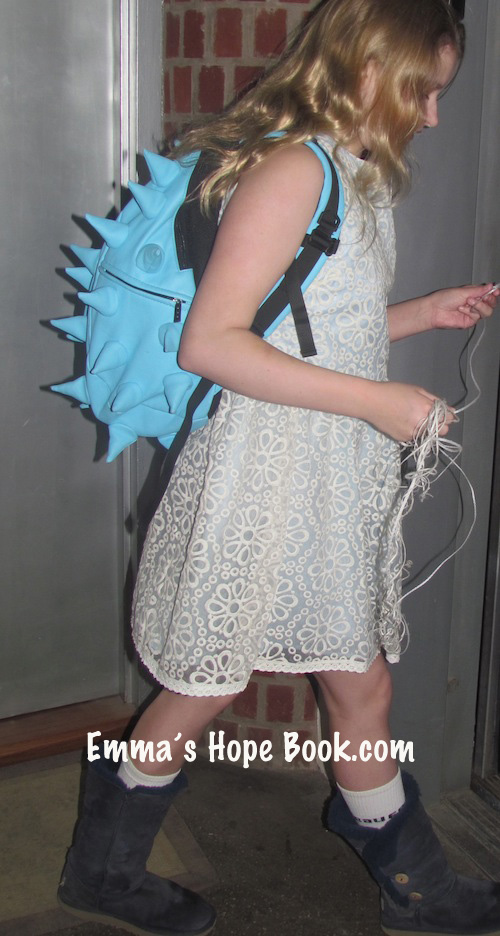
Emma Wears A Pretty Dress To School ~ April 4th, 2014

Emma Wears A Pretty Dress To School ~ April 4th, 2014
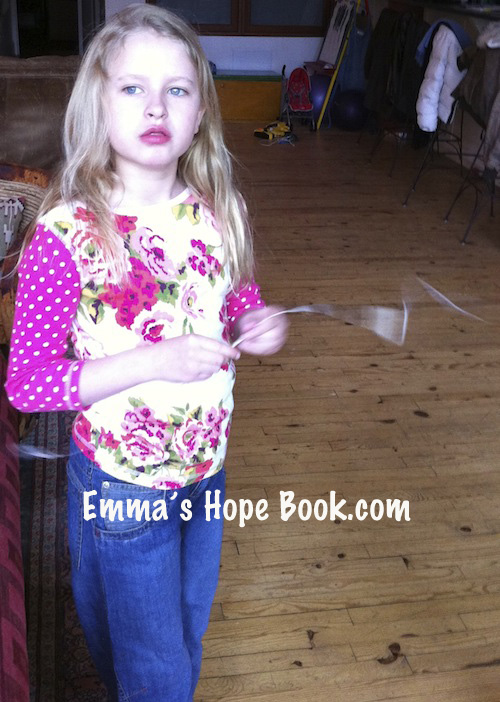
Emma Presents At CoNGo With Ari Ne’eman

Tuesday night I received a message from Jess of the blog  – Diary of a Mom – telling me she wasn’t feeling great, was supposed to get on an airplane the next morning to come to New York City to give a presentation, along with Ari Ne’eman, co-founder of ASAN (Autistic Self Advocacy Network) at CoNGO (Conference of NGO’s) in consultative relationship with the UN.  She asked me if I’d be able to step in if she still felt awful Wednesday morning.  I told her, not to worry, “we’ve got this,” urged her to drink liquids and get lots of rest, but that I fully expected her to wake feeling much better and that none of this would be necessary.

Fade to the following day.

Jess texts me to say she’s feeling wretched, definitely has the flu, there’s no way she’s going anywhere and has contacted the person who invited her to speak to tell him she can’t make it, but that she’s asked me and is hoping he’s okay with this change in plans.  So we wait to hear from him and I go about my day, trying as best I can to not think about it.

Three hours before the event I was able to check my email and see that I’d been given the green light.  I had a few things I needed to do before I could even think about what I would say, but because of an earlier conversation I’d had with Erich who organized the event, I felt I had a pretty good idea.  Basically I intended to introduce Emma and begin by reading her A Letter to the World followed by Emma Discusses Awareness, a quote from something Emma wrote about Acceptance just a few hours before and ending with a question to Emma, “would you like to add anything?”  An hour before the event I was in a panic, while Emma was cheerfully singing and dancing to Donna Summers, wearing her pretty party dress which she chose specifically for the presentation.

We arrived and Ari gave a terrific speech about autism, acceptance, the reason calling a group of people “burdensome” and an “epidemic” is hurtful and problematic and then it was Emma’s turn.  After I read Emma’s words about “Awareness” I said, “I asked Emma earlier today what she thought about awareness versus acceptance.  Emma wrote, “I am aware of many things, and so are you.  Acceptance takes more dedication.”  I paused and then turned to Emma and said, “Do you have anything else you’d like to add?”  I held her stencil board and gave her a pencil.  Emma wrote, saying each letter as it was pointed to, “Yes.  Autism was not something parents wanted to hear, but I hope that will change when more people meet someone like me.”

Applause.

I intended to post the video of the whole thing here, but our camera had a different idea and when we returned home, excited to see the footage, nothing had been recorded.  And because we thought the whole thing was being recorded we didn’t bother taking any still shots either.  So other than a few photographs of Ari, we got nothing.  (Insert sad emoticon.)

Regardless, Ari and Emma rocked and I’m guessing at least a few people came away with a very different idea of what autism is and isn’t.  And if I’m right then it was worth every second.

PS  Jess, I’m hoping you’re feeling better.

Ari Ne'eman

Ari Ne’eman


Awareness Sucks

Today I wanted to do a companion post to yesterday’s “Emma Discusses – Awareness“, with a post entitled, “Emma Discusses – Acceptance”.  I love when Emma tells me to put something she’s written on the blog, because her words are always so profound and insightful.  But once we returned home Em was too tired, so I resigned myself to writing about Autism Awareness and what that means to me.  After all today is World Autism Awareness Day.

A year ago I wrote a  post – Autism Awareness? where I discussed how my awareness regarding autism has changed over the years.  The next day I wrote  – “What I Wish I’d Been Made Aware of When my Daughter Was Diagnosed With Autism“.  After rereading those posts, I then remembered a couple of others I’d written about autism awareness and acceptance, ‘here,’ ‘here,’ ‘here,’ and ‘here‘.  And after all that I just felt cranky.  Seriously.  Just cranky.

I don’t look forward to April the way I once did.  April is a loaded month when many of my friends feel they must hide or cannot look at social media because they know they’ll be triggered by all the calls to “light it up blue,” the hype from organizations like Autism Speaks who seem to do nothing, but speak… it’s exhausting and in the end the awareness they’re pushing isn’t awareness that helps either me or my daughter.   What they seem to call awareness, is to my mind hyperbole, fear mongering and irresponsible.  I’ll be honest, I would be happy if Autism Speaks folded up their little tents and found something else to rant about.

In addition to Autism Speaks’ dire calls for action, the CDC released new statistics – 1 in 68 – and I just groaned because I know how those numbers will be used, forget that they’re almost completely meaningless and actually not an accurate number as Jim Martin explains in his most recent post, 3 Reasons Why Canadians (and Everyone Else) Should Stop Using the 1 in 68 Autism Stat (For Now).  More fear. More anger.  More calls for action.  More listening to people who don’t know what they’re talking about.  More and more and more and more and I just want to crank up Pharrell Williams’ Happy at full volume, put it on repeat and dance.

So in the midst of all the calls for awareness I’m going to hold my daughter close, revel in her presence, sink into my immeasurable gratitude that I get to be her mom and feel the joy in knowing she is a young woman who is talented, funny, creative, wise, insightful, kind, and more forgiving than anyone I’ve ever met. And, boy, am I proud of her.

How’s that for a little awareness?

Emma ~ 2010

Emma ~ 2010

Emma Discusses – Awareness

“Awareness is deciding something is worth your time and attention.  It is not necessarily good.  Real awareness needs to be balanced.” ~ Emma Zurcher-Long

I asked Emma whether she wanted to write something about autism awareness since April 2nd is World Autism Awareness Day, designated by the UN in 1989.  Emma wrote,

“Autism awareness really does me very little.  It is not honoring or making my life easier.  So many believe I am unintelligent even though I write well.  Until they see me writing, it is not what they assume.  What good is awareness if it doesn’t tell people the truth?”

Ariane:  “What is the truth?”

“The truth is, so much of what we perceive compared to another, isn’t known.  People see me, but don’t understand what they are seeing.  I want people to know what it is like to have smart thoughts, but not be able to prove it.

“No one wants to be treated with impatience.  I am happy when people are aware of how bright I am.  Maybe they have a special light bulb for that.  Shine some awareness on those of us who can’t talk the way we think.”

Texas ~ September, 2013

Texas ~ September, 2013