Monthly Archives: June 2013

A Word Of Thanks

A friend of mine hasn’t been feeling well.  She had a cold or maybe it was the flu.  When she wrote me I could tell by the uncharacteristic abundance of typos that she wasn’t feeling great.  I thought about her, hoping she’d feel better soon.  And then yesterday there she was, so much better, her old self, witty, funny, silly, and I felt tremendous relief.  I hadn’t realized how concerned I was until she was better.

When I was nine my father went horse back riding.  It was a Wednesday.  He and my mother always went riding Wednesday afternoons.  I was home, sick with the flu that afternoon.  I remember staring out the window of my bedroom, the sunlight far too harsh forced me to turn my head from its glaring light.  My father told me he’d look in on me when he returned.  He never did.  At least not for a long time.  That afternoon he fell off his horse and, as luck would have it, he did not die as, those who administered to his broken body, predicted.  He did not die, but he was never the same.

Sometimes our lives change so suddenly it is impossible for our minds to keep up.  Sometimes it takes years to fully appreciate how one second can change so much.

When Emma was born, I could not have anticipated how completely my life would change as a result of her being.  It took years for me to process, to catch up, to fully appreciate the magnitude of one child’s existence and all that would occur as a direct result.  I could not have imagined how completely her life would change mine.   And now, today, in this moment I can say with complete and utter conviction, her life has made mine infinitely better, infinitely more enriched, infinitely more meaningful.  Her life.  Her existence.  Selfishly, and I do mean that literally, selfishly, I have benefited so completely from her being in this world, it takes my breath away.

In any given moment our lives can change.  Just like that.  And in that moment we have no way of knowing where we will be led.  Awhile ago I made a choice.  I didn’t think of it as a choice at the time, but I see now, that in fact it was.  I chose to view the things that have happened in my life as moments of possibility.  As long as I am allowed to live, each moment is a possibility to learn, to grow, to be open to new ideas.  I can say that easily now.  I understand this.  As lives go, mine has been a privileged one.  My perceived “hardship” is nothing compared to what so many have endured.  I do not say any of this flippantly.  This choice I made has been relatively easy to follow.

When my friend was sick I worried, when my father almost died I was devastated, when my child was diagnosed I despaired, but these things happened regardless of my response.  My response to them didn’t change their occurrence.

In this moment it’s raining outside.  Drops of water plop erratically on the air conditioning unit outside my studio, the clouds drift lazily along, skimming the tops of the multilevel buildings I see outside my window.  The red brake lights from the cars careening along the interlaced roadways create a moving collage as they speed off and on the exit ramps of the 59th Street bridge.  In this moment I am safe, my husband is safe, my family is safe, my friend is feeling better…  In this moment, in this brief moment, all is well and I am filled with gratitude for all I have.  I am filled with appreciation for the enormity of how one life has so profoundly changed my own in ways I could not have dared imagine.  I am humbled, knowing I will never be able to fully repay the gifts she has given me.

Beautiful Emma
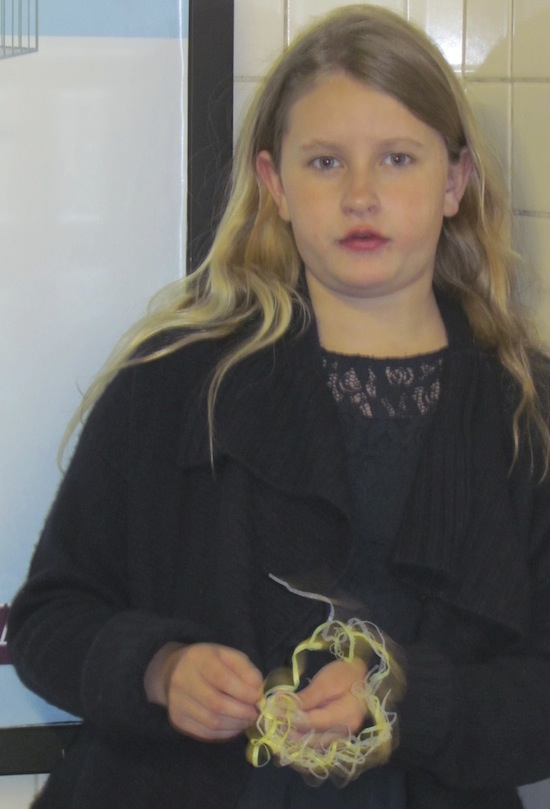
Em


Non-Speaking People Who Type

This is a topic I would prefer not to discuss, but a few things happened recently that make it difficult not to write about this.  So… here goes…

Facilitated communication has had a bumpy history.  It began in the ’70’s and has been lurching along ever since.  There have been studies done, both proving it’s validity and others proving it as an invalid method of aiding those who do not speak to communicate.  This post is not about whether FC is valid.  Those who do not believe in FC’s ability to help those who cannot speak will not be swayed by anything I write here.  For those who are interested in reading more about FC and its history you can do so by reading this and this and the many links embedded in these posts.

What I will write about however, is all those FC users who have gone on to type independently.  And here is where things get really interesting.  Those same people who are convinced FC is all a mirage, a kind of non-speaking, Autistic version of an elaborate magic show, remain convinced the non-speaking person who now types independently is not really doing so.  Those people continue to insist it is a “hoax” despite witnessing, some even after seeing in real life, a non-speaking person type on their own.

Just to be clear, I am not writing about hand over hand or a hand on a forearm assistance.  I am writing about the many people who began typing with a facilitator, but who now type independently.  By independently I am referring to those who may still need a trusted person standing nearby.   Some type with another person’s hand placed on the middle of their back, others may need a hand gently placed on their shoulder.  Yet these same people who speak out forcefully, often aggressively to any who dare write about someone who is non-speaking and writing of their experiences, say even a hand on the back proves these non-speakers cannot and do not type their own words.  They insist that they are merely puppets doing the bidding of the person who is physically nearby.

What fascinates me about this is that these same people who insist it’s all a “hoax” (this is the word they usually use) would rather believe a person can move a seated, non-speaking person’s hand to hit specific keys on a keyboard by virtue of their physical presence, rather than entertain the notion that this non-speaking person, may in fact, be typing their own words.  One such person commenting on a blog post about something unrelated to FC, but that had a link to Barb Rentenbach’s book, I Might Be You, wrote, ” I don’t consider typing with an arm on the shoulder independent typing. You can clearly see the facilitator nudging her towards the letters.”  Not to quibble, but seriously?  So this is like some sort of typed ventriloquism?  Touch someone’s back and direct them to write thoughts that are not their own?

I urge any of you who believe this is possible to try doing it… place your hand on another’s shoulder or the middle of their back and see if you are able to control what that person then types.  And while you’re at it, try standing next to the person and psychically urge them to write something.  It seems incredible, but there are those who not only believe this to be the case, but they then demand “proof” that this person is typing independently, despite the fact that they’ve just been given the very “proof” they asked for.  Evidently “proof” is subjective.

What bothers me about all of this is that those who are typing to communicate are doing so because they have no other means.  This is not a “choice” that’s being made.  The people who continue to insist they are a “hoax”, that it’s all a “mirage”, that they are being “controlled” are taking away the only way they can communicate.  They are silencing them.  They counter this assertion by saying that on the contrary, they are actually “advocating” for those who do not speak and are protecting those who are at the mercy of a facilitator who is putting words into another’s mouth.  Yet, even when confronted with a non-speaking person’s typed words, typed without anyone’s hand on their arm, they continue to insist the very presence of this other person is all it takes.  The transference of perceived power to cover up their dehumanization of another is convoluted.

If you google “Carly Fleischmann” the third entry that comes up is “Carly Fleischmann fake”.  Sadly Carly is not alone when it comes to such beliefs.  There is a long and horrible history of non-speaking people being discounted and effectively silenced by those who believe they cannot possibly be intelligent, insightful beings.  There are those who will dismiss people like Carly as an anomaly, a “prodigy” and thereby ignore the years of effort it has taken her to get to where she now is, or they conclude she is a “fake”.  There is nothing new about the silencing of human beings deemed inferior.  (Read Inventing the Feeble Mind by James W. Trent, Jr.)  The ingrained prejudices and dehumanization of Autistic people continues.

I want to end with one last thought, which is this – if you found yourself unable to speak, but could type to communicate, yet when you did so, people doubted the validity of your words, accused you of not actually writing what you’d so painstakingly typed, what would you do?  How would you respond?  How would you fight back?  Could you fight back?  Restraints come in many forms, but all are effective.

As Barb Rentenbach writes, “I might be you.”  For those who doubt that sentence is her own, you better hope those words are wrong.

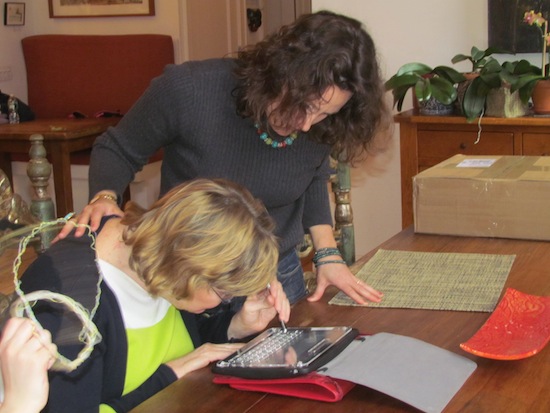
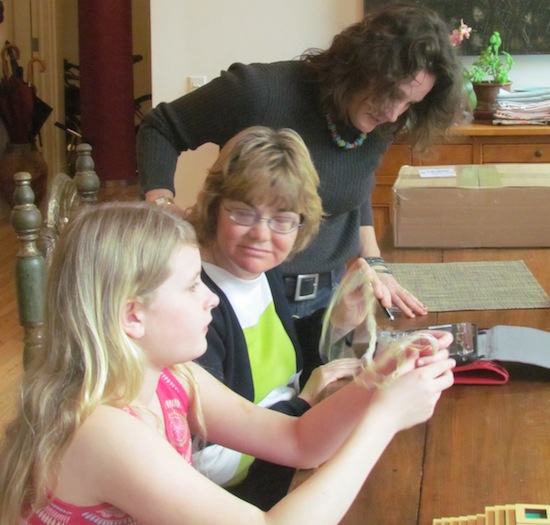
Barb types with Lois’s hand on her back as Emma twirls her string – April 2013

Barb types

We Are in This Together

It is in our best interest to remember that we are all the same.” ~ Barb Rentenbach in her book, I Might Be You.

One of the most insidious and destructive messages parents are given about their Autistic child is “the list.”  I am referring to that list of deficits we are given.  The list that enumerates all the reasons why our child has earned the “autism” diagnosis.   It is a list that divides.  It sets us a part from our child.  It makes us question our maternal instincts.  It makes us wonder what we did wrong.  It is the list that becomes our to-do list.  A list of things we now set out to “fix”.  Or so this was my experience when my daughter, Emma was first diagnosed.

That list, filled with judgment, a critique of my not-yet-three-year-old child, the same child that just moments before, I knew was different from what I expected, different than my son, yet still was a part of, was now branded with “other”.  If we are going to make such lists, I think it only fair the “evaluator” and all members of the human race be given similar critiques.  I would be curious to see how each of us stands up under such scrutiny.  Let us be evaluated by someone who does not share our particular neurology.  Let us each be judged by another – another who deems themselves superior.  Let’s see how well that plays out.

Loneliness is the most predominant side effect of our unique design. Many times, autistics revert to isolation by default rather than preference. It is infinitely easier to back away and not try to be included instead of oafishly stepping in and attempting to convey you intend to be a part.” ~ Barb Rentenbach in I Might Be You.

Have you ever felt like a fraud?  Have you ever said something to someone only to realize you said the wrong thing?  Have you ever been in a social situation and left, wondering why you feel uneasy, upset or just sad?  Have you ever spent time in the presence of a group, yet felt lonelier than had you been alone?  Have you ever had the thought that if people really knew you, they wouldn’t like what they found?  Have you ever felt separate from, less than, not good enough?  Have you ever felt critical of the way you look, the shape of your body, the size of a particular body part and wished it were different?  Have you ever thought if only that part was smaller, larger, different, if only the number on the scale was less, if only your hair was lighter, darker, straight, curly, your skin was a different shade, your height…  Have you ever thought if only X was different, I wouldn’t feel this way?

Remember a time, no matter how brief, when you felt that magical euphoria of connecting with another human being?  That moment when you felt the wonder and bliss that only comes with friendship and love, the beauty of connecting with another?  Remember what that felt like?  Wasn’t it beautiful?  Wasn’t it unlike anything you’ve ever felt?  A kind of anything-is-possible feeling?  A feeling of all being right with the world, that joy of knowing we belong.  Who among us has not experienced both?  Who among us has not felt the horror of feeling separate from, the worry that we are somehow damaged, not right?  Who among us has not felt the inextricable sadness that comes from feeling we are all alone?  Now add an entire society, a whole group of people, all of whom have decided we are “less than”.  Feel what that feels like.

Go back to the memory of bliss, of joy, of connection.  Feel the vibrancy, the exuberance that comes with that.  Which do you choose?  Would any choose differently?  We are all served by remembering we are more alike than not.

Reach out and connect with those who may be struggling with separation. It takes just one person to care to change a life for the positive. Be that for someone.” ~ Barb Rentenbach in I Might Be You.

Emma, Barb & Lois the week we recorded the audiobook of I Might Be You

Em, Barb & Lois

Autism And Stress

Lest you think this post is about stress felt by parents, let me quickly say, it’s not.  This post is about the stress I have observed my daughter experiences.  The stress she feels and that I (often unwittingly and unknowingly) exacerbate.  This is not about  beating myself up, but is an honest look at how my reactions can make matters worse.  As I’ve said before, it is my hope that as Emma’s mother I continue to make progress in my parenting, but also as a human being.  Just as I hope and expect my daughter to learn and progress, I hope the same for myself.

“We have to minimize her stress.”  This was something Soma Mukhopadhyay said during Emma’s most recent session with her.  It was in answer to my question about when to graduate from using a letter board to a computer keyboard during her RPM (rapid prompting method) sessions.  During the session Emma pointed to a letter, then Soma wrote the letter down, Emma pointed to another letter, and on it went until Emma had written an entire sentence.  This technique, of one letter pointed to, one letter written down, helps with Emma’s impulsivity, which is amplified when she’s feeling stress.  It was during this same session that Emma answered Soma’s question about whether she could feel colors, with, “Of course.  That answer, those two words spelled out so easily by my daughter, made me laugh and cry at the same time.

My daughter types and does things that astound me.  It doesn’t matter how much I believe in her competence, I am continually astonished, ecstatic and heartbroken all at the same time.  Astonished because of the ease and confidence with which she will say something like, “Of course” in answer to a highly complex question, heartbroken because for so long these were words I never imagined I’d hear, let alone learn what I am now learning about her.  I no longer believe these feelings are mutually exclusive to each other.  Now, instead of wondering whether it was all a dream, I celebrate the exquisite beauty of my child and all she does that constantly reminds me of just how vast and incredible the human mind is.  I am humbled, on a daily basis, in the best possible way.  I would not trade the awe I get to feel when in the presence of my child for anything.  Seeing my daughter defy every limited idea about her that has ever been uttered, including my own thinking, gives me tremendous hope for this world, for my own growth and for humanity.

I witness greatness when I watch her work and it is a beautiful thing.  So when she expresses upset, which I now am able to identify as stress, it breaks my heart in a way that it didn’t, before I understood.  What I used to think of as stubbornness or a temper tantrum or a form of manipulation, I now see as a product of the enormous stress she feels.  And I have to wonder, exactly how much stress must she cope with?  I have talked about what I perceived to be her “resistance” in typing, but am now beginning to think of it as less “resistance” and more stress.  Stress from how very difficult it is.  Stress from expectations, stress from making a mistake, stress from doing something different, and those are just the stresses I can easily come up with and relate to.  I’m guessing there are many more I am completely unaware of.

Stress is something that, when she is gripped by it, all systems seem to simultaneously crash.  To make matters worse, my stress level rises in direct proportion to hers and I am confronted with how unhelpful I am when I allow my stress to overwhelm me as was the case the other day.  My response to Emma’s panic was to panic too.  So much so that I could barely breathe.  “You have to calm down!” I instructed her, while my own sense of calm, shattered so completely, was a perfect example of what NOT to do.  It was the antithesis of modeling behavior sought and it reminded me of something my father used to say to my siblings and me – “Do as I say and not as I do!”  I think he thought it amusing, however I remember it as anything but.

There are times I cannot predict, when something happens, things I don’t know or understand, and suddenly my seemingly placid, happy child is in a turmoil of upset.  There is often a sensory component I’m unaware of.  During these times sentences are repeated that are obviously meaningful to her, but that I find confusing.  As her stress escalates, her ability to verbalize what’s going on plummets and my frenzied request that she “type it out” does nothing to alleviate the situation.  The longer all of this goes on, the more I feel completely ill-equipped to keep my stress level from going into the red, let alone help her with hers.  That Emma seems convinced I am, not only capable of pulling it together, but will be able to help her, is an example of my daughter presuming in my competence, which makes me all the more determined to work through my own issues and do better.  I owe it to her.

September, 2009

September '09