Tag Archives: sensory issues

Laughter

I used to believe I could cure Emma.  I used to believe if I just looked hard enough I would find the thing that would take her autism away.  I read the memoirs by parents who, through various bio-medical or behavioral interventions had “recovered” kids, I avoided reading the memoirs by parents who did not.  I used to believe that by force of will, hard work, focus, dedication and diligence I too would one day have a daughter who had gained membership to that exclusive club of “recovered children.”

I no longer believe that.  However that does not mean she cannot be helped.  Emma can grow, learn and progress as we all can.  It just takes her much, much longer and requires a great deal more support.

Emma has a stomach bug in addition to her other ailments.  She was up on and off all night.  Her ears are bothering her, her stomach hurts, her bowels are sluggish and blocked and despite all of this, despite having just thrown up what little food she ate for breakfast, she is cheerful.  ”Belly go bang bang,” she said, before turning on Michael Jackson’s Beat It.

Belly go bang-bang is what Emma calls the sensation she feels before she throws up.  It’s an apt description.  Right now she is singing to MJ’s incomprehensible lyrics and dancing.  It’s a muted version of her usual singing and dancing, but given how uncomfortable she must feel, it’s admirable.

As we lurched through traffic yesterday morning, headed for the emergency room with Emma, Richard said, “Well, you couldn’t accuse us of having boring lives.”

No, you really couldn’t.  And then for some reason I thought of Donald Trump’s hair.  Why this arbitrary and completely ridiculous image came to mind, I have no idea.  But it made me smile.  His wacky, and timeless, I might add, hairstyle is one of a number of constants in life that make me laugh.  I’m grateful for that.

For more on Emma’s journey through a childhood of autism, go to:   Emma’s Hope Book.

The Hospital

This was not the post I had intended to write.  This morning at around 2:00AM Emma came into our room, her little body burning up.  She nestled in between Richard and me.  Merlin had curled himself into a tight ball near my head; it is not an exaggeration to say it was a crowded bed.  This is the second time since my surgery that Emma’s been up in the middle of the night.  What was once a nightly occurrence has, thankfully, become a rarity.  By 6:30AM Emma was complaining about the right side of her abdomen hurting.  She became more agitated and upset as the minutes ticked by.  Richard and I realized we had no choice but to take her to the emergency room.

Once there, Emma seemed less upset and after we answered the thirtieth question about her medical history (for a ten year old, it is lengthy and extensive) went over all her various hospitalizations and the doctors we’ve seen, they decided to take an x-ray to determine if constipation was the cause of her pain.  As I stood in the booth with the technician, whose nephew has severe autism and is non-verbal, I could see that constipation was indeed the problem.  Not only was there a single enormous blockage, but her intestines were filled with stool.

Once again we were confronted with the question that has plagued us off and on for the last seven plus years.  How do you help a constipated child, who refuses to eat little if any of the foods that will help her, see the connection?  Or is that not the right question?  When the supervising pediatrician came in to speak with us she gave us the same remedies I have been given by countless other doctors and specialists.  This isn’t rocket science.  It’s pretty basic stuff.  But when you’re dealing with a child who has sensory issues, making it difficult for her to know when she feels the need to go to the toilet, along with fear from past painful experiences, add to that dietary limitations and an insistence on eating a dairy heavy diet, even though it’s gotten much, much better, you have a never-ending cycle that is very, very difficult to break.

“Let us be the bad guys.  We’ll give her an enema, maybe you or her dad could help hold her down,” the supervisor told us.  And as well meaning as she was, as obvious as her suggestion may be, I couldn’t agree to it.  Having Emma held down by three or even four strangers while a bottle of saline solution is pumped into her, while she screams and fights is not going to solve the bigger issue, the issue that we have been dealing with for the last seven years with varying degrees of success – constipation.

“I know,” the doctor said, in response to my despair that we were once again being told the same thing we’ve been told by literally DOZENS of doctors.   “I’m sure it’s very frustrating.”

“Actually frustrating doesn’t begin to cover it,” I said.

And it doesn’t.  Frustration is the beginning of a great many feelings when you are forced to watch your child writhe in pain from something that is so heinous and frightening.  Having just had surgery, having, for the first time had to personally experience the hell that sums up constipation, the pain, the fear, reminding myself to breathe into the pain and relax, I can relate to what Emma is going through in a way I never could have before.  So I did the only thing I know to do.  ”Come on Em.  Let’s go to the bathroom, I’ll stay with you, and then afterward we can go home.”

Emma took my hand and together we went into the bathroom where she sat with me crouched in front of her, just as I used to do every single day for so many years.  This time I looked into her eyes and said in a calm, gentle voice, “I’m here with you Emma.  I’m going to stay here with you.  You can do this.”

“I know, it hurts to poop,” Emma cried.

“Yes.  It does.  I know.”

Finally she was able to let go of at least some of the stool inside her and after another 30 minutes, we left and came home.  It’s not over, she’s still massively constipated, shes’ still uncomfortable.  We will have to insist she not eat as much dairy.  We will have to be more diligent about monitoring her.  We have no easy answers.  We have no quick fixes.  But we will get through the rest of the day, just this one day, one day, one step at a time.

For more on Emma’s journey through a childhood of autism, go to:   Emma’s Hope Book

A Birthday Party

Emma does not get invited to many birthday parties.  In fact I can count on one hand the number of times she’s been invited to a birthday party in the last year.  Okay, make that one finger.  Don’t misunderstand me, there is no resentment here.  The children with whom Emma goes to school all have autism in varying degrees, food allergies are rampant, each kid has their own specific sensory issues, some have physical challenges as well, so for a parent to take on the idea, let alone put into action, the planning of a birthday party, is a major undertaking.  The other children Emma knows or has any contact with are either her cousins or friends from before her diagnosis and most of them are Nic’s age, not Emma’s.

So when my cousin invited her to her daughter’s birthday party, Emma was so excited, she talked about it for at least a week prior to the actual party, which was this past Saturday afternoon.  Richard was sick with some nasty bronchial sounding cold, lending him a – come hither – husky quality, opted to stay home and not risk infecting all the children and their families with his germ riddled body.  (TMI – too much information – as Nic would say.)  Emma insisted on wearing a black shirt, embellished with little beads at the neckline, leggings and a plaid skirt, all but the leggings were a size too small, despite my suggesting she wear something a size larger.  ”No!  Please!  I want to wear this one!” She pleaded.

When we arrived, Emma said hello to all her cousins and though I kept my eye on her the entire time, she did very well.  There were some 30 children aged 5 – 12, mostly girls and mostly Emma’s age – 10.  The family had hired a couple of clowns who did an hour long routine, with gags, pratfalls and “magic” such as the man pretending to eat a piece of kleenex while the woman demands that he spit it out, only to have her pull the kleenex from his mouth, but instead of kleenex coming out, yards of multi-colored tissue pour forth, leaving one to wonder how he managed to get all of that in his mouth in the first place.  An hour is a long time for a child who may or may not understand all of what is being said and done, to sit.  But sit she did.  Right in the front with all the other girls, watching and though I don’t think she laughed at any of their antics, she did seem intrigued.

After the show ended, the other children ran around playing chase while Emma played with the string of a balloon.  When it was time for us to leave, Emma put on her shoes and coat and said, “We went to Gaby’s birthday party at Gaby’s house.”  And by the time the elevator let us out onto the street, Emma looked up at me and said, “We went to Gaby’s house a long time ago.”

For more on Emma’s journey through a childhood of autism, go to:   Emma’s Hope Book

Em’s New Shoes

A few weeks ago Emma’s teacher emailed me asking if we had a pair of sneakers we could send to school with Emma so she could participate in their gym class.  First of all, Emma doesn’t like wearing shoes, or socks, for that matter.  But when she must (which is most of the time) she wears one of two types of shoes – Uggs (winter) or Crocs (summer).   She has a couple of variations on this theme such as a pair of Ugg slip-ons that resemble black pumps (Spring/Fall) and some fake fur-lined Crocs (Fall/Winter), but as I said, Uggs or Crocs are the only two brands of shoes her feet have seen in recent years.  So, no.  We do not have sneakers to send into school.  This weekend I decided to change that.

“Hey Em.  Today after gymnastics I’m going to take you shoe shopping for a pair of sneakers.”  I smiled enthusiastically at her and winked at Nic who muttered, “That’s probably not such a great idea, Mom.”

“Together,” was Emma’s reply.

“Yes, we are going to go together.”

We are going to go together,” Emma repeated.  ”Just you and Mommy.”

I put my hand up and pointed to her, “Say it again.”

“We are going to go together, just you and me!”  She pointed to herself when she said me and bounced up and down.

“Yes!  That’s right.  Just you and me.”

Later in the sporting goods store we first went upstairs where they have their snow boots, rain boots, hiking boots and rougher terrain shoes for children.   I figured these might be an easier sell as most of them have velcro straps, which do not require tying shoelaces and besides these looked more in keeping with some of the shoes she’s agreed to wear in the past.  ”Hey Em.  Do you like any of these?”  I motioned with my hand in a sweeping gesture toward the wall with shoes.

“Yes!”  Emma said.

“Really?”  I was surprised by both her answer and her apparent enthusiasm.  ”Which do you like?”

“This one.  I like this one.”  She reached up and grabbed the one pair of shoes they had that did not fall into the rough terrain, outdoor shoe category. In her hand was a little black pump.

In patent leather.

With a tiny leather bow on it with, what looked like, a fake pearl.

And fancy stitching.

“You want to try on these?”  I asked.

“Yes.  I like these,” she said.

First I had her try on at least a dozen pairs of traditional sneaker type shoes.  I even took her downstairs where they have their running and gym shoes.  Emma was terrific about trying on lots of different shoes, but each time she would say, “Too tight!”  or “Too big!”  or “I don’t like these!”  or “No, no, no, no!”

Finally back upstairs we went and she tried on the black patent leather shoes.  ”Do you like these, Em?”

“Yes.  I like them.”

“Will you wear these if I buy them?”

“Yeah!”

“Okay, Em.”

Em’s new shoes

For more on Emma’s journey through a childhood of autism, go to:  Emma’s Hope Book
Biting and Other Self Injurious Behaviors – Autism

Yesterday Emma came home from school with her forearm covered in bite marks.  I sat down next to Emma on her bed and gently touched her arm.

“You bit!”  She said sadly.

“I can see that,” I said, stroking her arm.

“I want to unlock it,” she said, twirling a scrap of what was once her blanket around and around her index finger.  ”I want cokie,” she added.

I continued to stroke her arm.

“You cannot bite!  Emma!  No biting!”  She shouted.

When Emma is very upset, she begins to script.  In other words she mimics things others have said to her using the same tone of voice and if they have an accent, she’ll say the words with the same accent.  It’s a bizarre experience to listen to your upset child alternate between using someone else’s words, tone and inflections and her own voice, as though she were auditioning for all the roles in a play with an ensemble cast.  Sometimes she’ll throw me into the mix – “Oh sweetheart!”  and then severe and scolding – “You cannot bite!  That is not okay,” with her own pleading, “I want cokie, I don’t want to lock it up,” then the logical, calm tone of a teacher or therapist, “You can have cokie later.  First go to the roof, then you can have cokie.”  Her face crumples up while she fights back the tears, often losing the battle and collapsing into an anguished heap of heaving sobs and cries.

At a certain point, when her frustration, anger and upset become more than she can bear she turns it inward and becomes violent toward herself.  The emotions too great for her to contain, she bites herself, leaving the imprint of a full set of teeth upon her arm or finger or hand.  Once, when I held her arm to prevent her from hurting herself she jerked her other arm away and punched herself hard in the face.  The force with which she did this, took my breath away.

I mentioned on this blog, once before, when I was younger I struggled with bulimia.  A more accurate description would be less a struggle and more a complete and utter surrender to the eating disorder.  A therapist I was seeing at the time talked of the act of vomiting as self inflicted violence and I remember being furious with this description.  I wasn’t being violent toward myself, I was simply pursuing a thinner physique.  But after years and years of therapy and then recovery I came to recognize the violence in what I had done to myself for all those years.  When I see my own daughter hurting herself it is impossible for me not to reflect on those years of frustration and rage.

Emma’s acts of self injurious behavior are expressions of her rage, frustration and there is an added piece to this, I am convinced – the desire to control the pain, coupled with her many and varied sensory issues.  I think the combination is deadly.  But how to help her?

That is the question I have no solid answer to.  For now we are trying to explore other ways for her to get her sensory needs met without hurting herself.  However I know from having engaged in destructive behavior for more than two decades how entrenched and addictive that behavior can become.  There are no easy solutions, but then autism itself is like that.

For more on Emma’s journey through a childhood of autism, go to:   www.EmmasHopeBook.com

Gymnastics – Autism

Because Emma has a wide variety of sensory issues and because she is so active, we are always trying to find things she can do that might give her some of the sensory input she so craves as well as help her focus while doing something she enjoys – moving.  Finding someone willing and able to teach her is often challenging.  It requires a special person who can keep her focused without using a great deal of language, who also has the patience and desire to continue to work with her for more than one of two times.

When we finally found Brett, a gymnastics instructor, we leapt at the chance to make this into a weekly affair.  So on Sundays Emma and Nic have an hour of gymnastics – or they did until Brett hurt his ankle.  But now Brett is back and off they went last Sunday to their first gymnastics class in almost four months.  Emma was very excited and kept saying, “Oh, Brett’s ankle is broken.”  ”Brett hurt his ankle.”  ”Ankle all better now.”

To which we would answer, “Yes, Brett hurt his ankle, but now it’s much better!”

When we arrived and Brett came out to get Nic and Emma, Emma bent down and gently patted his ankle.  ”You hurt your ankle,” she said, sadly.

“Yeah, but it’s better.  Thanks Emma.”

“Ouch!  Have to get a bandaid,”  Emma said.  Because to Emma, anything that hurts requires a bandaid and will feel better if a bandaid is applied.

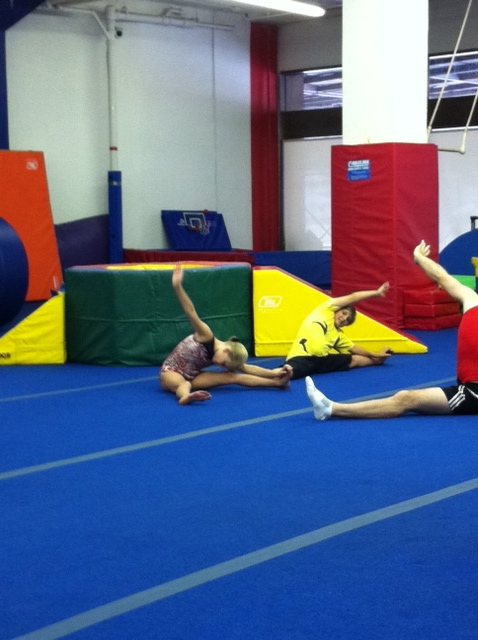
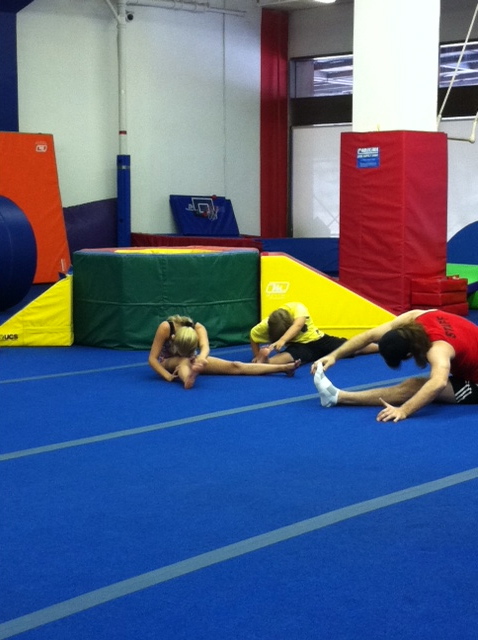
Emma and Nic stretching with Brett

Since it’s been awhile since Emma had gymnastics, I was curious to see what if anything was different.  Would she be able to stay more focused?  Would she attend more?  Would she be able to follow instruction better?

During their stretching period, Emma managed to keep up.

And while her form wasn’t great, she did do all the various stretches as best she could.

Later she was able to do straddle jumps on the trampoline and forward and back rolls on the mat.  She became a bit distracted when a birthday party took place in another part of the gym, but for the most part she attended and tried to listen.

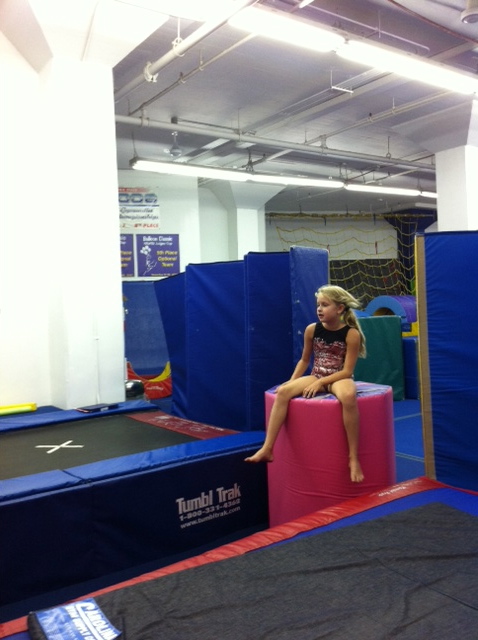
Waiting for her turn on the trampoline.

All in all she showed progress, slow but steady progress.

For more on Emma’s journey through a childhood of autism, go to:  www.EmmasHopeBook.com

In the Playground – Autism

Yesterday while at the playground, Emma pushed a little boy off of a roundabout.  It wasn’t clear why she did this, though it reminded me of a game they played at camp where the little girls stood in line by the pool and then pushed the girl in front into the water.  (I can hear the defensiveness in this sentence, I know. But let me continue.)  The boy was seated on the edge of the spinning circle, like a giant saucer, filled with a dozen other children.  A few children were on the ground pushing, while running to make it go faster.  The children seated within the saucer were shrieking with laughter and then the little boy went flying off.  The child’s mother, understandably upset, was furious with Emma and yelled at her that this was unacceptable behavior.

I was seated with a friend of ours whose son was playing with Nic.  I noticed Nic staring at me with a horrified expression and making gestures with his hands for me to come.  When I reached him he told me what had happened.  ”She just pushed that kid off, Mom.”

“Which kid?” I asked Nic.

“That one,” he pointed to a young child being led away by his mother.  ”We were all just playing and this one kid was spinning the thing around really fast.  Emma was laughing and that boy was sitting pretty close to the edge and then Emma just pushed him and he went flying.  The mom got really mad and started yelling at Emma.”

“Okay.  Thanks Nic.”

I made Emma get off and had her sit on a bench next to her father.  I told her she was to sit still until I returned.  I then ran after the mother and her son, apologizing and explaining to her that Emma has autism.  I told her how very sorry I was and inquired after her son, who seemed frightened and confused.  I told him Emma hadn’t meant to hurt him.  The mother told me, with an apologetic look that Emma’s behavior wasn’t okay.  I nodded my head and agreed with her.  She then said, “Oh dear, I didn’t know.  I hope I didn’t scare her when I yelled at her, but I was so upset.”

I assured her that Emma was fine and again apologized for Emma’s behavior.  When I returned to where Emma was seated I said, “Emma.  You cannot push other children.  It is not okay to do that.  You could have hurt him.  Do you understand that, Emma?”

“You cannot push,” Emma said, nodding her head.

“That’s right.  You cannot push.”

“Go back?”  Emma asked, pointing to the spinning saucer.

“No.  You can sit here next to me.”

“One minute,” Emma said.

“Ten minutes.  You will sit next to me for ten minutes Emma.  And you may not play on that again.  You can run around and do other things.  And Em, if you push again, you will go home.  It’s not okay.  You could have hurt that little boy.”  Emma looked down at her hands.  ”Do you understand, Em?  It’s not okay to push.”  I watched her for any sign of understanding.  She continued to stare down at her hands, which were in her lap.  ”Em.  Do you understand?”

“Yes, mommy.  You cannot push.  It’s not okay.”

It is times like these that I feel at a loss.  We so rely on communicating through speech that these sorts of situations feel impossible with Emma.  She showed no sign of understanding, she wasn’t angry, she didn’t seem particularly upset, if anything she seemed completely baffled by the whole situation.  ”Emma.  Why did you push him?”  I finally asked.

“You pushed.  It’s not okay to push,” was her response.

One hears about aggression in children with autism all the time.  Emma, when upset, frustrated or angry, usually hurts herself.  Biting her arm or hand is her most common reaction, but a few times she’s thrown something or punched herself in the face.  It is difficult to witness these acts of violence against herself.  It is even more difficult to make her understand why it’s not okay to hurt herself.

But this episode in the playground was different.  Emma wasn’t acting out in anger, evidently she’d had no interaction at all with the little boy she pushed.  What was going through her head?  Why did she push him?  It’s impossible to know.  But I do have a few ideas, none of which dismiss her behavior, but they do explain what may have happened.  Emma craves sensory input.  Often children who crave vestibular movement can be calmed by having ten minutes or so of it.  Emma appears to never be satisfied no matter how much she gets.  Richard and I have had countless conversations with her various therapists about this.  In our neuro-typical world we call people like this “thrill-seekers”.  In the world of autism it’s called sensory integration disorder -

Someone once explained to me that it’s a bit like having a body part fall asleep and the desire to stomp, pinch or hit that body part in the hope of “waking” it. Roller coasters, swings, trampolines, carousels, anything that moves quickly and erratically are Emma’s way of “waking”.  Pushing the boy was not an act or display of aggression as much as it was an unconscious response to her craving more movement.  It may be that he brushed against her by mistake or perhaps he was too close to her or she may not have been aware of him at all.  Unfortunately none of this helps the child who was pushed or his mother.

For more on Emma’s journey through a childhood of autism, go to:  www.EmmasHopeBook.com

Emma’s Ears – Autism

Monday night Emma was up at midnight screaming.  Her ears were bothering her.  This has been an ongoing problem for many months now.  She is highly sensitive to the changing air pressure.  As a result of Emma’s sensitivity, I too have become increasingly aware of it and am surprised that I have lived this long without noticing how often it changes, causing my ears to “pop”, as Emma describes the sensation, too.  Still, just to be safe we have taken her to her pediatrician who assured us her ears were fine and referred us to an ear specialist.  To date Emma has gone to the ear specialist three times.  Her ears are fine, we’ve been repeatedly told.  She’s just extremely sensitive to the air pressure which is constantly fluctuating.

“I need help!”  she screamed.  ”Ears popping, have to unpop!  Mommy!  Mommy I need help?”

This can go on – as it did Monday night for hours.  That night she was up until past 4:00AM, I don’t know when she finally fell asleep as I eventually lapsed into a kind of restless state of unconsciousness.  When I woke it was just past 7:00AM and Emma was fast asleep, arms spread out like Christ on the cross, blonde hair fanned out on the pillow beside me.  Richard had long since relinquished his place in our bed and gone to her bed.  Merlin, preferring the rocking chair in the living room, was happily curled up away from all of us when I came into the kitchen to begin preparing the children’s breakfast.

I reminded myself that Emma used to regularly wake up at around 2:00AM only to finally fall back asleep somewhere between 4:00 or 5:00AM.  How we managed to get through those middle of the night awakenings month after month is something I cannot fathom given how exhausted I was yesterday.  The combination of crying in pain and screaming for help, help I am unable to give, is what breaks my heart.  I try to remind myself that being there, just sitting with her, even though I cannot change the air pressure, is a kind of help too.  Still it’s difficult not to feel the rising panic and accompanying helplessness that come with witnessing ones child in such obvious pain.

“Please Mommy.  You have to unplug.  Ears!  Ears!”  she continued to cry while twisting her blanket up and trying to push it down her ear canal.

“Em, try to yawn,” I told her opening my mouth in an exaggerated yawn.

“NOOOOOOOO!”  Emma screamed, pounding the side of her head with her hand.  ”Nooooo!  Mommy!  Mommy!  I need help!”

It is during moments like these that I want to scream.  I want to hit the wall with my fist.  I want someone or something to help my daughter.  So I go wake up my blissfully sleeping husband, Richard and get him to help me.

“I got this,” he told me after I woke him, waving me away.  ”Go back to sleep.”

Only I couldn’t go back to sleep so I followed him into her bedroom where he had ingeniously pulled out a balloon and told her to blow into it for a few seconds.  He also had the foresight to bring some nasal spray which the ear specialist had given us for her.

And while none of these things were “magical” cures for her popping ears, his calm demeanor helped settle her and me down.

“I’m going to lie down with her, you go back to bed,” I told him.  As he got up to leave, I said, “And thank you.”  To say I feel gratitude that I have a husband who is so completely in the trenches with me, who is more than willing to do his share and often does much more than that, who isn’t afraid to submerge himself in all things that make up our crazy family, would be a vast understatement.

An hour later, Emma, still in pain, but at least not screaming like an air raid siren, whimpered, “Ears still popping.  Go to Mommy’s bed?”

“Okay Em.  Come on.”  I led her through the hallway into our bedroom and climbed into bed with her.

Last night, exhausted and concerned that we might have a repeat episode, I went to sleep early.  Miraculously Emma slept until almost 7:00AM.

For more on Emma’s journey through a childhood of autism, go to:  www.EmmasHopeBook.com

Anger

The invisible hand grenade being tossed into a room – anger – whether it explodes or is a slow simmer, it is something I feel when I think of my daughter, Emma’s diagnosis.  To admit this, by the way, is something I rarely do.  It is unseemly, impolite, not what we do and certainly not what we admit to feeling.

But I do feel it.

I wish it weren’t so.  I’d like to think I could think it away.  However the fact remains – I am angry.  I would take away her autism, all the things that make up that word, all the behaviors, the neurological blips, the tangled mess that make her both hyper and hypo sensitive to pain, to noise, her internal inflammations, ulcerations, her rigidity, the obsessive compulsive tendency, all those things when added up that equal autism, I would prefer it was all gone, in an instant.

I went hiking with a friend yesterday who was telling me jokes.  One, about a guy who is allowed three wishes, which a genie promises to fulfill, made me think about my one wish.  Just one, I don’t need three, thank you very much.  My one wish is for Emma to have a neuro-typical brain.  That’s it.  Just the one wish.  I’m like everyone else, I can always add a couple other wishes if pressed, but that has always been and remains my one wish, the wish that blows all the others out of the water.  Please.  Let her brain repair itself.

I know my anger, the slow simmering rage I feel covers a whole ocean of sadness.  But honestly I prefer not to feel any of it.  And I usually don’t.  I either am too busy or I make the conscious decision to turn it off.  Yesterday though, while hiking, it all came surging back.  Like the flood gates had been pried open and try as I might, they were unwilling to be shut, until they’d had their say.  It is in this state that I reject God.  The God so many turn to is one I turn my back on.  I reject, actively reject, angrily reject.  I know this.  And yet, Emma’s autism, perhaps like nothing else, has created such a feeling of need for something beyond myself.  It is beyond a desire, it is beyond a craving, it feels larger than all of that.  It is a need for something, something I can lean on.  I have no sense of it beyond these words.  Perhaps one day I will.

For more on Emma’s journey and ours through her childhood of autism, go to:  www.EmmasHopeBook.com

Amusement Parks & Autism – Continued

Emma’s entire system was crashing.

“You have to ask Mommy!  Mommy can I go on the roller coaster with Gaby, please?”   She cried over and over again through screams and tears.

It was heart breaking and anyone with a neuro-typical child would think – oh just let her go on it one more time and then go home.  I even thought this a number of times as I tried to peel her off the pavement where she had fallen in a heap of tears, snot pouring from her nose, her hands made into tight fists while hitting herself in the head, on her chest, legs, arms wherever she could before I, or any of us could stop her.  The biting is horrible because it can break the skin and then there’s blood, and later scabs and enormous angry blue and purple bruises that can last for more than a week, reminding all of us of her agony.  But the hitting – a quick, violent punch to the face is shocking to witness and as a parent, it’s difficult not to feel one has done something horribly, horribly wrong.  How can this sweet, blissful child do this to herself?

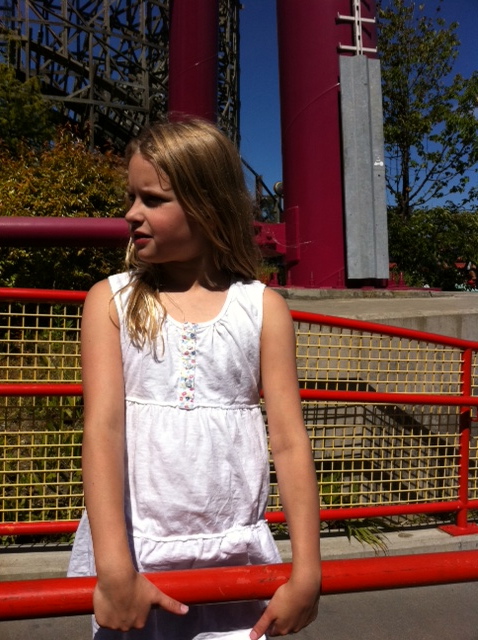
Emma waiting for Joe, Nic and Gaby while they ride on the Corkscrew

Richard and I have always said to the children – hitting is wrong.  We don’t do it, we don’t want them to ever do it to each other and until Emma began hitting herself, it hadn’t occurred to us to add – we don’t hurt ourselves.  We don’t hit others or ourselves.  We say it, but I don’t know that it makes a difference.  When Emma’s brain has become set on something, no amount of calm, reassuring logic seems to help her.  No amount of soothing, we just have to vacate the premises.  It’s our only hope.  Kind of like shutting the whole system down, a kind of reboot.  We have tried the other option, which is to let her go on one more ride or do whatever it is one more time and the misery, the abject misery continues.  Like an addict who has to have that drink or that drug even while bringing them no real solace.  There’s no relief to be had at a certain point.

“Emmy it’s going to be okay.  We’re going to go home now.  We can ride the little roller coaster one more time and you can sit with Gaby and then we have to go home,” we told her.

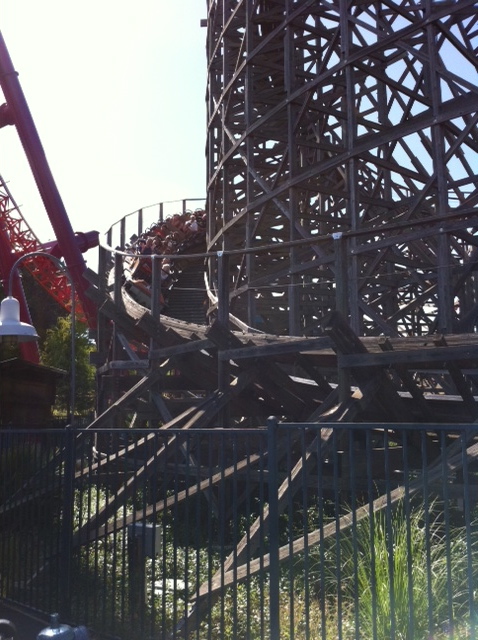
But Emma’s brain couldn’t take in this information it was already in lock down mode.  I gave her a banana to eat and then everyone, our once cheerful little group, now more weary warriors than a family intent on having a lovely day at an amusement park trooped along.  She was able to sit with Gaby on the little roller coaster for one last ride and then we trudged back to the car while Emma kept looking over her shoulder at the wooden roller coaster named Roar.  As we headed home Emma said, “It’s okay, we’ll come back tomorrow.”

“No Em.  Tomorrow we’re going to traintown where there are different rides and then we’re going to Uncle Andy’s wedding,” we told her.

“Different rides,” Emma repeated, sadly.  ”We’ll come back soon,” she said.  There was a wistful tone to her words, and we knew it wasn’t likely that we would ever come back to this part of the world.  But there would be other amusement parks and maybe one day Emma’s massive sensory issues will have abated to such a degree that these kinds of episodes will become rarer.

We can only hope.

For more on Emma’s journey through a childhood of autism go to:  www.EmmasHopeBook.com